Building A Contact Mic Using Homemade Piezo Crystals

homemade_piezo_contact_mic

[Leafcutter] is big in to making music and has put together all sorts of musical instruments and tools over the years. Recently, he was inspired to make his own piezo crystals, and wrote in to share the results of his experiments with us.

[Leafcutter] is no stranger to messing around with piezo elements, and after seeing [Collin’s] tutorial on making your own piezo crystals at home, he knew he had to give it a try. He stopped by the grocery store to fetch all of the ingredients, then followed [Collin’s] instructions to the letter…well, almost. It seems that he might have cooled the solution too quickly, so he found himself with a jar full of tiny, barely usable piezo crystals instead of larger ones like [Collin] was able to produce.

Undeterred, he decided to see if the stuff was any good, and rigged up a makeshift contact microphone using some conductive foil and a clamp. He piped the output to his amplifier, and wouldn’t you know it…it worked!

He has a small sound clip of what the mic sounded like on his site, and it worked pretty darn well despite the crystal’s tiny size. He is going to give the whole process another go, so we hope to see more experiments with bigger crystals in the near future.

Adding Wireless Controls To Vintage Stereo Equipment

marantz_wifi_remote_control

[Jean] was shopping around for a vintage stereo receiver, and happened upon a broken, but repairable Marantz 4240. After getting things back to working order, he thought it would be great if he could use his iPhone to remotely control the unit (PDF Writeup, Schematics and Code).

He scrounged around for parts, and after locating a PIC and a handful of parts from old copiers and printers, he got down to business. He etched some custom boards to house electronic bits, then strapped motors to the volume and source selection knobs. He also rigged up the push button power switch on the receiver, using a small servo and a bit of string.

Now, he can control everything using his iPhone, which communicates with the stereo over WiFi. While the power, volume knob, and input selector can be triggered remotely, he still has the ability to tweak any of these items manually if desired.

We think that this is a great way to add modern amenities to vintage electronics, without ruining the aesthetics of the components. Don’t take our word for it though, check out the video demonstrations [Jean] but together after the jump.

Continue reading “Adding Wireless Controls To Vintage Stereo Equipment”

Noise Generator Ported To Run On Small AVR, Also Arduino Compatible

Feeling a bit left out because he didn’t have a PICAXE on hand, [Rob Miles] decided to port the Luna Mod code so that it would work on an AVR chip. He chose to build his around an ATtiny45, but also mentions that this is Arduino compatible.

This case layout is a bit different from the original Make version, but we like this look just a bit better. It might not satisfy your need for that hipster looking enclosure, but the repurposed macadamia nut box looks seems it was built for this purpose. Take a look as the video after the break to see the final product and hear it spewing newly composed cacophony. [Rob] is sharing the sketch as a dropbox file but we’ve also included our own hosted link after the break in case is stops working.

Continue reading “Noise Generator Ported To Run On Small AVR, Also Arduino Compatible”

Quick And Easy Audio Preamp

npn_transistor_audio_preamp

The most recent installment of [Dino Segovis’] Hack a Week covers the construction of a simple NPN transistor audio preamp. Some time ago, he built a small audio amplifier using an LM386 which worked well, but didn’t quite get his music as loud as he would like it. He decided to build a preamp to complement his amplifier, and demonstrates how you too can build one with just a small handful of components.

As the name probably suggests, the cornerstone of this amplifier is an NPN transistor. He explains that a forward bias is applied to the base-emitter junction, which results in the transistor operating halfway between its cut-off and saturation regions. Both halves of the input audio signal are superimposed on this bias voltage, resulting in a decent amount of gain across both channels from a relatively small package.

The preamp isn’t going to win any awards among audiophiles, but it is definitely a great beginner project. Its a novel way of demonstrating how transistors work, while producing a useful takeaway piece of audio equipment at the same time.

Continue reading to see a video showing just how big an effect [Dino’s] NPN preamp had on his music.

Continue reading “Quick And Easy Audio Preamp”

MIDI Air Drums Let You Play Anywhere

[Maayan Migdal] wrote in to share a really cool drum kit he constructed that has one special twist – no drums at all. Using a simple MIDI device and an Arduino, his “Air Drums” look pretty sweet.

The hack makes use of a pair of garden rakes, which serve as his drum sticks. The rakes were cut down and modified to allow the addition of accelerometers and some USB cables. The left stick contains a single accelerometer for registering hi-hat hits, while the right stick is armed with a pair of the modules, which are used to trigger snare and crash symbol strikes. He modified a pair of sandals to fit better while drumming before adding a sensor to each shoe. The left sandal contains an accelerometer to register bass drum hits, while the right shoe uses a light sensor to simulate the use of a hi-hat pedal.

We think that the results are awesome, but feel free to check out the video below to see what we mean. If Guitar Hero wasn’t dead in the water on hiatus, we think this sort of setup would make a great replacement for the flimsy drum set that comes with the game.

Continue reading “MIDI Air Drums Let You Play Anywhere”

Singing Robot

The 4DOF CXN-I anthropomorphic robot arm in the Mechatronics Lab at FICES-UNSL (Engineering faculty, San Luis National University, Argentina) was built from scratch, and it is still a work in progress to teach and learn about mechatronics , in order to build another, more robust and precise arm in the future. When one of the students working with the device thought “hey, these motors are quite noisy, aren’t they? let’s put them to work towards something more useful”.

Armed with some guitar tabs, a robot and some noisy servos, [Guille] got the robotic arm to sing a little song raised a couple of octaves, and included it in the introduction video. Because hey, whipping a metal arm around like that is pretty mechanically strenuous, and its not all that great for the servos either.

Join us after the break for a quick video, the singing starts about 58 seconds into the show.

Continue reading “Singing Robot”

Guitar Becomes An Improved Color Organ

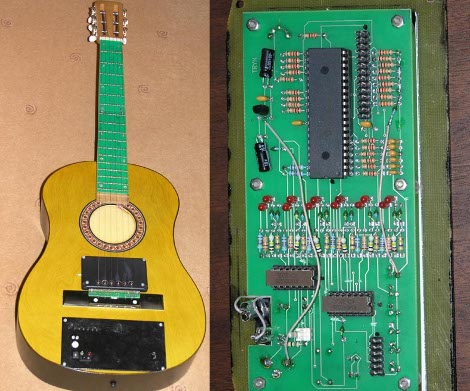
[Charles] wanted to put some LEDs in his guitar. He also wanted individual notes to output certain colors, but he couldn’t find any projects with tone-based algorithms to convert sound into colors. After about a year of work, his ColorChord guitar was born.

Unlike every other color organ build we’ve seen, the color of a note does not relate to the absolute pitch of the note. Instead, the colors are mapped within a musical key. A I chord will always be Yellow, a IV chord will always be purple, and a V chord will always be blue. Playing in the key of C will have the LEDs output yellow, purple, and blue for a C, F and G chord, respectively.

Continue reading “Guitar Becomes An Improved Color Organ”