DNA Computers Are In The Lab Now

Although it isn’t very real-world practical, researchers at Cal Tech have produced a DNA-based programmable computer. Spectrum reports that the system executes programs using a set of instructions written in DNA using six bits. Like any programmable computer, this one can execute many programs, but so far they have run 21 different programs.

Using DNA for computation isn’t new — your body does it all the time. But, in general, DNA computers were akin to some logic gates that would do one set of things, not a general-purpose reprogrammable computer.

DNA has two parts composed of four different chemicals — you can think of each part as a ladder cut vertically down the middle with each “rung” being one of the four chemicals. Each part will try to pair up with a part that has a complementary set of rungs. The researchers created DNA strands to act like logic gates that have two inputs and two outputs. They combine five of these gates to create a layer with six inputs and six outputs. A program contains a stack of these six-bit layers.

Continue reading “DNA Computers Are In The Lab Now”

Executing A Vehicle Keyless Entry Attack

You read about well-publicised security exploits, but they always seem to involve somebody with a deity’s grasp of whatever technology is being employed, as well as a pile of impossibly exotic equipment. Surely a mere mortal could never do that!

Happily, that’s not always the case, and to prove it [Gonçalo Nespral] replicated an attack against RF devices such as some garage doors and motor vehicle locks that use a rolling code. His inspiration came from a device from2015, that encouraged the owner of a key to keep transmitting fresh codes. It did this by swamping the receiver of the car, garage door, or whatever with a strong slightly off frequency signal. This would cause the lock to not work, so the user would try again and again. The attacker listens with a very narrow bandwidth receiver on-frequency that is good enough to reject the jamming signal, and can harvest a sequence of the rolling codes enough to compromise it.

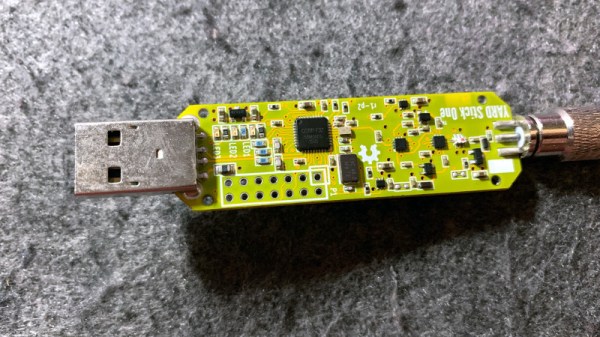
[Gonçalo]’s set-up uses a YARD stick One transceiver dongle as its transmitter, and an RTL-SDR for receive. A GNU Radio setup is used to retrieve the key data, and some custom Python code does the remaining work. We wouldn’t advocate using this in the wild and it could conceivably also gain you access to another car with a flashing light on top, but it’s an interesting exposé of the techniques involved.

Rolling code keyfob attacks are something we covered a few years ago, back when these attacks were all shiny and new.


Office Depot And OfficeMax Find Malware That Isn’t There

Sometimes we are rebuilding a RAID array or replacing a BIOS chip and we wonder how ordinary people keep their computes running. Then we realize that most of them come to someone like us for help. But what if you don’t have a family member or friend who is computer savvy? No problem! Plenty of stores — including big box office stores such as Office Depot and OfficeMax — will be glad to help you. Why most of them will be willing to test your computer for free. Sounds nice until you find out that at least in some cases these tests were showing problems that didn’t need fixing so users would pay for services they didn’t need. The Federal Trade Commission (FTC) has fined Office Depot (who owns OfficeMax) $25 million and plans to use the funds to issue refunds. In addition, a vendor, Support.com, will pay $10 million to support the refunds.

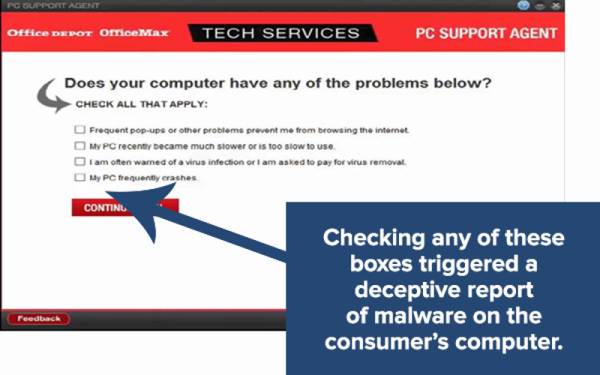
The free check used software to detect problems on a PC. However, during the scan the user is asked if their computer has any of the following symptoms. For example, if their PC has become slow or frequently reboots. If you said yes to any of these questions, the software would produce a report claiming to have found evidence of malware and offering fixes that could cost significant amounts of money even if there was no other evidence.

Continue reading “Office Depot And OfficeMax Find Malware That Isn’t There”

Air-Breathing Rocket Engine Promises Future Space Planes

If you are a certain age, you probably remember the promise of supersonic transports. The Concorde took less than 4 hours to go across the Atlantic, but it stopped flying in 2003 and ended commercial supersonic passenger flights  But back in the 1970s, we thought the Concorde would give way not to older technology, but to newer. After all, man had just walked on the moon and suborbital transports could make the same trip in 30 minutes and — according to Elon Musk — go between any two points on the Earth in an hour or less. A key component to making suborbital flights as common as normal jet travel is a reasonable engine that can carry a plane to the edge of space. That’s where the UK’s Sabre engine comes into play. Part jet and part rocket, the engine uses novel new technology and two different operating modes to power the next generation of spaceplane. The BBC reports that parts of the new engine will undergo a new phase of testing next month.

The company behind the technology, Reaction Engines, Ltd, uses the engine in an air-breathing jet mode until it hits 5.5 times the speed of sound. Then the same engine becomes a rocket and can propel the vehicle at up to 25 times the speed of sound.

Continue reading “Air-Breathing Rocket Engine Promises Future Space Planes”

Maritime Analog Computer From 1503 Is The Oldest Remaining

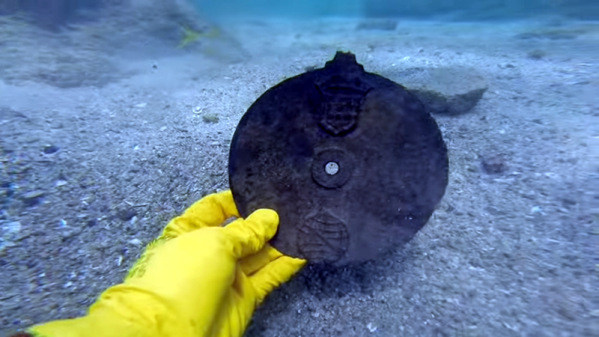
We might not think of analog computers as having existed in the 1500s, but in fact the astrolabe first appeared around 220 BC. However, as you might expect only a few very old ones still exist. Early astrolabes were often wooden and were difficult to use aboard ships, however brass astrolabes with special features were more accurate on the deck of a ship underway. A recent archeological find from one of Vasco da Gama’s ships that sunk in the Arabian Sea has brought the number of known archeologically-significant instruments to 104, and also is one of the few nautical versions to employ a solid disk. As of now, it is the oldest known maritime astrolabe found so far — the ship sunk in 1503. You might wonder how the 104th astrolabe became number 108, but the catalog includes a few pieces or fragments of astrolabes. If you count those, there are 108 items in the catalog.

If you think archeology is about men in fedoras carrying whips, or stuffy old men wandering around tombs, you should have a look at the article about this find. In addition to divers recovering the piece from the shipwreck (see the video, below), the science involved in restoring it and analyzing it includes chemistry, lasers, X-rays, and energy-dispersive spectroscopy.

Continue reading “Maritime Analog Computer From 1503 Is The Oldest Remaining”

World’s Oldest Computer Festival Is This Weekend

There was a time when owning a home computer was kind of a big deal. In the days before the popularization of the Internet, so-called “computer shows” were the best way to meet with others to swap advice, information, and hardware. Of course today, things are very different. The kind of people who are building their computers just buy the parts online, and everyone else is probably using a $200 laptop from Walmart that isn’t worth spending the time or money on to upgrade.

Small sampling of the talks at TCF 2019

So while the Trenton Computer Festival (TCF) may have started in 1976 as a way for people to buy early computers like the Altair 8800, over the years it has morphed into something much closer to the modern idea of a “con”. Those who visit the 44th TCF on March 23rd at the College of New Jersey will likely spend most of their time at the festival attending the 40+ talks and workshops that will be happening in a span of just six hours. But anyone who’s got some cash to burn can still head over to the flea market area where they’ll be able to buy both modern and vintage hardware.

Talks run the gamut from Arduino to quantum computing, and if you don’t see something that piques your interest in this year’s program, one might wonder how you found yourself reading Hackaday in the first place. If you manage to find some spare time between all the talks, the New Jersey chapter of the The Open Organisation Of Lockpickers (TOOOL) will be there giving a hands-on lock picking class, and if you don’t mind taking the crash course, you can even get your ham radio license. All for the princely sum of just $20 at the door.

In fact, there’s so much going on at TCF that it can be somewhat overwhelming. As I found out during my visit last year, the number of simultaneous events means you’ll almost certainly have some difficult decisions to make. I’ll be making the trip out to the College of New Jersey campus again this year for TCF, and will have plenty of Hackaday stickers and buttons to give out to anyone who manages to stop me while I dash between talks.

You’re Listening To Quantum Radio

Researchers at Delft University of Technology have created a detector that enables the detection of a single photon’s worth of radio frequency energy. The chip is only 10 mm square and the team plans to use it to explore the relationship of mass and gravity to quantum theory.

The chip has immediate applications in MRI and radio astronomy. Traditionally, detecting a single photon at radio frequencies is difficult due to the significance of thermal fluctuations. At lower frequencies, cryogenic cooling can reduce the issue, but as frequency increases the fluctuations are harder to tame.

The trick requires a qubit that samples the radio frequency energy. While the radio source is at 173 MHz, the qubit is at 1 GHz, allowing a fine time resolution. Coupling of the two is via an LC circuit that uses a Josephson junction which, of course, requires very cold temperatures. Continue reading “You’re Listening To Quantum Radio”