Drone Sightings, A New British Comedy Soap Opera

There’s a new soap opera that I can’t stop watching. Actually, I wish I could change the channel but this is unfortunately happening in real life. It’s likely the ups and downs of drone sightings would be too far fetched for fiction anyway.

If you aren’t British, maybe you will know a little of our culture through the medium of television. We don’t all live in stately homes like Downton Abbey of course, instead we’re closer to the sometimes comedic sets, bad lighting, and ridiculously complicated lives of the residents of Coronation Street or of Albert Square in Eastenders that you may have flashed past late at night on a high-number channel.

Our new comedy soap lacks the regional accents of Emmerdale or Hollyoaks, but has no less of the farce about it. Here at Hackaday we’ve brought you news of the UK’s peculiar habit of bad reporting and shoddy investigation of questionable drone sightings several times over the last year or two. Most recently we covered a series of events before Christmas that closed Gatwick, London’s second airport for several days over what turned out to be nothing of substance.

Unfortunately it didn’t end there. We’re back once more to catch up with the latest events down on the tarmac, and come away with a fresh set of reasonable questions unanswered by the popular coverage of the matter.

Continue reading “Drone Sightings, A New British Comedy Soap Opera”

Tiny Voltmeter Uses DNA

We use a lot of voltmeters and we bet you do too. We have some big bench meters and some panel meters and even some tiny pocket-sized meters. But biological researchers at the University of Chicago and Northwestern University have even smaller ones. They’ve worked out a way to use a DNA-based fluorescent reporter to indicate the voltage across cellular membranes.

We don’t know much about biology, but apparently measuring the voltage on the membrane around a cell is easy, but measuring the voltages across membranes inside the cell isn’t. Previous work disrupted cells and measured potentials on isolated organelles.

The indicator — called Voltair — can target specific parts of a cell and includes a reference indicator so that a ratiometric measurement is possible. In fact, there are three main parts to the 38-base pair DNA duplex. One module contains a voltage-sensing dye that fluoresces in a way that indicates voltage. The second module is a reference dye that allows researchers to judge the voltage level. The final module identifies where the probe should attach.

Continue reading “Tiny Voltmeter Uses DNA”

3D Printed Microscope Stage Offers Precise Movement

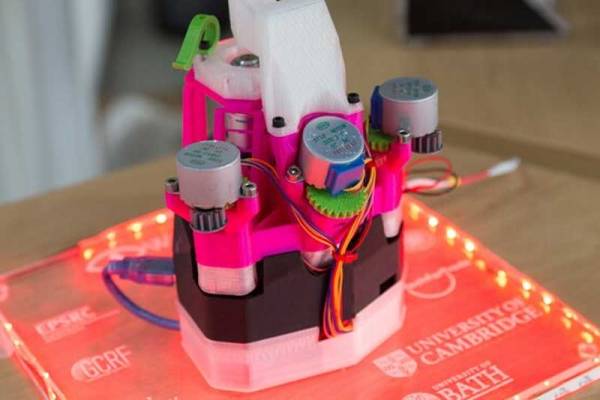
3D printing isn’t something you would usually associate with a high precision device, but this one shows that it can be used to create rather intricate things when needed. The Openflexure is a microscope stage that offers a mechanical stage that can be maneuvered precisely. The optics can be swapped out so it uses anything from a webcam to a very high-powered 100x magnification lens, but still move the stage smoothly and precisely. It can be driven by turning a knob or by three small motors. The plan is that the motors will eventually be driven by the software that is being written for the device.

Continue reading “3D Printed Microscope Stage Offers Precise Movement”

Amateur Astronomers Spot Meteorite Impact During Lunar Eclipse

According to ancient astronaut theorists, the lunar eclipse this weekend had an unexpected visitor. Right around the time of totality, a meteoroid crashed into the moon, and it was visible from Earth.

Meteoroids crash into the Earth and Moon all the time, although this usually happens either over the ocean (70% of the Earth) where we can’t see it, on the far side of the moon (~50% of the Moon) where we can’t see it, or on the sunlit side of the Moon (another, different 50%), where we can’t see it. These meteoroids range from the size of a grain of sand to several meters across, but only the largest could ever be seen by the human eye. This weekend’s lunar eclipse, the Super Blood Wolf Moon was visible to a large portion of the population, and many, many cameras were trained on the Moon. Several telescopes livestreamed the entire eclipse, and multiple people caught a glimpse of a small flash of light, seeming to come from around Lagrange crater. Because this event was seen by multiple observers separated by thousands of miles, the only conclusion is that something hit the moon, and its impact event was recorded on video.

This is not the first time an impact event has been recorded on the moon. The Moon Impacts Detection and Analysis System (MIDAS) running out of La Hita Observatory has regularly recorded impact events, including one that was comparable to an an explosion of 15 tons of TNT. These automated observatories aren’t running during a full moon, like during a lunar eclipse, because no camera would be able to pick up the flash of light. We were somewhat lucky last weekend’s impact happened during totality, and with dozens of cameras trained on the Moon.

Further investigation will be necessary to determine the size of the meteoroid and obtain pictures of its impact crater, but for a basis of comparison, the LCROSS mission plowed a Centaur upper stage (2.2 tons) into the lunar surface at 2.5 km/s. This should have resulted in a flash visible through binoculars, but it didn’t. The meteoroid that struck the moon last weekend would have been traveling faster (a minimum of about 12 km/s), but the best guess is that this rock might have been of suitable size to have fit in the back of a pickup truck, or thereabouts.

The Vectrex Projector We’ve Been Waiting For

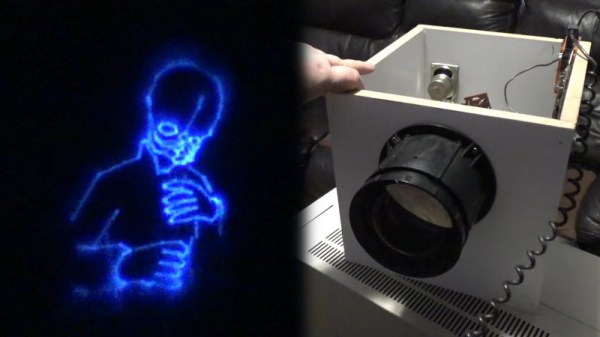
Unlike most old consoles, the Vectrex is unique for having a vector-based display. This gives it a very different look to most of its contemporaries, and necessitated a built-in display, as regular televisions aren’t built to take vector signals. Not one to be limited to the stock screen size, [Arcade Jason] decided the Vectrex needed a projection upgrade, and built exactly that.

The build relies on a lens that [Jason] salvaged from an old rear-projection TV. These units used CRTs with big lenses which projected the image onto a screen. That’s precisely what is happening here, with a vector display replacing the CRT used in the original TV. The vector display itself used here is a tube from a small black and white TV set, which [Jason] modified to use a Vectrex yoke, making it capable of vector operation.

Through some modification and careful assembly, [Jason] was rewarded with a wall-sized display for his Vectrex console. This is demonstrated with some beautiful glowing vector demos, accompanied with appropriate bleep-bloop music, as was the style at the time. The Cantina band is a particular highlight.

We’ve seen [Jason]’s vector hacks before, too – like this Asteroids machine modified to display in color. Video after the break.

Continue reading “The Vectrex Projector We’ve Been Waiting For”

Human Augmentation For Weight Loss

If you read almost any article about powered human implants, you will encounter the same roadblock, “it could be so much better with more powerful batteries.” Our fleshy power systems are different from electrical systems, but we are full of moving parts, so [Xudong Wang] and fellow researchers have harnessed that power (Sci Hub Alt) and turned it right back into something else our body understands.

The goal of this project is to control obesity by tricking the vagus nerve into thinking we are full as we digest our current meal. The treatment has already been proven with battery-powered implants, but this version uses the oscillations of the stomach for power and sends the generated power right where it is needed. A control group of rats showed no change over 100 days, but those with this implant shed more than a third of their body weight. This may need some tuning but its effectiveness seems to be heading the right way, and it is surgically reversible.

The device is a triboelectric generator coated in polyimide and Ecoflex™ with gold electrodes that wrap around the vagus nerve at the gastro-esophageal junction. The generator presses against the stomach from outside and the rhythm of the muscles generates the signal that the stomach is full so it becomes a loop of digesting ⇄ sated.

Another handful, of implants don’t need power from inside the body and use RFID technology.
Via IEEE Spectrum.

The Greatest Computer Ever Now Gets A New, Injection Molded Clear Case

The Macintosh SE/30 is the greatest computer ever made. It was a powerhouse when it was launched almost exactly thirty years ago today. You could stuff 128 Megabytes of RAM into it, an absolutely ludicrous amount of RAM for 1989. You could put Ethernet in it. You could turn the 1-bit black or white internal display into an 8-bit grayscale display. I think there was a Lisp card for it. These were just the contemporaneous hacks for the SE/30. Now, people are actively developing for this machine and putting Spotify on it. There’s a toolbar extension for Macs of this era that will let you connect to a WiFi network. You’ll be hard pressed to find a computer that still has a fanbase this big thirty years after release.

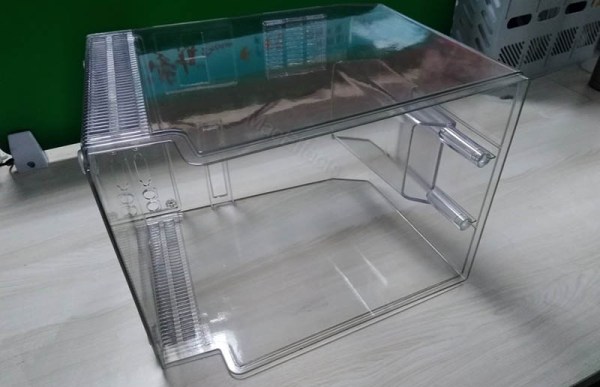
Now, there’s a project to create new injection molded cases for the Mac SE/30 (and the plain ‘ol SE). These cases will be clear, just like Apple prototypes of the era. It’s also one of the most difficult injection molding projects retrocomputer enthusiasts have ever taken up.

Over the years, we’ve seen some interesting projects in the way of creating new plastic cases for old computers. The most famous is perhaps the remanufacturing of Commodore 64C cases. Instead of a purely community-driven project, this was an accident of history. The story goes that one guy, [Dallas Moore], went to an auction at an injection molding factory. The owner mentioned something about an old computer, and wheels started turning in someone’s head. A Kickstarter later, and everyone who wanted a new C64 case got one. You could get one in translucent plastic to go with the retro aesthetic.

New cases for the Amiga A1200 have also been made thanks to one fan’s Solidworks skills and a Kickstarter campaign. There is, apparently, a market for remanufactured cases for retrocomputers, and it’s just barely large enough to support making new injection molding tooling.

So, about that SE/30. The folks on the 68k Macintosh Liberation Army forums are discussing the possibility of making a new case for the greatest computer Apple will ever make. The hero of this story is [maceffects] who has already modeled the back ‘bucket’ of the SE/30 and printed one out on a filament printer (check out the videos below). This was then printed in clear SLA, and the next step is crowdfunding.

While this isn’t a complete case — a front bezel would be needed to complete the case — it is an amazing example of what the retrocomputing community can do. The total cost to bring this project to fruition would be about $15,000 USD, which is well within what a crowdfunding campaign could take in. Secondary runs could include a translucent Bondi Blue polycarbonate enclosure, but that’s pure speculation from someone who knows what would be the coolest project ever.

Continue reading “The Greatest Computer Ever Now Gets A New, Injection Molded Clear Case”