Make Christmas Commercial Again With This Tiny TV Ornament

Readers of a certain age will remember a time when the Christmas season in the US officially kicked off after Thanksgiving. That was when advertisers began saturation bombing the communal mind with holiday-themed TV commercials night and day. Broadcast TV no longer holds sway like it did back then, and advertisers now start their onslaught in September, but you can put a little retro-commercialism back to Christmas with this 90s Christmas commercial-playing ornament for your tree.

The idea came to [SeanHodgins] after stumbling upon a collection of Christmas commercials from the 1990s on YouTube. With his content identified, he set about building a tree-worthy display from a Pi Zero W and a TFT LCD display. An audio amp and tiny speaker from an old tablet and a LiPo battery and charger form the guts of [Sean]’s TV, which were stuffed into a 3D-printed TV case, appropriately modeled after the TV from The Simpsons. The small fresnel lens that mimics the curved screens of yore is a nice touch. The software has some neat tricks, such as an HTTP server that accepts the slug of a YouTube video, fetches the MP4, and automatically plays it. We prefer our Christmas tree ornaments a little quieter, so a volume control would have been nice, but aside from that this looks like a ton of fun.

This isn’t [Sean]’s first foray into tricked-out ornaments, of course; readers might recall his IoT cheer-measuring Christmas ornaments from last season.

Continue reading “Make Christmas Commercial Again With This Tiny TV Ornament”

What You Need To Know About The Intel Management Engine

Over the last decade, Intel has been including a tiny little microcontroller inside their CPUs. This microcontroller is connected to everything, and can shuttle data between your hard drive and your network adapter. It’s always on, even when the rest of your computer is off, and with the right software, you can wake it up over a network connection. Parts of this spy chip were included in the silicon at the behest of the NSA. In short, if you were designing a piece of hardware to spy on everyone using an Intel-branded computer, you would come up with something like the Intel Managment Engine.

Last week, researchers [Mark Ermolov] and [Maxim Goryachy] presented an exploit at BlackHat Europe allowing for arbitrary code execution on the Intel ME platform. This is only a local attack, one that requires physical access to a machine. The cat is out of the bag, though, and this is the exploit we’ve all been expecting. This is the exploit that forces Intel and OEMs to consider the security implications of the Intel Management Engine. What does this actually mean?

Continue reading “What You Need To Know About The Intel Management Engine”

Grabbing Better Images From A Newer Russian Satellite

The Soviet Union took the world by surprise when it sent its Sputnik satellite into low earth orbit way back in 1957. The event triggered a space race between the Soviets and the United States and ushered in technologies that would go on to touch the lives of every human on earth. Today, several nations have a space program. And one of the more useful things to put in orbit are weather satellites.

In 2014, the Russians launched their Meteor N M-2 weather satellite into a polar orbit. The part that were most interested in is the fact that it transmits images at 137.1 MHz using the standard LRPT protocol. However, the newer Meteor N M-2 transmits images at twelve times the resolution of US NOAA satellites. No typo there –  that’s twelve (12!) times. Have we got your attention now?

We shouldn’t have to tell you to jump on over to [phasenoise’s] blog which gives you everything you need to start grabbing some of these awesome images.

Now, before you get your jumper wires in a bunch – we are well aware that receiving satellite images is nothing new.

Thanks to [Roy Tremblay] for the tip!

Meet The Modern Meat Man’s Modified Meat-Safe

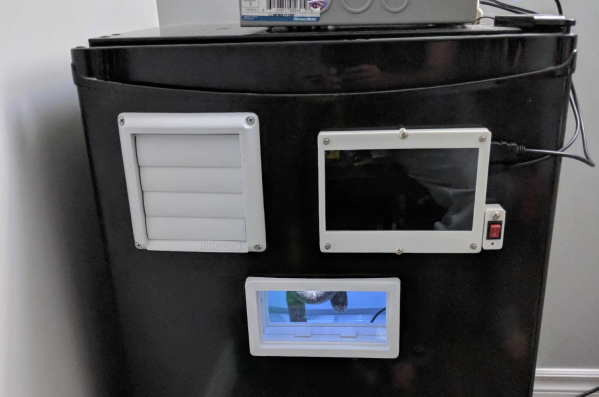
Charcuterie is delicious — but is it hackable? When talking about the salty preserved meats, one might be more inclined to indulge in the concept of bacon before pondering a way to integrate an electrical monitoring system into the process. However, [Danzetto] decided to do both when he did not have anywhere to cure his meats. He made his own fully automatic meat curing chamber lovingly called the curebOS with the aid of a raspberry pi. It is basically a beefed up mini fridge with all of the bells and whistles.

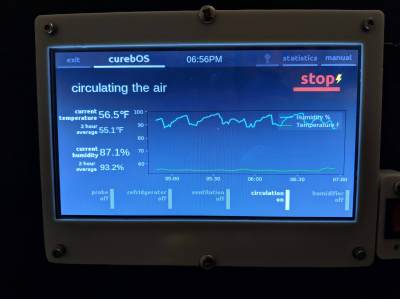
This baby has everything.  Sitting on top is a control system containing the Pi. There are 5 relays used for the lights, circulating fan, ventilating fans, refrigerator, and humidifier all powered by a 5 amp supply — minus the fridge. Down below that is the 3D printed cover with a damper for one of the many ventilation fans that regulate the internal temperature.  To the right is a touchscreen for viewing and potentially controlling the system if necessary. The control program was written in Python for viewing the different trends. And below that, of course, is a viewing window. On the inside are temperature and humidity probes that can be monitored from the front screen. These readings help determine when to activate the compressor, any of the fans, or the humidifier for optimal settings. For a final touch, there are also some LEDs placed above the hanging meat to cast a glowing effect upon the prized possessions.

Continue reading “Meet The Modern Meat Man’s Modified Meat-Safe”

Just In Time For The Holidays: Give The Gift Of Cray

The name Cray, as in [Seymour Cray] is synonymous with supercomputing. If you hurry, you can bid on a Cray J90/J916 on eBay. You might want to think about where to put it though. It is mounted on a trailer, requires 480V, and the shipping is $3,000!

First introduced in 1994, the J90 was an “entry level” machine. This particular machine supported up to 16 CPUs (each CPU was actually two chips) running at a blazing 100 MHz. The memory system was more impressive, achieving 48 GB/s.

The Cray T90 computer was much faster (and more expensive) but none of these computers had the performance of a typical PC’s graphics card these days. Even your phone may have more raw computing power, depending on how you choose to measure. Don’t fear, though. Cray Research still makes supercomputers that can eat your phone for lunch.

Still, at the time, this was big iron. The I/O system used SPARC processors that would have been entire workstations in that era. The eBay listing says it might need a little work — we weren’t clear if the seller meant in general or just the cooling system, but you can assume this is a fixer-upper. Apparently, the Retro-Computing Society of Rhode Island restored a similar beast so it can be done.

If your holiday budget doesn’t have room for a real supercomputer, here’s one that is 1/10 the size and much less expensive. Or, you could just pretend.

Next Week’s Bay Area Meetups

Next week we’ll be at a few awesome hardware meetups around the Bay Area, and we want you to head out and join us.

The first meetup will be the Silicon Valley Hardware Meetup at the Evil Mad Scientist shop in Sunnyvale. It’s going down Wednesday, December 6th, from 6:30 until 9:30. At least some of the Hackaday/Tindie/Supplyframe crew will be there, and the night will be filled with lightning talks, demos, and the cool hardware people you know and love.

Speakers for this meetup will include [Mitch Altman], hacker extraordinaire and owner of far, far too many TV remotes. He’ll be talking about hardware successes and failures in his own businesses. Also headlining the event will be [Clarissa Redwine] from Kickstarter. She’ll be talking about crowdfunding hardware, and the fact that making a thousand of something is a million times harder than making one of something.

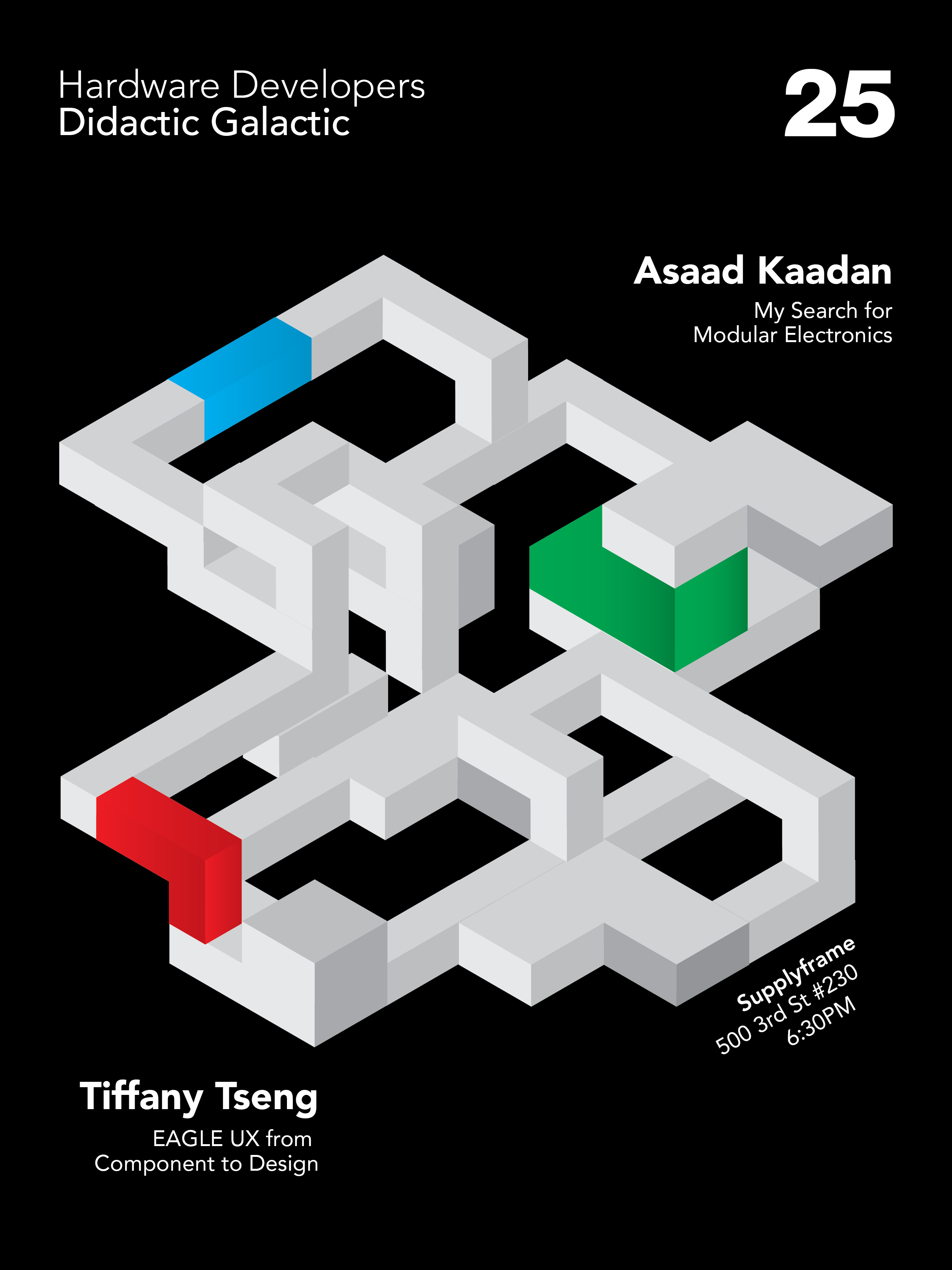
The day after, on December 7th, we’re also going to be opening the doors at the San Francisco Supplyframe office to host the Hardware Developers Didactic Galactic. These Didactics are fun and popular, and you don’t need to go to the South Bay. Food and drink will be served, and there’s a sweet Rick and Morty mural in the alley across the street.

On deck for this month’s Didactic is [Tiffany Tseng], lead UX designer at Autodesk. Her work involves creating and implementing the design decisions that go into Eagle CAD. If you’re wondering why the icons changed a few years ago, she is not the person to talk to; that happened before the Autodesk mothership bought Eagle. If you’re wondering how the awesome push and shove routing actually works, [Tiffany] is the person to talk to.

Also at the Didactic will be [Asaad Kaadan]. He’s a robotics engineer working on cinematic tools for his day job and is currently exploring a very, very cool modular electronics project called Hexabitz. He’ll be talking about Hexabitz and designing for modular electronics.

Introducing The Mobility Unlimited Challenge

If you take a walk across the centre of your city, you will find it to be a straightforward experience with few inconveniences. The occasional hold-up at a pedestrian crossing perhaps, or maybe a crowd of people in a busy shopping area. If however you take the same walk in the company of a wheelchair user you are likely to encounter an entirely different experience. The streets become a nightmare of obstacles to avoid and inaccessible areas requiring a detour, and suddenly what had been a pleasurable experience becomes a significant effort. Despite building and planning code updates to improve the situation, and millions of dollars invested in ramps, lifts, and other improvements, there remain so many problems to be addressed. Meanwhile legislators and the general public imagine that something has been done, the accessibility box has been ticked, and they can move on to the next thing that captures their attention.

The paralympian athlete [Tatyana McFadden] is an ambassador for the Toyota Mobility Foundation’s Mobility Unlimited Challenge, a global competition with the aim of improving mobility for people with disabilities. She’s written a piece introducing the challenge from her informed point of view as a wheelchair user, and makes the point that the basic design of a chair has not significantly changed since the 1930s. Her sentence: “There may be more hype around Bitcoin, but innovators could have far more impact if they turned their attention to how they can make the freedom to move available to all.” is one to make those of us with an interest in technology stop and think. To introduce the challenge they’ve released a glossy video, and we’ve placed it below the break.

As part of this year’s Hackaday Prize, we had an Assistive Technologies section that attracted some fantastic entries. That demonstrates that our community has plenty of people with the required skills, experience, and ideas to make a difference, and we hope that some of them might be among the entries for the Mobility Unlimited competition. If it excites your interest, we’d like to urge you to give it a second look.

A word of warning though – take care to avoid the Engineer Saviour Trap.

Continue reading “Introducing The Mobility Unlimited Challenge”