Odroid C2 Bests Raspberry Pi 3 In Several Ways

It’s been a big week in the world of inexpensive single board computers, and everyone’s talking about the new Raspberry Pi 3. It blows away the competition they say, nobody can touch it for the price.

Almost nobody, that is.

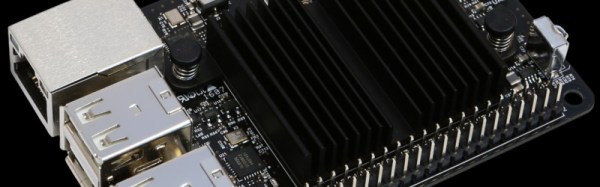
With a lot less fanfare on these shores, another cheap and speedy 64-bit quad-core ARM-based SBC slips onto the market this week, Hardkernel’s Odroid C2. And looking at the specification it seems as though the Pi 3 may be given a run for its money. Like the BCM2837 in the Pi 3 its Amlogic S905 SoC is a quad-core ARM Cortex-A53, but the C2’s 2GHz clock speed gives the raspberry to the 1.2GHz of the Pi 3. There is twice the RAM of the Pi 3 at 2Gbytes, and the onboard Mali-450 GPU can deliver 4K video.

Unlike the Pi 3 there is no wireless or Bluetooth on board, but the C2 has a Gigabit Ethernet port which is wired directly into the SoC. Compared to the Pi 3’s 100 megabit port which suffers through being on a USB interface, that’s likely to be very quick.

Storage can be a choice of either the usual micro SD card or eMMC. Given that the two boards share a very similar form factor it is no surprise that they have very similar GPIO capabilities, however it is worth noting that the C2 has a built-in analog-to-digital converter. As to operating systems, the C2 can run Ubuntu 16.04, or Android Lollipop.

Of course, we’ve seen so many boards touted as Pi-killers, and like all those also-ran tablets touted as iPad killers a few years ago we’ve never heard of most of them again after a brief moment of chatter. They look so good on paper but the price always lets them down.

The C2 could just escape that fate though, its $40 price point is very close to that of the Pi 3. Setting aside for a moment how much shipping and customs might cost for a package from Korea, that sounds interesting to us.

Why might you buy a C2 then, and why might you buy a Pi 3? That the C2 has a much faster processor is beyond doubt. This and its faster wired networking would make it a much more interesting prospect for anyone whose work involves network-attached data processing. But even though a USB wireless network adaptor can be had for only a few dollars the Pi 3’s onboard wi-fi and Bluetooth makes it much more attractive to a home user or someone using a computer on a platform unfettered by wires.

However impressive the C2 may be it is overwhelmingly likely that the Pi 3 will outsell it many times over. This will not just be due to the massive publicity advantage achieved by the Pi Foundation, but the huge ecosystem of hardware and software developers that have made the Pi boards perform to the limit of their abilities in all directions. If you don’t mind forgoing that support though, you could just find that the board from Korea gives you enough extra bang for your buck to make having it on your bench worthwhile.

We’ve followed the Odroid products from the start here at Hackaday. The C2 is just the latest of a procession of boards from Hardkernel, and we’ve featured a few projects that include them. Theirs is always the name at the top of the list when the subject turns to Raspberry Pi competitors, perhaps with the C2 they’ve got a winner.

Our thanks to [Derrick].
Pi 3 Benchmarks: The Marketing Hype Is True

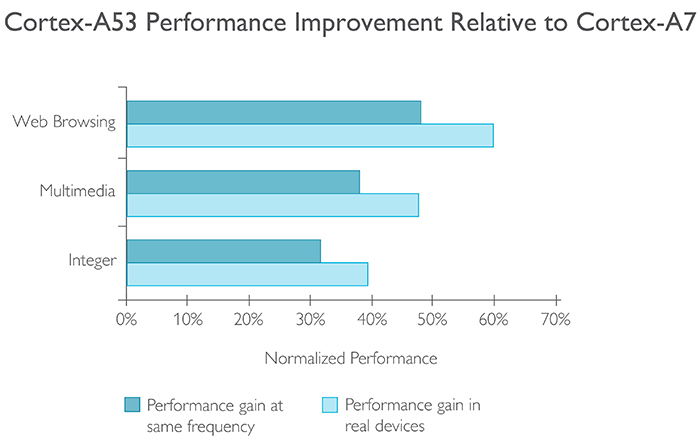
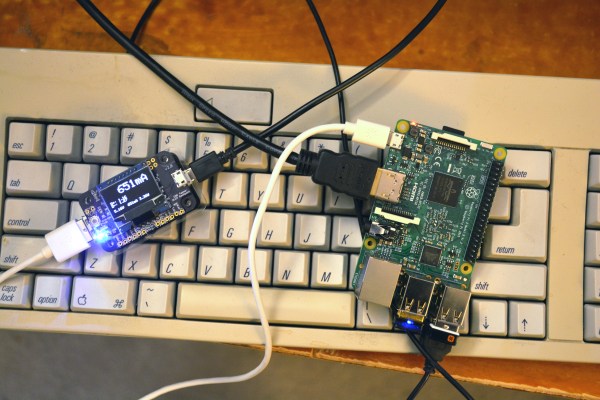
The spec bullet list for the latest Raspberry Pi begins as you’ve already heard: WiFi and Bluetooth, now standard. While this is impressive itself, it doesn’t tell the whole story. The Pi 3, with an ARM Cortex A53, is up to 50% faster than the Pi 2 from last year. That’s an astonishing improvement in just 12 short months.

In playing with the Pi 3 for a few hours, it’s apparent the Pi 3 is fast. It passes a threshold of usability. The Raspberry Pi isn’t a computer that just sits on a shelf and runs a few cron jobs and blinks LEDs anymore – this is a computer that’s usable as a computer. But how fast is it? By stroke of luck, the official website for the Cortex A53 gives us a direct comparison between this chip and the CPU in the Raspberry Pi 2:

image credit: arm.com

In real devices, the performance improvement from the Pi 2 to the Pi 3 is somewhere between 40 and 60 percent. At least that’s what ARM and the Raspberry Pi foundation are claiming. Is this true? There are tests we can run, and the marketing speak, for once, isn’t too terribly off the mark.

Continue reading “Pi 3 Benchmarks: The Marketing Hype Is True”

Moore’s Law Is Over (Again)

According to this article in Nature, Moore’s Law is officially done. And bears poop in the woods.

Note when the time axis ends...
Note when the time axis ends…

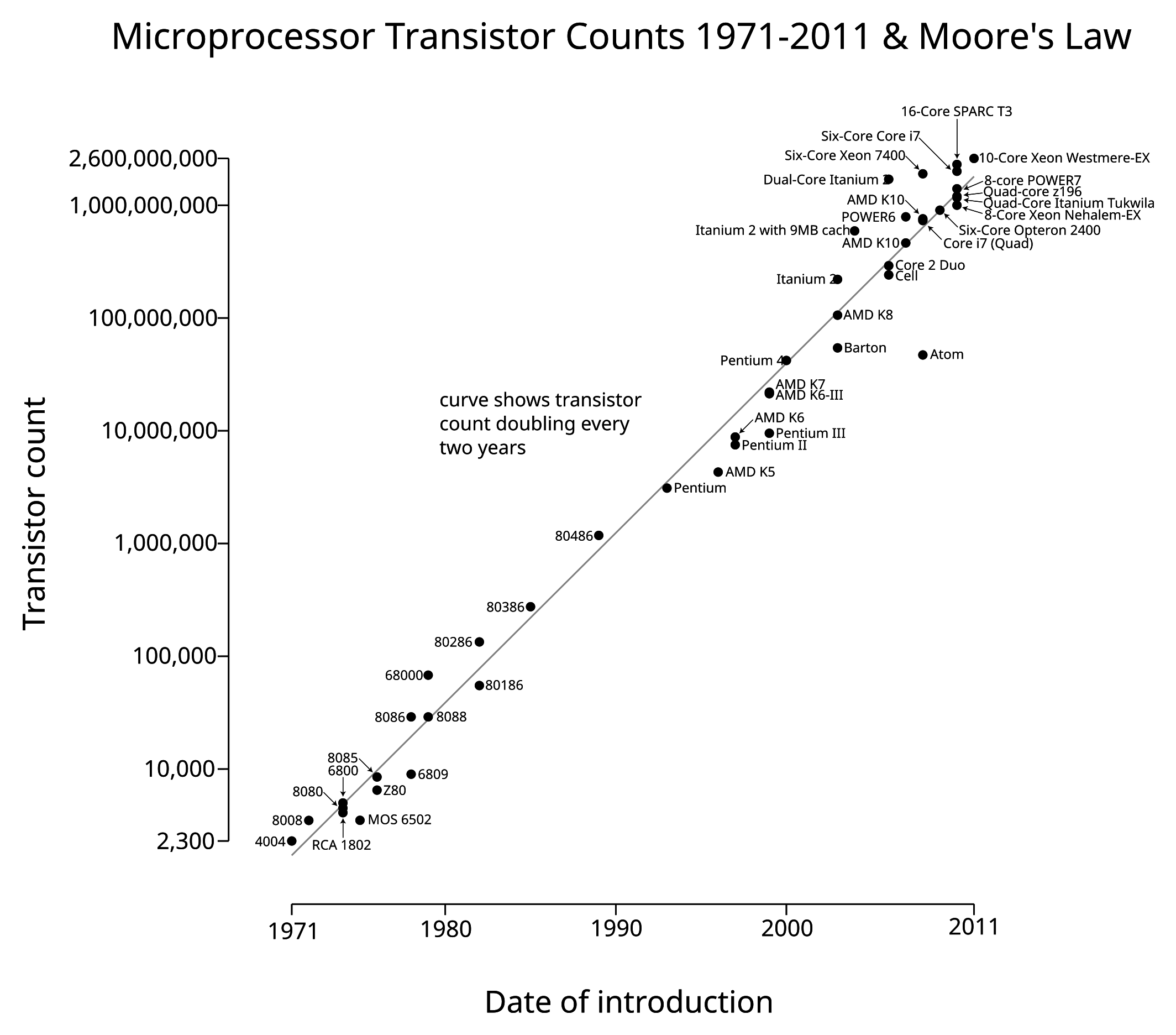
There was a time, a few years back, when the constant exponential growth rate of the number of transistors packed into an IC was taken for granted: every two years, a doubling in density. After all, it was a “law” proposed by Gordon E. Moore, founder of Intel. Less a law than a production goal for a silicon manufacturer, it proved to be a very useful marketing gimmick.

Rumors of the death of Moore’s law usually stir up every couple years, and then Intel would figure out a way to pack things even more densely. But lately, even Intel has admitted that the pace of miniaturization has to slow down. And now we have confirmation in Nature: the cost of Intel continuing its rate of miniaturization is less than the benefit.

We’ve already gotten used to CPU speed increases slowing way down in the name of energy efficiency, so this isn’t totally new territory. Do we even care if the Moore’s-law rate slows down by 50%? How small do our ICs need to be?

Graph by [Wgsimon] via Wikipedia.

Boldport Tribute To Bob Pease

We have lost something in PCB design over the last few decades. If you open up a piece of electronics from the 1960s you’ll see why. A PCB from that era is a thing of beauty, an organic mass of curving traces, an expression of the engineer’s art hand-crafted in black crêpe paper tape on transparent acetate. Now by comparison a PCB is a functional drawing of precise angles and parallel lines created in a CAD package, and though those of us who made PCBs in both eras welcome the ease of software design wholeheartedly we have to admit; PCBs just ain’t pretty any more.

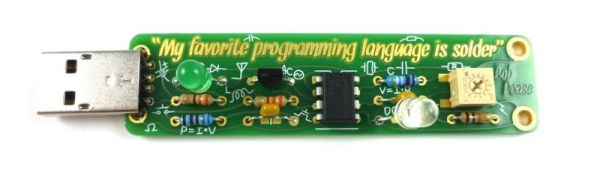
It doesn’t have to be that way though. Notable among the rebels are Boldport, whose latest board, a tribute to the late linear IC design legend [Bob Pease], slipped out this month. They use their own PCBmodE design software to create beautiful boards as works of art with the flowing lines you’d expect from a PCB created the old-fashioned way.

The board itself is an update to an earlier Boldport design, and features Pease’s LM331 voltage to frequency converter IC converting light intensity to frequency and flashing an LED. It’s one of the application circuits from the datasheet with a little extra to drive the LED. Best of all the kit is a piece of open-source hardware, so you can find all its resources on GitHub.

We are fans of Boldport’s work here at Hackaday, and it should come as no surprise that we have featured them before. From one of their other kits through several different pieces of PCB wall art, to their work making an appearance in Marie Claire magazine they have graced these pages several times, and we hope this latest board will be one of many more.

SensorTape Unrolls New Sensor Deployment Possibilities

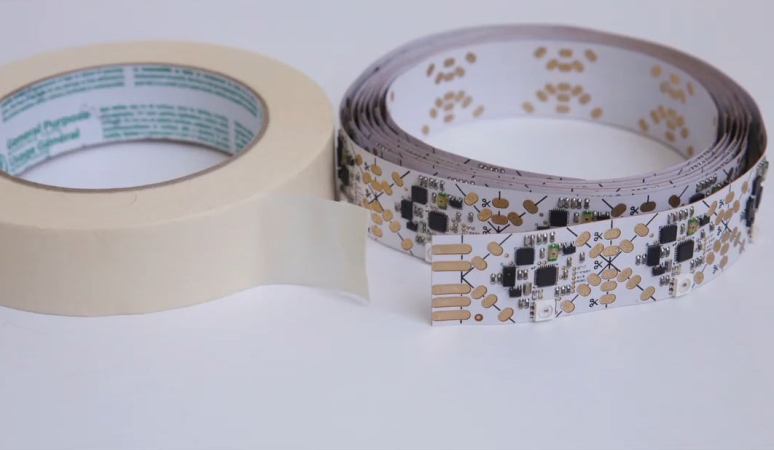
An embedded MEMS sensor might be lots of fun to play with on your first foray into the embedded world–why not deploy a whole network of them? Alas, the problem with communicating with a series of identical sensors becomes increasingly complicated as we start needing to handle the details of signal integrity and the communication protocols to handle all that data. Fortunately, [Artem], [Hsin-Liu], and [Joseph] at MIT Media Labs have made sensor deployment as easy as unraveling a strip of tape from your toolkit. They’ve developed SensorTape, an unrollable, deployable network of interconnected IMU and proximity sensors packaged in a familiar form factor of a roll of masking tape.

Possibly the most interesting technical challenge in a string of connected sensor nodes is picking a protocol that will deliver appreciable data rates with low latency. For that task the folks at MIT Media labs picked a combination of I²C and peer-to-peer serial. I²C accomodates the majority of transmissions from master to tape-node slave, but addresses are assigned dynamically over serial via inter-microcontroller communication. The net effect is a fast transfer rate of 100 KHz via I²C with a protocol initialization sequence that accommodates chains of various lengths–up to 128 units long! The full details behind the protocol are in their paper [PDF].

With a system as reconfigurable as SensorTape, new possibilities unfold with a solid framework for deploying sensors and aggregating the data. Have a look at their video after the break to get a sense of some of the use-cases that they’ve uncovered. Beyond their discoveries, there are certainly plenty others. What happens when we spin them up in the dryer, lay them under our car or on the ceiling? These were questions we may never have dreamed up because the tools just didn’t exist! Our props are out to SensorTape for giving us a tool to explore a world of sensor arrays without having to trip over ourselves in the implementation details.

via [CreativeApplications]

Continue reading “SensorTape Unrolls New Sensor Deployment Possibilities”

Introducing The Raspberry Pi 3

TL;DR: The Raspberry Pi 3 Model B is out now. This latest model includes 802.11n WiFi, Bluetooth 4.0, and a quad-core 64-bit ARM Cortex A53 running at 1.2 GHz. It’s a usable desktop computer. Available now at the usual Pi retailers for $35.

News of the latest Raspberry Pi swept around the Internet like wildfire this last weekend, thanks to a published FCC docs showing a Pi with on-board WiFi and Bluetooth. While we thank the dozens of Hackaday readers that wrote in to tell us about the leaked FCC documents, our lips have been sealed until now. We’ve been doing a few hands-on tests with the Pi 3 for about two weeks now, and the reality of the Pi 3 is much cooler than a few leaked FCC docs will tell you.

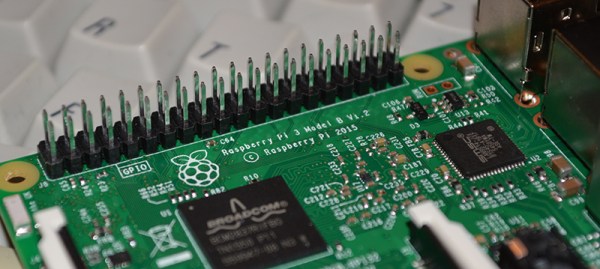
The Raspberry Pi 3 Model B features a quad-core 64-bit ARM Cortex A53 clocked at 1.2 GHz. This puts the Pi 3 roughly 50% faster than the Pi 2. Compared to the Pi 2, the RAM remains the same – 1GB of LPDDR2-900 SDRAM, and the graphics capabilities, provided by the VideoCore IV GPU, are the same as they ever were. As the leaked FCC docs will tell you, the Pi 3 now includes on-board 802.11n WiFi and Bluetooth 4.0. WiFi, wireless keyboards, and wireless mice now work out of the box.

Continue reading “Introducing The Raspberry Pi 3”

FCC Locks Down Router Firmware

For years, we have been graced with consumer electronics that run some form of Linux, have a serial port on the circuit board somewhere, and are able to be upgraded through official and unofficial means. That digital picture frame you got for Christmas in 2007 and forgot to regift in 2008? That’s a computer, and it would make a wonderful Twitter feed display. Your old Linksys WRT54G router? You can make a robotic lawnmower out of that thing. The ability to modify the firmware of consumer electronics is the cornerstone of Hackaday’s editorial prerogative. Now that right we have all enjoyed is in jeopardy, thanks to regulations from the FCC and laziness from router manufacturers.
Continue reading “FCC Locks Down Router Firmware”