About Those Gravitational Waves

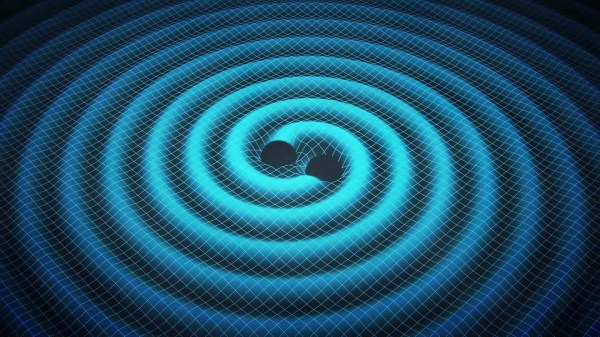
It was the year of 1687 when Isaac Newton published “The Principia“, which revealed the first mathematical description of gravity. Newton’s laws of motion along with his description of gravity laid before the world a revolutionary concept that could be used to describe everything from the motions of heavenly bodies to a falling apple. Newton would remain the unequivocal king of gravity for the next several hundred years. But that would all change at the dawn of the 20th century when a young man working at a Swiss patent office began to ask some profound questions. Einstein had come to the conclusion that Newtonian physics was not adequate to describe the findings of the emerging electromagnetic field theories.  In 1905, he published a paper entitled “On the Electrodynamics of Moving Bodies” which corrects Newton’s laws so they work when describing the motions of objects near the speed of light. This new description became known as Special Relativity.

It was ‘Special’ because it didn’t deal with gravity or acceleration. It would take Einstein another 10 years to work these two concepts into his relativity theory. He called it General Relativity – an understanding of which is necessary to fully grasp the significance of gravitational waves.
Continue reading “About Those Gravitational Waves”

Microchip Unveils Online MPLAB IDE And $10 Board

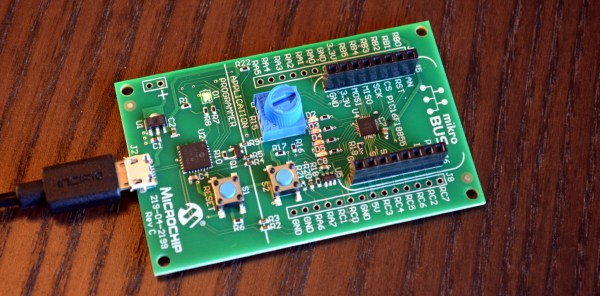
Today, Microchip released a few interesting tools for embedded development. The first is a free online IDE called MPLAB Xpress, the second is a $10 dev board with a built-in programmer. This pair is aimed at getting people up and running quickly with PIC development. They gave us an account before release, and sent over a sample board. Let’s take a look!

Continue reading “Microchip Unveils Online MPLAB IDE And $10 Board”

Suddenly, 4G Feels Slow

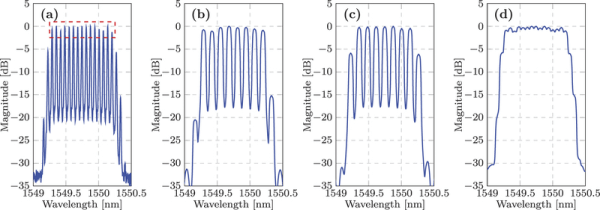
Researchers at University College London successfully transferred data over an optical transmission system at a rate of 1.125 Tb/s. That’s over ten times as fast as typical commercial optical systems, and thousands of times faster than the standard broadband connection. The study appeared in Scientific Reports and takes advantage of encoding techniques usually seen in wireless systems.

The prototype system uses fifteen channels on different wavelengths. Each channel used 256QAM encoding (the same as you see on cable modems, among other things). A single receiver recovers all of the channels together. The technology isn’t commercially available yet. It is worth noting that the experiment used a transmitter and receiver very close to each other. Future tests will examine how the system performs when there are hundreds or thousands of feet of optical fiber between them.

Continue reading “Suddenly, 4G Feels Slow”

Flexible Phototransistor Will Make Everything Subtly Better In The Future

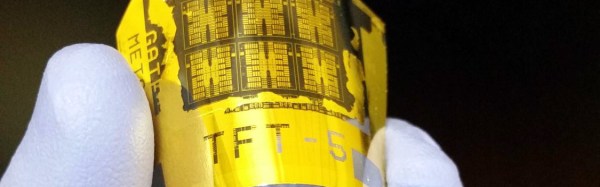
University of Wisconsin-Madison is doing some really cool stuff with phototransistors. This is one of those developments that will subtly improve all our devices. Phototransistors are ubiquitous in our lives. It’s near impossible to walk anywhere without one collecting some of your photons.

The first obvious advantage of a flexible grid of phototransistors is the ability to fit the sensor array to any desired shape. For example, in a digital camera the optics are designed to focus a “round” picture on a flat sensor. If we had a curved surface, we could capture more light without having to choose between discarding light, compensating with software, or suffering the various optical distortions.

Another advantage of the University’s new manufacturing approach is the “flip-transfer” construction method they came up with. They propound that their method produces a vastly more sensitive device. The sensing silicon sits on the front of the assembly without any obstructing material in front; also the metal substrate it was built on before flipping is reflective; also increasing the sensitivity.

All in all very cool, and we can’t wait for phone cameras, with super flat lenses, infinite focus, have no low light capture issues, and all the other cool stuff coming out of the labs these days.

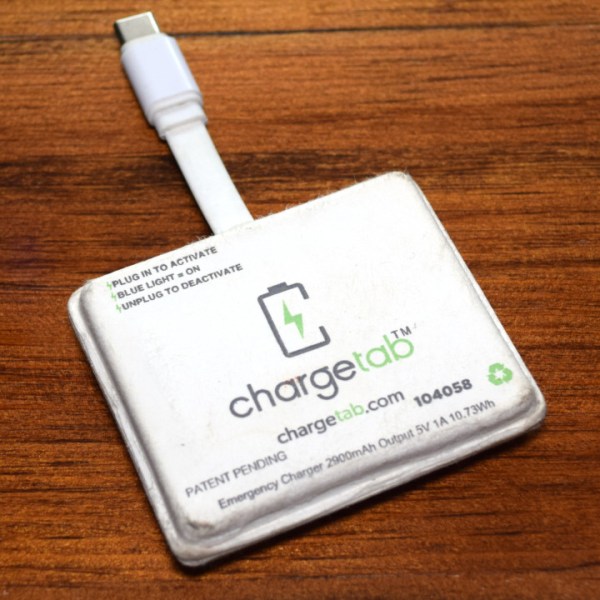
New Efficiency Standards For Wall Warts In The US

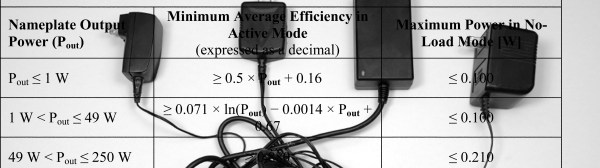
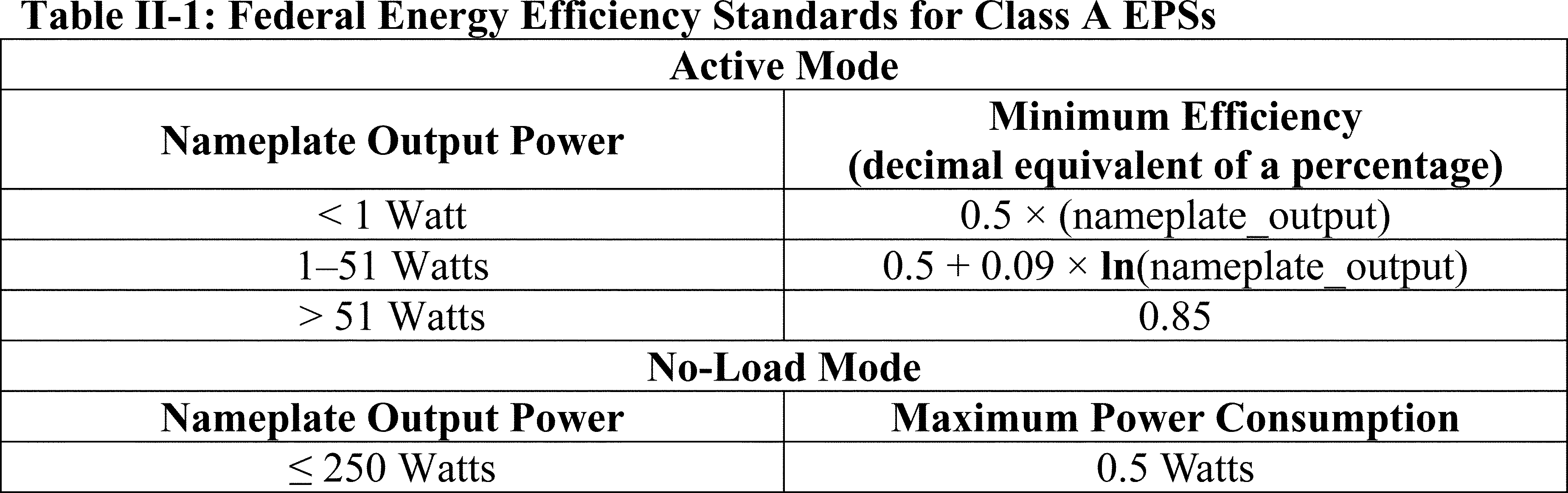
The common household wall wart is now under stricter regulation from the US Government. We can all testify to the waste heat produced by many cheap wall warts. Simply pick one at random in your house, and hold it; it will almost certainly be warm. This regulation hopes to save $300 million in wasted electricity, and reap the benefits, ecologically, of burning that much less fuel.

original
The old standard.

We don’t know what this means practically for the consumer. Will your AliExpress wall warts be turned away at the shore now? Will this increase the cost of the devices? Will it make them less safe? More safe? It’s always hard to see where new regulation will go. Also, could it help us get revenge on that knock-off laptop adapter we bought that go hot it melted a section of carpet?

However, it does look like most warts will go from a mandated 50-ish percent efficiency to 85% and up. This is a pretty big change, and some hold-out manufacturers are going to have to switch gears to newer circuit designs if they want to keep up. We’re also interested to hear the thoughts of those of you outside of the US. Is the US finally catching up, or is this something new?

Dry Ice Is Nice For Separating Broken Phone Screens

Smartphones are the opium of the people. If you need proof, just watch the average person’s reaction when they break “their precious”. Repairing smartphones has become a huge business. The most often broken item on phones is of course the front glass. In most cases, the screen itself doesn’t break. On newer smartphones, even the touchscreen is safe. The front glass is only a protective lens.

The easiest way to repair a broken front glass is to swap the entire LCD assembly. For an iPhone 6 plus, this will run upwards of $120 USD. However, the glass lens alone is just $10. The problem is that the LCD, digitizer and front glass are a laminated package. Removing them without breaking the wafer thin LCD glass requires great care. The hardest part is breaking down the optical glue securing the glass to the LCD. In the past that has been done with heat. More recently, companies from China have been selling liquid-nitrogen-based machines that cool the assembly. Now immersing a phone screen in -196° C liquid nitrogen would probably destroy the LCD. However, these machines use a temperature controller to keep a surface at -140° C. Just enough to cause the glue to become brittle, but not kill the LCD.

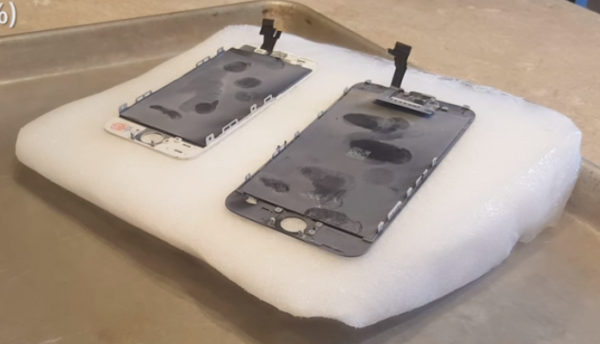
[JerryRigEverything] doesn’t have several thousand dollars for a liquid nitrogen machine, but he does have a $5 block of dry ice. Dry ice runs at -78.5°C. Balmy compared to liquid nitrogen, but still plenty cold. After laying the phone screens down on the ice for a few minutes, [Jerry] was able to chip away the glass. It definitely takes more work than the nitrogen method. Still, if you’re not opening your own phone repair shop, we think this is the way to go.

Broken phones are a cheap and easy way to get high-resolution LCD screens for your projects. The problem is driving them. [Twl] has an awesome project on Hackaday.io for driving phone screens using an FPGA. We haven’t seen it done with iPhone 6 yet though. Anyone up for the challenge?

Continue reading “Dry Ice Is Nice For Separating Broken Phone Screens”

China’s Fusion Reactor Hits Milestone

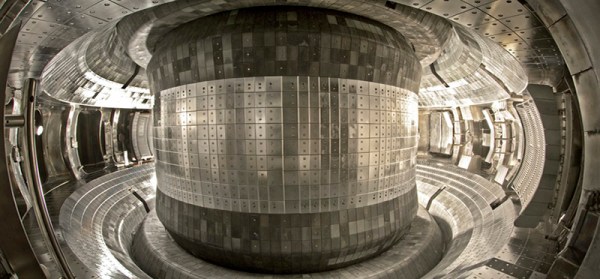
An experimental fusion reactor built by the Chinese Academy of Science has hit a major milestone. The Experimental Advanced Superconducting Tokamak (EAST) has maintained a plasma pulse for a record 102 seconds at a temperature of 50 million degrees – three times hotter than the core of the sun.

The EAST is a tokamak, or a torus that uses superconducting magnets to compress plasma into a thin ribbon where atoms will fuse and energy will be created. For the last fifty years, most research has been dedicated to the study of tokamaks in producing fusion power, but recently several projects have challenged this idea. The Wendelstein 7-X  stellarator at the Max Planck Institute for Plasma Physics recently saw first plasma and if results go as expected, the stellarator will be the design used in fusion power plants. Tokamaks have shortcomings; they can only be ‘pulsed’, not used continuously, and we haven’t been building tokamaks large enough to produce a net gain in power, anyway.

Other tokamaks currently in development include ITER in France. Theoretically, ITER is large enough to attain a net gain in power at 12.4 meters in diameter. EAST is much smaller, with a diameter of just 3.7 meters. It is impossible for EAST to ever produce a net gain in power, but innovations in the design that include superconducting toroidal and poloidal magnets will surely provide insight into unsolved questions in fusion reactor design.