ARM Unveils New, High Efficency CPU

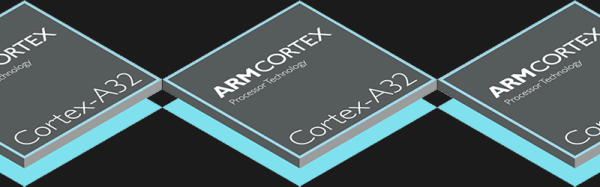
ARM has announced their latest IP core the Cortex A32. This 32-bit chip brings the benefits of the ARMv8-A architecture to low-power devices, ostensibly ones that will be the backbone of the Internet of Things.

For the last few years, the state of ARM CPUs has been firmly planted in the world of ARMv7 instructions. These chips, the Cortex A5, A7, A9, A15, and A17 are divided into ‘good, better, best’ segments, with the A7 pulling its weight as the processor in the Raspberry Pi 2, and a dual-core A15 finding its way into the latest BeagleBoard. While these CPUs are very capable, they don’t support the latest ARM architecture, ARMv8. For the last few years, the only ARM processors with the v8 architecture fell into the ‘better’ and ‘best’ segments. Although the A53, A57, and A72 chips are very capable, there hasn’t been a low power ARMv8 chip until this announcement.

So what does this announcement mean for the next generation of the Internet of Things, single board computers, and the wearable electronics of tomorrow? Absolutely nothing. Only the processor IP was released, and it will take at least a year for this core to make it into a chip. It will be 18 to 24 months until you can find this core in a consumer device. On the other hand, when these devices do appear, they will be significantly faster than current devices with a Cortex A5 and A7.

BBC Micro:Bit Gets An App

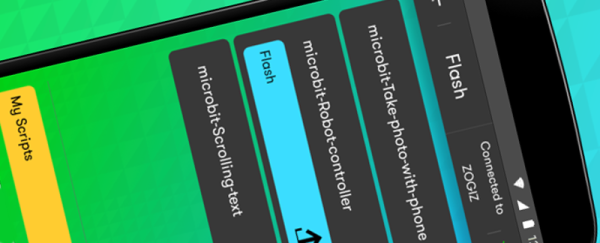
It’s a small, cheap, British single board computer, and nobody can get hold of them. Another Raspberry Pi Zero story, you might think, but no, this is about the other small cheap and difficult to find British SBC, the BBC micro:bit. Samsung UK have produced an app for the micro:bit that allows owners to write code on their Android phones, and upload it to their micro:bit via Bluetooth.

The micro:bit story has played out with agonising slowness over the last year, but it seems that there may now be light at the end of the tunnel. The idea is a good one: give a small but very capable single board computer to every Year 7 (about 12 years old) child, and watch them learn something more useful about computers than how to use a Windows application. It has echoes of the BBC Micro 8-bit computer for schools sponsored by the UK government in the 1980s, and the hope is that it will help reproduce the same technical literacy enjoyed by 1980s kids.

The plan was for the youngsters to receive their boards last October but the project as been plagued by a series of delays and the latest estimate from January was that the boards would reach the kids after the school half-term. In other words within the next couple of weeks, depending on which part of the UK the school is located in.

We recently had a brief opportunity here at Hackaday to examine a micro:bit in the wild. It is a capable little board in its own right, being at heart an mbed, however the recommended web-based micro:bit IDE and compiler differs from the more usual mbed toolchain. One thing that caught our attention in the demo we were given was the micro:bit’s use of USB to deploy code; since schools lock down computer hardware to the n’th degree we were concerned that the micro:bits might not be visible on school USB ports. Easy Bluetooth deployment through the Samsung app promises to bypass that barrier, which can only be a good thing.

We’ve been watching the micro:bit story here at Hackaday from the start, most recently we noted the arrival of Python on the platform. If it has a formative influence on the generation of developers and engineers you’ll be hiring in the mid-2020s then we expect it to feature in many future stories.


Star Wars Droid Translating Helmets

Now how’s this for an expo costume? [AEInnovations] put together a set of Droid helmets that talk to each other in droid speak!

Before you get too excited, we have to let you know, they aren’t actually translating anything. One, there’s no such thing as a complete droid speak language from Star Wars, and two, it’d be ridiculous. No, what he’s created is a bit simpler, but nonetheless awesome and very clever.

The helmets have walkie talkies built in, so two people wearing the helmets can simply talk to each other, in plain old English — well, or maybe Klingon. But when you speak, a sensor in the helmet notices you speaking, and starts broadcasting a randomized droid speech for everyone else to hear.

Continue reading “Star Wars Droid Translating Helmets”

Waiting For China To Re-Open, From Huaqiangbei

The Chinese New Year is something we keep in mind at least half of the year, and probably still don’t plan for properly. In case you’re new to the situation: The Chinese New Year celebration empties out Shenzhen of its more than 12 million residents for the better part of a month. It’s the one time of year that manufacturing sector workers (and everyone that supports that ecosystem) travels home to visit family.

For those involved in manufacturing goods in Shenzhen, this part of the year leaves us cut off from one of our vices and we count the days until our tracking numbers and order confirmations start to show signs of life. It’s an inconvenience of an entirely different nature if you are one of the lonely few that stays in the city during the holiday. [Ian] over at Dangerous Prototypes wrote a blog post from his office in Huaqiangbei which is a sub-district of Shenzhen, China to share the experience with us.

Shenzhen is uniquely a migrant-worker city, and when emptied of the factory employees there are not enough people to patronize local services like markets and restaurants so they also shut down. But an empty city offers its own interesting entertainment like wicked fireworks sessions. As always, [Ian] does a great job of sharing this peculiar part of Shenzhen culture. He also kindly points out some of the offensive offers that come through the inter-webs from desperate customers who have poorly planned around the holiday.

$3 Smartphone From India

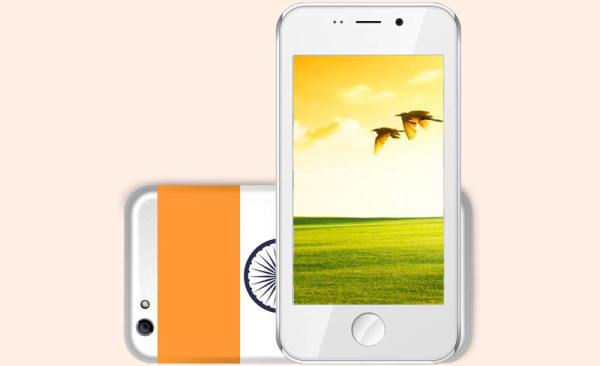
The release of the Ringing Bells Freedom 251 means exciting things for India, and if it goes well possibly the hacker community, too. This $3 device comes with all the things you’d expect from your standard smartphone. Considering any of the individual components alone (4″ IPS screen, cell modem, 1450 mAh battery, 1.3 GHz quad-core processor, 3.2 MP front and 0.3 MP rear cameras) could cost more than the whole thing put together, some skepticism is warranted.

There is speculation about how this is possible given Ringing Bells’ claims of no government subsidies. Considering the prototype presented to the media was from Chinese company Adcom, this may be a big scam in the making. The BBC does an examination of the many ways this seems sketchy, including the lack of appropriate government approvals (like the Indian equivalent of the FCC), and the experience of the company selling it (established in 2015).

Still, consider us curious and hopeful that we may have a new tool as useful and cheap as the ESP8266 has been. That said, it will be interesting to see if the company can maintain stock and limit hardware sales to their intended market or will a curious world electronics ecosystem make them a scarce stock item.

[via BBC]

The Contrarian Response To Apple’s Need For Encryption

On December 2, 2015, [Syed Rizwan Farook] and [Tashfeen Malik] opened fire at a San Bernardino County Department of Public Health training event, killing 14 and injuring 22. This was the third deadliest mass shooting in the United States in recent memory, and began a large investigation by local, state, and federal agencies. One piece of evidence recovered by the FBI was an iPhone 5C belonging to one of the shooters. In the days and months after the shooting, the FBI turned to Apple to extract data from this phone.

A few days ago in an open letter to customers, [Tim Cook], CEO of Apple, stated they will not comply with FBI’s request to build a backdoor for the iPhone. While the issue at hand is extracting data from an iPhone recovered from the San Bernardino shooting, [Cook] says building a new version of iOS to extract this data would allow the FBI to unlock any iPhone. Needless to say, there are obvious security implications of this request.

Apple does not publish open letters to its customers often. Having one of the largest companies on the planet come out in support of privacy and encryption is nearly unprecedented. There is well-founded speculation this open letter to the public will be exhibit A in a supreme court case. Needless to say, the Internet has gone a little crazy after this letter was published, and rightly so: just imagine how better off we would be if AT&T said no to the NSA in 2002 – [Snowden] might just be another IT geek working for a government contractor.

CalvinThere is a peculiar aspect of public discourse that doesn’t make any sense. In the absence of being able to say anything interesting, some people have just decided to add a contrary viewpoint. Being right, having a valid argument, or even having evidence to support assertions doesn’t matter; being contrary is far more interesting. Look at any comment thread on the Internet, and you’ll find the longest comment chain is the one refuting the parent article. Look up the ratings for a cable news channel. You’ll find the highest rated show is the one with the most bickering. When is the last time you saw something from the New York Times, Washington Post, or LA Times on Facebook or your favorite news aggregator? Chances are, it wasn’t news. It was an op-ed, most likely one that was espousing a view contrary to either public opinion or public policy.

As with any headline event on the Internet, the contrarians have come out of the woodwork. These contrarians are technically correct and exceedingly myopic.

Continue reading “The Contrarian Response To Apple’s Need For Encryption”

5D Glass Disc Can Store 360TB!

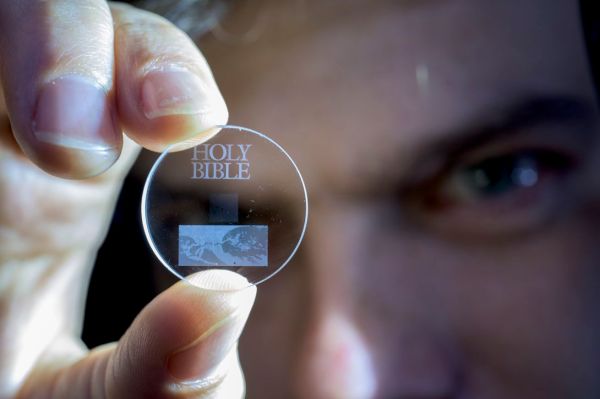
There’s a small subset of hackers out there concerned with the end of the world. What if our entire existence vanished? How would an alien race learn not to do what we did, what resulted in our demise? We’ve all heard of laser etching metal disks with the Bible, accounts of history, and even just names — pretty sure we’ve sent quite a few into space. But researchers at the University of Southampton’s Optical Research Center have come up with an even superior storage method. They call it the 5D Disc.

According to the researchers, each disc could hold a theoretical 360TB. They can withstand temperatures of up to 1000C, and it’s believe that they could last up to 13.8 billion years at room temperature without degrading — if that’s true, our sun would be long dead before the disc degraded! Continue reading “5D Glass Disc Can Store 360TB!”