Harmonic Analyzer Mechanical Fourier Computer

If you’re into mechanical devices or Fourier series (or both!), you’ve got some serious YouTubing to do.

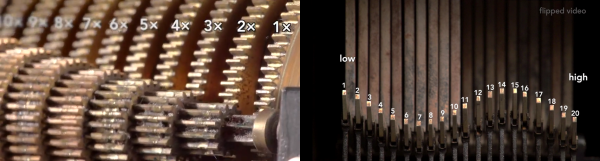
[The Engineer Guy] has posted up a series of four videos (Introduction, Synthesis, Analysis, and Operation) that demonstrate the operation and theory behind a 100-year-old machine that does Fourier analysis and synthesis with gears, cams, rocker-arms, and springs.

In Synthesis, [The Engineer Guy] explains how the machine creates an arbitrary waveform from its twenty Fourier components. In retrospect, if you’re up on your Fourier synthesis, it’s pretty obvious. Gears turn at precise ratios to each other to create the relative frequencies, and circles turning trace out sine or cosine waves easily enough. But the mechanical spring-weighted summation mechanism blew our mind, and watching the machine do its thing is mesmerizing.

In Analysis everything runs in reverse. [The Engineer Guy] sets some sample points — a square wave — into the machine and it spits out the Fourier coefficients. If you don’t have a good intuitive feel for the duality implied by Fourier analysis and synthesis, go through the video from 1:50 to 2:20 again. For good measure, [The Engineer Guy] then puts the resulting coefficient estimates back into the machine, and you get to watch a bunch of gears and springs churn out a pretty good square wave. Truly amazing.

The fact that the machine was designed by [Albert Michelson], of Michelson-Morley experiment fame, adds some star power. [The Engineer Guy] is selling a book documenting the machine, and his video about the book is probably worth your time as well. And if you still haven’t gotten enough sine-wavey goodness, watch the bonus track where he runs the machine in slow-mo: pure mechano-mathematical hotness!

Continue reading “Harmonic Analyzer Mechanical Fourier Computer” →

The Future Of The Internet Of Things

When buying anything, you’re going to have a choice: good, fast, or cheap. Pick any two. A plumber will fix a drain good and fast, but it won’t be cheap. The skeezy guy you can call will fix a drain fast and cheap, but it won’t be good.

Such it is with radios. You can have long-range (good), high bandwidth (fast), or a low price (cheap). Pick any two. The Internet of Things demands a cheap, long-range radio module, but until now this really hasn’t existed. At Electronica last week, Microchip demoed their IoT solution, the LoRa. This module has a 15km (rural) or ~3km (heavy urban) range, works for a year on two AAA batteries, and is very cheap. Bandwidth? That’s crap, but you’re not streaming videos to your shoe.

Continue reading “The Future Of The Internet Of Things” →

Bricked Raspberry Pi Displays History

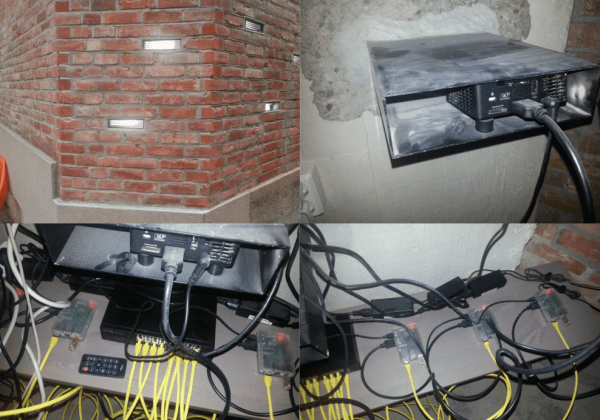
[eN0Rm’s] Raspberry Pis are much more than just another brick in the wall. He’s used the popular embedded Linux platform to build several small rear projection screens in a brick wall (Imgur link). Brick shaped metal enclosures were mortared into the wall of the building. Each rear projection screen is illuminated by a DLP projector which sits inside the metal enclosure. The Raspberry Pis sit on a shelf below all this.  The bricks are in a building in the Aker Brygge section of Oslo, Norway, and show historical facts and short videos about the local area.

[eN0Rm] could have used a PC for this task, the price for a low-end PC with a few graphics cards probably wouldn’t have been much more expensive than several Raspberry Pi’s with cases. However, this system has to just work, and a PC would represent a single point of failure. Even if one Raspberry Pi goes down, the others will continue running.

The current installation is rather messy, but it’s just a test setup.  [eN0Rm] has already been taken to task for the lack of cable management in his Reddit thread.  As [eNoRm] says – first get it working, then make it pretty.

[Ben Krasnow] Shows Us How A Crookes Radiometer Works

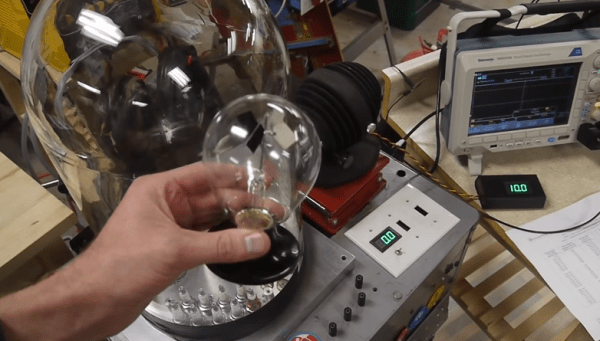
[Ben Krasnow] is tackling the curious Crookes Radiometer on his Applied Science YouTube channel. The Crookes Radiometer, a staple of museum gift shops everywhere, is a rather simple device. A rotor with black and white vanes rotates on the head of a needle. The entire assembly is inside a glass envelope. The area inside the glass is not at a hard vacuum, nor is it filled with some strange gas. The radiometer only works when there is a partial vacuum inside.

The radiometer’s method of operation was long misunderstood. Sir William Crookes and James Clerk Maxwell both believed that the vanes moved due to the pressure of the photons hitting the vanes. If that were true though, the radiometer would spin in the opposite direction it normally does when held near a light source.  It was eventually discovered that the system is a thermodynamic one. [Ben] proves this by cooling down the radiometer’s glass with a can of freeze spray.  The radiometer immediately begins spinning backwards, with no light source present.

From there [Ben] mounts the rotor of a radiometer inside his vacuum chamber, which many will recognize as the chamber from his DIY electron microscope. As expected, the vanes don’t spin at a hard vacuum. In fact, [Ben] find the vanes spin fastest when the pressure is about 7 mTorr.

Continue reading “[Ben Krasnow] Shows Us How A Crookes Radiometer Works” →

Multi-target IDE For 8-Bit CPUs

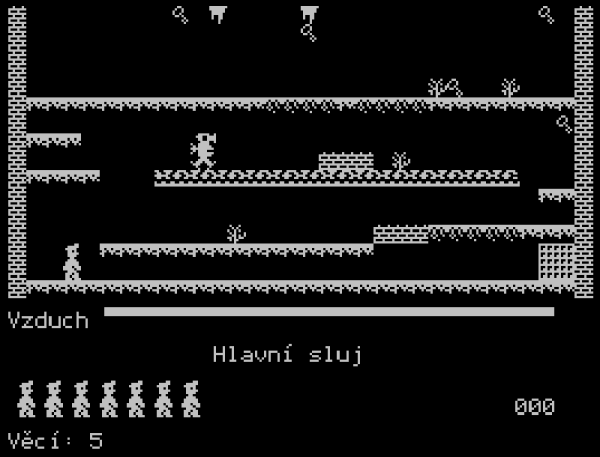
A long time ago, [Martin] played with old 8-bit computers. Recently, he’s been honing his assembly skills again, and the idea of an IDE for a boatload of old systems came to him. After a year of work, he announced a multitarget IDE for 8-bit computers that works in your browser.

The project is called ASM80, and includes a code editor, a workspace to put all your code, compilers for the 8080/8085, Z80, 6502, 6800 and 6809 CPUs, emulators for all these CPUs, and emulators for a few Czech computers, the ZX Spectrum, and a few of [Grant Searle]’s single board computers.

What makes this project interesting is the syntax for all the different CPUs is pretty much the same. It’s a real, modular code editor that supports macros and everything you would expect for a code editor for ancient computers.

You can check out an assembler description here. [Martin] also has an offline, desktop-based version of ASM80 called IDE80, with a video demo of that below.

Continue reading “Multi-target IDE For 8-Bit CPUs” →

Hackaday Printing Press Upgrade

There comes a time when your movable type becomes so over-used that you no longer get a legible print off of the printing press. For months now we’ve been at work on a new site design that maintains the essence of Hackaday while ejecting the 10-year-old dregs of the site. With each small success we’ve actually ruined ourselves on viewing the old design. It is with great relief that we unveil a site design built specifically for Hackaday’s needs.

The most notable change is in the content of our landing page. For ten years, loading Hackaday.com resulted in the most recent blog posts. The blog concept is proven, but provides little opportunity to highlight quality original content and information about upcoming events. We have tried the use of “sticky” posts but honestly I find them somewhat annoying. The solution to this is not immediately apparent, but I feel we have found the most efficient solution to our complex set of needs..

We have a lot of community members who participate in Hackaday in numerous ways. Changes found in this design are driven by that fact. The landing page will, from this point forward, be a somewhat more persistent collection of notable content from the blog, our community site (hackaday.io), as well as news regarding live events, store features, contest highlights, and more. Those hard-core fans — a label I also assign to myself — will find the same reading experience as always on the new blog URL: hackaday.com/blog.

Aesthetically, we hope that all will agree the new design far supersedes the old. There was a lot to fix, and the work of the Hackaday crew who designed and implemented this new interface is truly amazing. I hope you will take the time to leave a positive comment about their work. As with any major transition, there will be some bumps in the road. Right now most of our sidebar widgets have not been migrated but that and any other problems will be fixed soon.

In this design we strived to highlight the title and image of each post to immediately convey the core concepts of the projects shown here. The author by-line and comment count remain core to the presentation of the articles, and our link style continues to be immediately apparent in the body of each article. I think we have far surpassed the readability of the comments section, in addition to the content itself. We knew we could rebuilt it… we have the technology… long live articles worth reading.

UPDATE: We are working very hard to fix all the parts that don’t look quite right. Thanks for your patience!

UPDATE 2: Infinite scrolling isn’t a feature, it’s a regression. On our test server all the blog listings were paginated just like always. When our host, WordPress VIP, pushed live the infinite scrolling manifested itself. We’ve filed a ticket with them and are hoping for a solution shortly.

UPDATE 3: Infinite scrolling has now been fixed and the blog layout now paginates. The mouse-over zoom effect has been removed. Slideshow speed has been adjusted and if you hover you mouse over a feature it will pause the scrolling.