Lasers Could Help Us Recycle Plastics Into Carbon Dots

As it turns out, a great deal of plastics are thrown away every year, a waste which feels ever growing. Still, as reported by Sci-Tech Daily, there may be help on the way from our good friend, the laser!

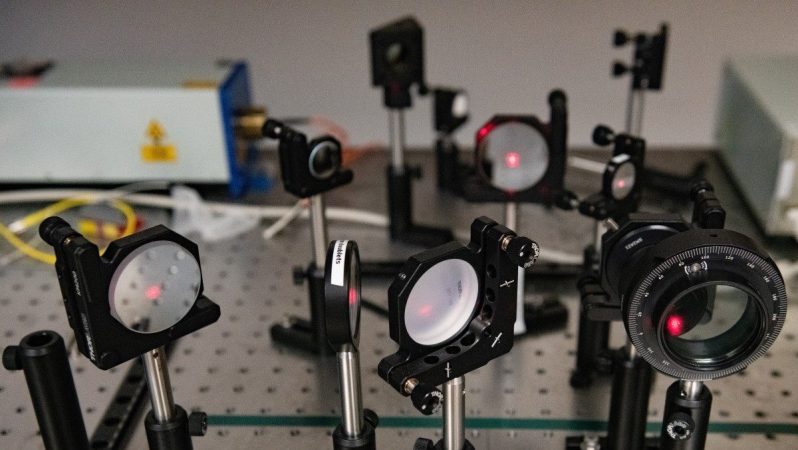
The research paper  from the University of Texas outlines the use of lasers for breaking down tough plastics into their baser components. The method isn’t quite as simple as fire a laser off at the plastic, though. First, the material must be laid on a special two-dimensional transition metal dichalcogenide material — a type of atomically-thin semiconductor at the very forefront of current research. When the plastics are placed under the right laser light in this scenario, carbon-hydrogen bonds in the plastic are broken and transformed, creating new chemical bonds. Done right, and you can synthesize luminescent carbon dots from the plastic itself!

“By harnessing these unique reactions, we can explore new pathways for transforming environmental pollutants into valuable, reusable chemicals, contributing to the development of a more sustainable and circular economy,” says Yuebing Zheng, a leader on the project. “This discovery has significant implications for addressing environmental challenges and advancing the field of green chemistry.”

Sure it’s a bit trickier than turning old drink bottles into filament, but it could be very useful to researchers and those investigating high-tech materials solutions. Don’t forget to read up on the sheer immensity of the world’s plastic recycling problems, either. If you’ve got the solution, let us know!


Las Vegas’ Sphere: Powered By Nvidia GPUs And With Impressive Power Bill

A daytime closeup of the LED pucks that comprise the exosphere of the Sphere in Paradise, Nevada (Credit: Y2kcrazyjoker4, Wikimedia)

As the United States’ pinnacle of extravaganza, the Las Vegas Strip and the rest of the town of Paradise are on a seemingly never-ending quest to become brighter, glossier and more over the top as one venue tries to overshadow the competition. A good example of this is the ironically very uninspiredly named Sphere, which has both an incredibly dull name and yet forms a completely outrageous entertainment venue with a 54,000 m2 (~3.67 acre) wrap-around interior LED display (16 x 16K displays) and an exterior LED display (‘Exosphere’) consisting out of 1.23 million LED ‘pucks’. Although opened in September of 2023, details about the hardware that drives those displays have now been published by NVidia in a recent blog post.

Driving all these pixels are around 150 NVidia RTX A6000 GPUs, installed in computer systems which are networked using NVidia BlueField data processing units (DPUs) and NVidia ConnectX-6 NICs (up to 400 Gb/s), with visual content transferred from Sphere Studios in California to the Sphere. All this hardware uses about 45 kW of power when running at full blast, before adding the LED displays and related hardware to the total count, which is estimated to be up to 28 MW of power and causing local environmentalists grief despite claims by the owner that it’ll use solar power for 70% of the power needs, despite many night-time events. Another item that locals take issue with is the amount of light pollution that the exterior display adds.

Although it’s popular to either attack or defend luxurious excesses like the Sphere, it’s interesting to note that the state of Nevada mostly gets its electricity from natural gas. Meanwhile the 2.3 billion USD price tag for the Sphere would have gotten Nevada 16.5% of a nuclear power station like Arizona’s Palo Verde (before the recurring power bill), but Palo Verde’s reactor spheres are admittedly less suitable for rock concerts.

Time’s Up For Mbed

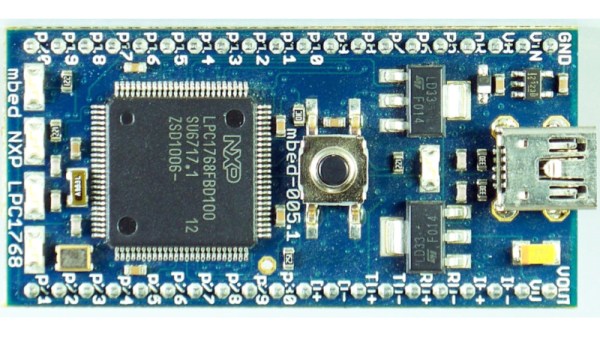
In a forum post has come the announcement that mBed, ARM’s accessible microcontroller development platform, is to reach end-of-life in July 2026. This means that the online platform and OS will no longer be supported by ARM, though the latter will remain an open source project. The website will be shuttered, and no new projects can be created after that date using ARM infrastructure.

mBed was originally launched back in 2009, as a competitor to the Arduino IDE for ARM’s chips. Its easy development made it attractive and there were soon an array of boards from different manufacturers supporting it, but perhaps due to its support for only the one architecture, it failed to find success. It’s certainly not the first time a single-architecture microcontroller development platform has been discontinued, we need only look to the Intel Edison for that, but given the success of ARM platforms in general it’s still something of a surprise. Perhaps it’s time to take the press release explanation that other platforms such as Arduino have simply been much more popular.

Will a community form around an open source mBed? Given that it’s been a definite minority among Hackaday projects over the years, while we hope it does, we’re not so sure.

mBed board image: Viswesr, CC BY-SA 3.0.

Nitric Acid Is The Hot New Way To Pick Locks

Lockpicking is a grand skill to have, and one that’s often presumed to be one of the dark arts of the burglar. However, a new technique has come to the fore in some European contexts. It appears nitric acid is being used to damage locks to allow criminals to gain entry into residential premises.

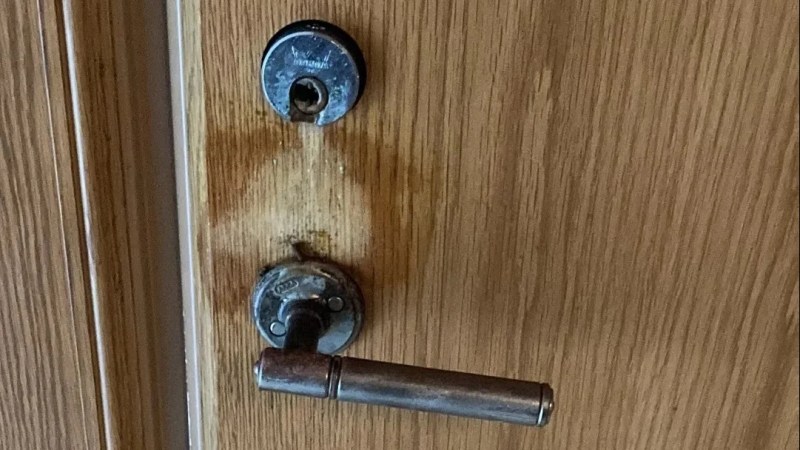
Germany’s Bild has covered this matter, as has Feuerwehr Magazine. The technique has apparently come to prominence in the last couple of years. Attackers pour the corrosive liquid into the keyway of a typical door lock. This damages the cylinder, and perhaps the pins inside as well. Once the metal has been eaten away and the structure of the lock is sufficiently degraded, it can presumably be forced open quite easily with hand tools. The technique is apparently especially effective in Germany, where locks are typically installed with the pins facing down. This makes it easy for any liquid trickled into the lock to eat away at the pins in the bottom.

German authorities advised people to be on the look out for discoloration around door locks. If seen, it’s important to avoid contact with any corrosive liquid that may have been used on the lock.

It’s a nasty technique that doesn’t just damage locks, but doors as well! Meanwhile, if you’re learning the art of lockpicking, just remember not to practice on any important locks you might actually need. More pictures after the break.

Continue reading “Nitric Acid Is The Hot New Way To Pick Locks”

This Week In Security: Blast-RADIUS, Gitlab, And Plormbing

The RADIUS authentication scheme, short for “Remote Authentication Dial-In User Service”, has been widely deployed for user authentication in all sorts of scenarios. It’s a bit odd, in that individual users authenticate to a “RADIUS Client”, sometimes called a Network Access Server (NAS). In response to an authentication request, a NAS packages up the authentication details, and sends it to a central RADIUS server for verification. The server then sends back a judgement on the authentication request, and if successful the user is authenticated to the NAS/client.

The scheme was updated to its current form in 1994, back when MD5 was considered a cryptographically good hash. It’s been demonstrated that MD5 has problems, most notably a chosen-prefix collision attack demonstrated in 2007. The basis of this collision attack is that given two arbitrary messages, it is possible to find a pair of values that, when appended to the end of those messages, result in matching md5 hashes for each combined message. It turns out this is directly applicable to RADIUS.
Continue reading “This Week In Security: Blast-RADIUS, Gitlab, And Plormbing”

Embedded Python: MicroPython Is Amazing

In case you haven’t heard, about a month ago MicroPython has celebrated its 11th birthday. I was lucky that I was able to start hacking with it soon after pyboards have shipped – the first tech talk I remember giving was about MicroPython, and that talk was how I got into the hackerspace I subsequently spent years in. Since then, MicroPython been a staple in my projects, workshops, and hacking forays.

If you’re friends with Python or you’re willing to learn, you might just enjoy it a lot too. What’s more, MicroPython is an invaluable addition to a hacker’s toolkit, and I’d like to show you why. Continue reading “Embedded Python: MicroPython Is Amazing”

Ticketmaster SafeTix Reverse-Engineered

Ticketmaster is having a rough time lately. Recently, a hacker named [Conduition] managed to reverse-engineer their new “safe” electronic ticket system. Of course, they also had the recent breach where more than half a billion accounts had personal and financial data leaked without any indication of whether or not the data was fully encrypted. But we’re going to focus on the former, as it’s more technically interesting.

Ticketmaster’s stated goals for the new SafeTix system — which requires the use of a smartphone app — was to reduce fraud and ticket scalping. Essentially, you purchase a ticket using their app, and some data is downloaded to your phone which generates a rotating barcode every 15 seconds. When [Conduition] arrived at the venue, cell and WiFi service was totally swamped by everyone trying to load their barcode tickets. After many worried minutes (and presumably a few choice words) [Conduition] managed to get a cell signal long enough to update the barcode, and was able to enter, albeit with a large contingent of similarly annoyed fans trying to enter with their legally purchased tickets.

Continue reading “Ticketmaster SafeTix Reverse-Engineered”