Xbox 360 Controller On NES

[youtube=http://www.youtube.com/watch?v=TzW0JAx2lFM]

Some may think that linking an Xbox 360 controller to an original NES console is overkill. [Francois] would not count him self among that group. When the robotics team at his school was done using the controller with one of their projects, [Francois] used a Cortex M3 processor to get it to run with one of Nintendo’s 8-bit consoles. Part of the code for using the controller with the robot and the NES is available. Now all that is left is being able to play Duck Hunt with a Sixaxis controller.

DS Goes Full Size – Pockets Everywhere Rally In Protest

It’s hard to believe we missed this one from a couple of years back but we’re thankful that reader [Christian] tipped us off about it. This a Nintendo DS with two tablet pc screens being used as an external display. He’s using an FPGA but not to emulate the processor. It is translating the video data from the DS board into usable signal for the larger LCD screens. In the video after the break you can see that pen input has been implemented, with the FPGA sending location data back to the DS.

[Neal], the creator, priced the project out at around $580. It’s worth a lot more considering the know-how needed to get the video scaling and pen input right using the FPGA. It won’t fit in your pocket, but it doesn’t have a case either so it’s not going anywhere anytime soon.

Continue reading “DS Goes Full Size – Pockets Everywhere Rally In Protest”

Uzebox In An NES Controller

[David Cranor] has managed to fit a fully working Uzebox system into an old NES controller. Uzebox, an open source gaming platform based on the ATmega 644 and an AD725 NTSC encoder, is one of a couple systems that are becoming more and more widespread and accessible. There are a number of ready-to-go Uzebox kits available, but for the more hands-on types, [David] has been very generous with his schematics and step by step instructions. These schematics can all be readily reshaped, and would easily fit into controllers with less fun applications and sentimental value.

Gamecube To Go

gamecube-to-go

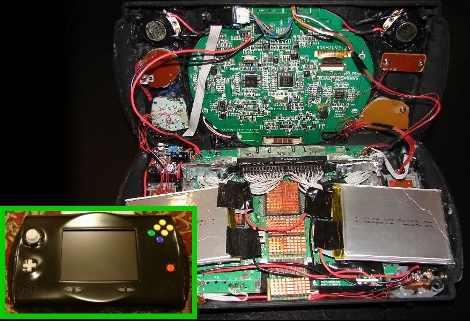
[Hailrazer] built a handheld GameCube so he could take his gaming with him. The final product is quite nice, providing a large display and about 3 hours of play time on the lithium polymer batteries.

Starting with the case from a Kidz Delight Datamax game, he used Bondo ABS cement and plastic bumper filler to alter the case but still provide a professional look. The display is a five-inch PlayStation One LCD Screen from which he also incorporated the speakers. At least four controllers were cannibalized for use as the buttons, sticks, triggers, and directional pad. Our favorite feature is the totally exposed optical head mounted on the back.

We’ve embedded video as well as a picture of the optical drive after the break. This goes so far beyond just making the GameCube an all-in-one system. If you like this build, check out the Nintendo 64 and Dreamcast mods on [Hailrazer’s] YouTube channel.

Continue reading “Gamecube To Go”

Make Your Own SNES Games With Developer Cartridge

Have you always wished that you could develop games for the Super Nintendo but couldn’t because you were only 4 years old when it was released in 1990? Here’s a second chance. [Max] and his team have created a SNES developer’s cartridge that allows you to load your own code, run it on the SNES, and debug as needed. At its core is an Atmel AVR ATmega644 that is running a boot loader, allowing for firmware updates via USB. Once the system is powered on, ROM code is sent over USB to the 16 megabits of onboard SRAM. A debug terminal can be connected with an RS232 converter, providing status information and allowing some register manipulation.

We can believe there are a few hardcore SNES fans out there who will take the time to write custom code. We could also see this being used for the purposes of SNES sythesized music. But is there a wide demand for this type of hardware? If you’ve ever looked into developing for the SNES, let us know in the comments.

Bluetooth Cartridge For Nintendo DS

bluetooth-cartridge-nintendo-ds

We’ve received tips from a few different people about a new Bluetooth module that connects as a game cartridge for the Nintendo DS. This is a homebrew solution and not an official Nintendo add-on. The cartridge houses an ATmega168 microcontroller which provides the interface between the DS and a Roving Networks RN-41 bluetooth module.

They’ve provided a schematic for the device but we didn’t see any board artwork or pictures of the internals so you’re on your own for board layout. The libraries needed to use the bluetooth connection with homebrew software are up for download. This should provide a nice way to use the DS with a Bluetooth GPS module, or perhaps as a discrete Bluetooth sniffer and spoofer.

NES Processor Cloned On A FPGA

nes-on-an-fpga

[Bradley] decided to tackle the challenge to recreate the original Nintendo Entertainment System’s processor in a Field Programmable Gate Array. Say what? The original NES is a Legacy System, still used but no longer manufactured. If a system breaks, it becomes more and more difficult to repair or find replacements parts as time passes. By using a programmable integrated circuit such as a CPLD or a FPGA to clone the functionality of the original hardware, legacy systems can live on long after the original hardware has given up the ghost.

It took [Bradley] about a year to fully implement the NES processor as part of his Master’s project at Bradley University. He used what was known about the processor combined with some detective work with logic probes along the way. The programming was done in VHDL and those files are available for download (click on Documentation).

With the ubiquity of NES emulators on every device known to man you probably won’t be replicating this unless you want a reason to play with a FPGA. What interests us is the hardware solution this type of work provides for obsolete hardware that still serves a useful purpose. If you’ve used a FPGA or similar device to keep an old system running, let us know about it in the comments.