Avoid Missed Connections With The Connectorbook’s Web Tool

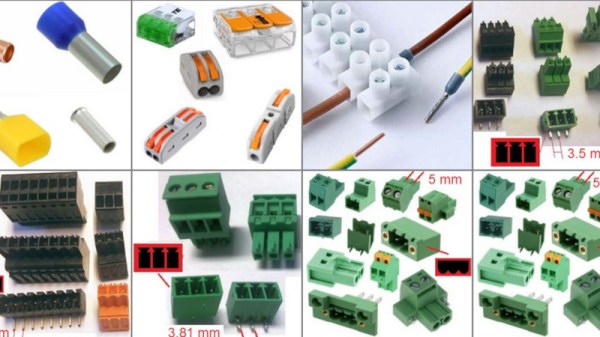
Connectors are wonderful and terrible things. Wonderful, in that splicing wires every time you need to disassemble something is really, really annoying. Terrible in that it can be just such an incredible pain-in-the-assets to find the right one if you’re stuck with just a male or a female for some unfortunate reason. We’ve all been there, and all spent time growing increasingly frustrated poring over the DigiKey catalog (or its local equivalent) trying to figure out what the heck we were dealing with. That’s why [Davide Andrea]’s The Connectorbook exists–and even better, the free web service they call Identiconn.

The tool isn’t super new–the Wayback Machine has snapshots of it dating back to 2021–but it’s still very much worth highlighting. There’s a “quick pick” option that lets you narrow it down with photos, or if you want to get specific there are dozens of filters to try and help you find your exact part. You can filter based on everything from the pitch and geometry of the connectors, to how it terminates, attachments, latches, et cetera. While we can’t guarantee the database is fully exhaustive, it looks pretty darn big, and using it is going to be a lot less exhausting than pouring through catalogs hoping that particular vendor or manufacturer lists the matching part.

Some might argue that this database is not a hack, but it’s certainly going to enable a certain amount of hacking. That’s why we’re grateful to [Alex] for the tip! If you’ve got a know tool you think we all should know about that hasn’t been shared yet, please let us know.


The Great ADS1115 Pricing And Sourcing Mystery

The AdaFruit ADS1115 board hooked up for testing. (Credit: James Bowman)

Following up on the recent test of a set of purported ADS1115 ADCs sourced from Amazon [James Bowman] didn’t just test a genuine Ti part, but also dug into some of the questions that came up after the first article. As expected, the AdaFruit board featuring a presumed genuine Ti ADS1115 part performed very well, even performing significantly better on the tested parameters than the datasheet guarantees.

Thus we can confirm that when you get the genuine Ti part, you can expect very good and reliable performance for your ADC purposes. Which leaves the unaddressed questions about what these cheapo Amazon-sourced ADS1115 ICs are, and how it can be that LCSC has what should be the same parts for so much cheaper than US distributors?

As far as LCSC pricing is concerned, these are likely to be genuine parts, but also the subject of what is known as price discrimination. This involves pricing the same product differently depending on the targeted market segment, with e.g. Digikey customers assumed to be okay with paying more to get the brand name assurance and other assumed perks. Continue reading “The Great ADS1115 Pricing And Sourcing Mystery”

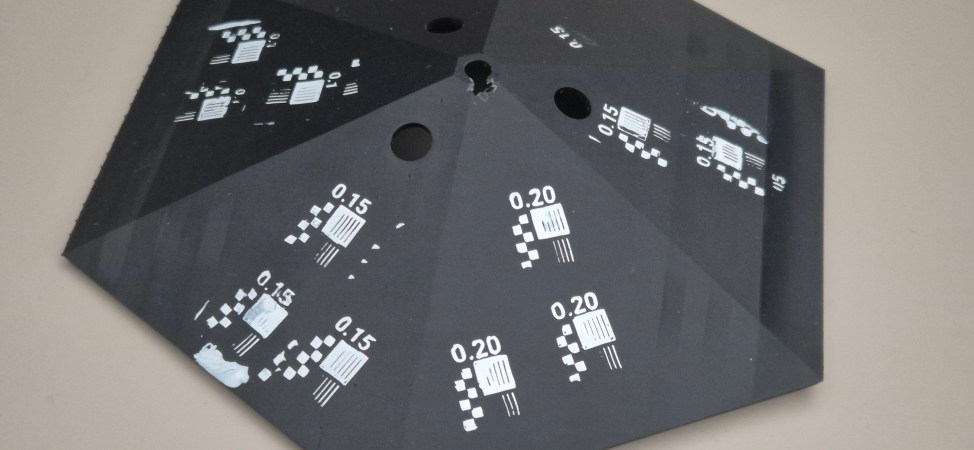
These are test stampings-- the final product looks a lot better.

2025 Component Abuse Challenge: Nail Your Next Decal

One of the hardest parts of a project — assuming it makes it that far — is finishing it up in an aesthetically pleasing manner. As they say, the devil is in the details, wearing Prada. Apparently the devil also has an excellent manicure, because [Tamas Feher] has come up with a way to introduce incredibly detailed decals (down to 0.1 mm) in cheap, repeatable fashion, using a technique borrowed from the local nail salon. 

The end result can look quite a bit better than the test piece above.

For those who aren’t in to nail art (which, statistically speaking, is likely to be most of you) there is a common “stamping” technique for putting details onto human fingernails. Nail polish is first applied to voids on a stencil-like plate, then picked up by a smooth silicone stamper, which is then pressed against the nail, reproducing the image that was on the stencil. If that’s clear as mud, there’s a quick demo video embedded bellow.

There’s a common industrial technique that works the same way, which is actually where [Tamas] got the idea. For nail salons and at-home use, there are a huge variety of these stencils commercially available for nail art, but that doesn’t mean you’re likely to find what you want for your project’s front panel.

[Tamas] points out that by using a resin printer to produce the stencil plate, any arbitrary text or symbol can be used. Your logo, labels, whatever. By printing flat to the build plate, you can take advantage of the full resolution of the resin printer — even an older 2 K model would more than suffice here, while higher res like the new 16 K models become the definition of overkill. The prints go quick, as they don’t need any structural thickness: just enough to hold together coming off of the plate, plus enough extra to hold your designs at a 0.15 mm inset. That doesn’t seem very thick, but remember that this only has to hold enough nail polish to be picked up by the stamper.

[Tamas] cautions you have to work fast, as the thin layer of nail polish picked up by the stamper can dry in seconds. You’ll want plenty of nail polish remover (or plain acetone) on hand to clean the stamper once you’ve finished, as well as your stencil. [Tamas] cautions you’ll want to clean it immediately if you ever want to use it again. Good to know.

While this is going outside of the nail art kit’s comfort zone, it might not quite be abuse. It is however a very useful technique to add to our ever-growing quiver of how to make front panels. Besides, we don’t specify you have to literally make components suffer; we just want to see what wild and wonderful substitutions and improvisations you all come up with.

Continue reading “2025 Component Abuse Challenge: Nail Your Next Decal”

Blinking An LED With A Single Transistor

Let’s say you want to blink an LED. You might grab an Arduino and run the Blink sketch, or you might lace up a few components to a 555. But you needn’t go so fancy! [The Design Graveyard] explains how this same effect can be achieved with a single transistor.

The circuit in question is rather odd at first blush. The BC547 NPN transistor is hooked up between an LED and a resistor leading to a 12V DC line, with a capacitor across the emitter and collector. Meanwhile, the base is connected to… nothing! It’s just free-floating in the universe of its own accord. You might expect this circuit to do nothing at all, but if you power it up, the LED will actually start to flash.

The mechanism at play is relatively simple. The capacitor charges to 12 volts via the resistor. At this point, the transistor, which is effectively just acting as a poor diode in this case, undergoes avalanche breakdown at about 8.5 to 9 volts, and starts conducting. This causes the capacitor to discharge via the LED, until the voltage gets low enough that the transistor stops conducting once again. Then, the capacitor begins to charge back up, and the cycle begins again.

It’s a weird way to flash an LED, and it’s not really the normal way to use a transistor—you’re very much running it out of spec. Regardless, it does work for a time! We’ve looked at similar circuits before too. Video after the break.

Continue reading “Blinking An LED With A Single Transistor”

2025 Component Abuse Challenge: Conductive Filament Makes A Meltable Fuse

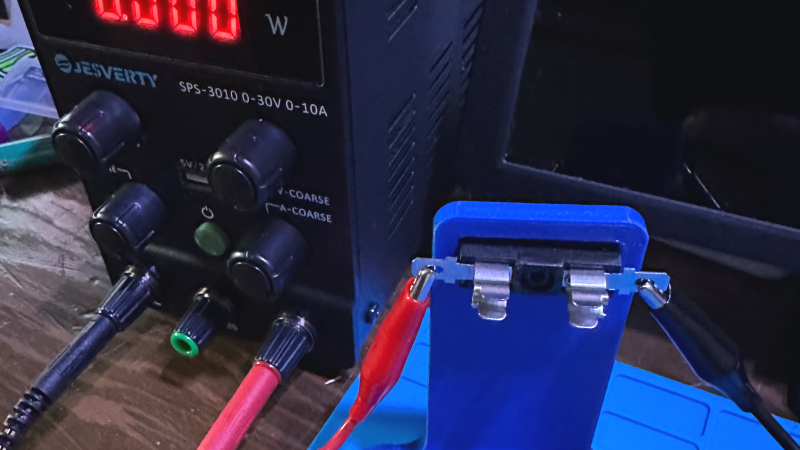
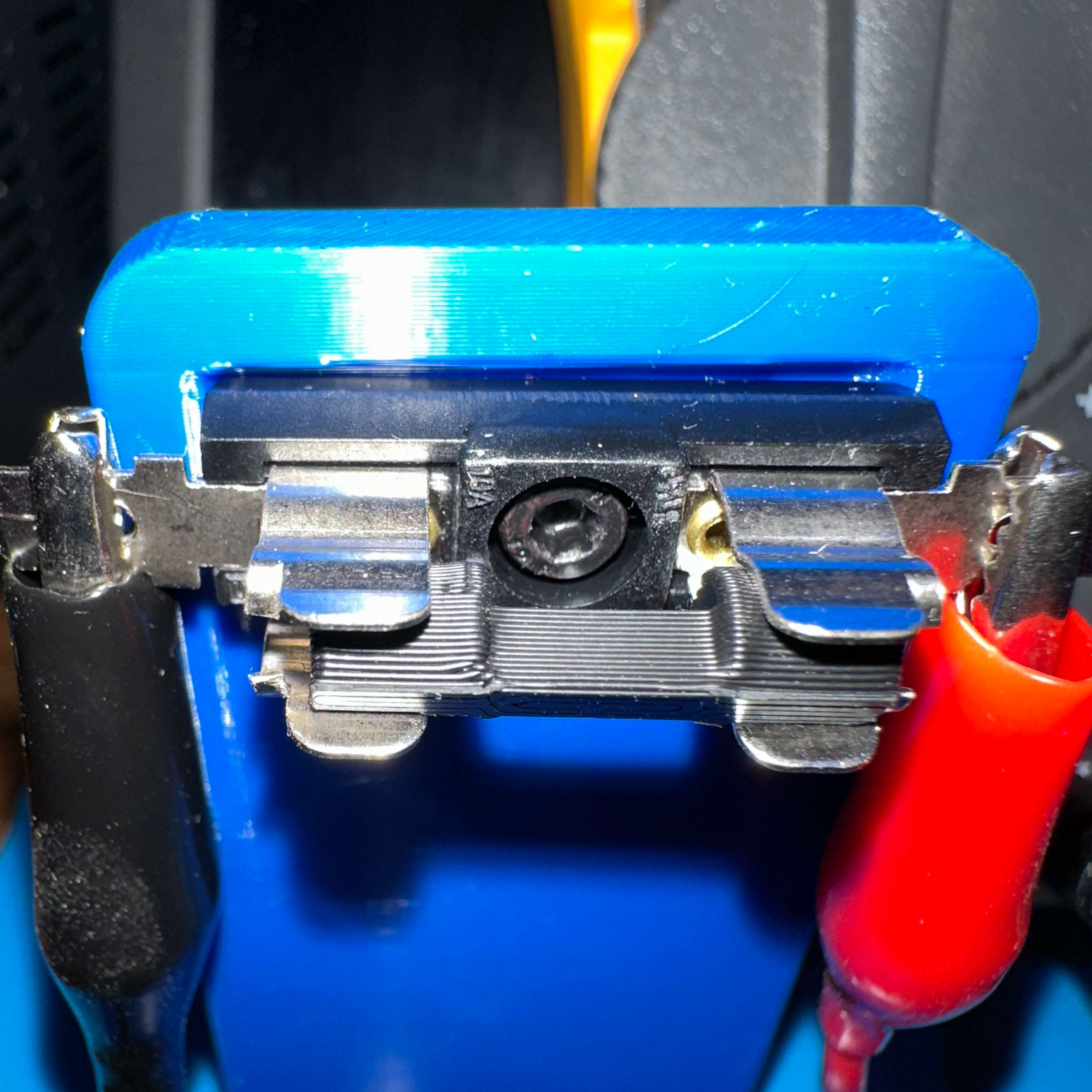
Everything is a fuse if you run enough current through it. Or at least [JohnsonFarms.us] seems to think so, which has led him to design 3D-printed fuses made from conductive PLA filament.

Conductive filament is a meltable resistor, which, if one squints hard enough, is basically a fuse.

In theory a 3D printed fuse works the same as a normal one: excessive current draw will cause the conductive plastic to briefly become a heater, causing it to self-destruct and break the electrical connection. There’s a risk of melted plastic and perhaps a nonzero combustion risk, but [JohnsonFarms.us] is less interested in whether this is a good idea and more interested in whether it can work at all, and with what degree of predictability and/or regret.

His experiments so far show that printed fuses are essentially meltable resistors with values between 300 Ω and 1250 Ω, depending on shape. What it takes to bring those to roughly 60 °C, where PLA softens, and around 150 °C, where PLA melts, is next on the to-do list.

Whatever conclusions are reached, it is interesting to think of conductive filament as a meltable resistor, and ponder what unusual applications that might allow.

Most conductive filaments have high resistance, but not all. Some, like Electrifi by Multi3D, have extremely low resistance and were used in a project that made 3d-printed logic gates.

2025 Component Abuse Challenge: Boosting Voltage With Just A Wire

Switching power supplies are familiar to Hackaday readers, whether they have a fairly conventional transformer, are a buck, a boost, or a flyback design. There’s nearly always an inductor involved, whose rapid change in magnetic flux is harnessed to do voltage magic. [Craig D] has made a switching voltage booster that doesn’t use an inductor, instead it’s using a length of conductor, and no, it’s not using the inductance of that conductor as a store of magnetic flux.

Instead it’s making clever use of reflected short pulses in a transmission line for its operation. Electronics students learn all about this in an experiment in which they fire pulses down a length of coax cable and observe their reflections on an oscilloscope, and his circuit is very similar but with careful selection of pulse timing. The idea is that instead of reflected pulses canceling out, they arrive back at the start of the conductor just in time to meet a pulse transition. This causes them to add rather than subtract, and the resulting higher voltage pulse sets off down the conductor again to repeat the process. We can understand the description, but this is evidently one to sit down at the bench and experiment with to fully get to grips with.

Continue reading “2025 Component Abuse Challenge: Boosting Voltage With Just A Wire”

2025 Component Abuse Challenge: An LED As A Light Dependent Capacitor

The function of an LED is to emit light when the device is forward biased within its operating range, and it’s known by most people that an LED can also operate as a photodiode. Perhaps some readers are also aware that a reverse biased LED also has a significant capacitance, to the extent that they can be used in some RF circuits in the place of a varicap diode. But how do those two unintentional properties of an LED collide? As it turns out, an LED can also behave as a light dependent capacitor. [Bornach] has done just that, and created a light dependent sawtooth oscillator.

The idea is simple enough, there is a capacitance between the two sides of the depletion zone in a reverse biased diode, and since an LED is designed such that its junction is exposed to the external light, any photons which hit it will change the charge on the junction. Since the size of the depletion zone and thus the capacitance is dependent on the voltage and thus the charge, incoming light can thus change the capacitance.

The circuit is a straightforward enough sawtooth oscillator using an op-amp with a diode in its feedback loop, but where we might expect to find a capacitor to ground on the input, we find our reverse biased LED. The video below the break shows it in operation, and it certainly works. There’s an interesting point here in that and LED in this mode is suggested as an alternative to a cadmium sulphide LDR, and it’s certainly quicker responding. We feel duty bound to remind readers that using the LED as a photodiode instead is likely to be a bit simpler.

This project is part of the Hackaday Component Abuse Challenge, in which competitors take humble parts and push them into applications they were never intended for. You still have time to submit your own work, so give it a go!

Continue reading “2025 Component Abuse Challenge: An LED As A Light Dependent Capacitor”