Supercon 2022: Andy Geppert Is Bringing Core Memory Back

Many Hackaday readers will be familiar with the term “core memory”, likely thanks to its close association with the Apollo Guidance Computer. But knowing that the technology existed at one point and actually understanding how it worked is another thing entirely. It’s a bit like electronic equivalent to the butter churn — you’ve heard of it, you could probably even identify an image of one — but should somebody hand you one and ask you to operate it, the result probably won’t be too appetizing.

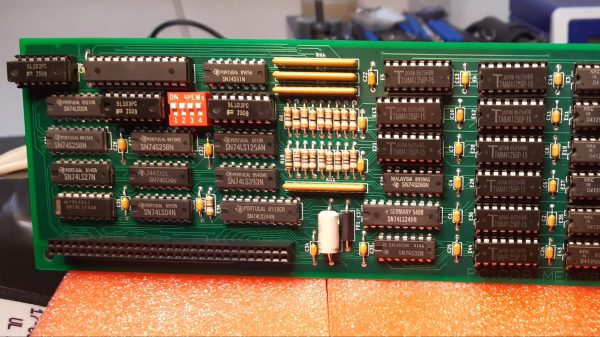
That’s where Andy Geppert comes in. He’s turned his own personal interest into magnetic core memory into a quest to introduce this fascinating technology to a whole new generation thanks to some modern enhancements through his Core64 project. By mating the antiquated storage technology with a modern microcontroller and LEDs, it’s transformed into an interactive visual experience. Against all odds, he’s managed to turned a technology that helped put boots on the Moon half a century ago into a gadget that fascinates both young and old.

In this talk at the 2022 Hackaday Supercon, Andy first talks the audience through the basics of magnetic core memory as it was originally implemented. From there, he explains the chain of events that lead to the development of the Core64 project, and talks a bit about where he hopes it can go in the future.

Continue reading “Supercon 2022: Andy Geppert Is Bringing Core Memory Back”

MIDI Interface For NeXTcube Plugs Into The Past

[Joren] recently did some work as part of an electronic music heritage project, and restored an 80s-era NeXTcube workstation complete with vintage sound card, setting it up with a copy of MAX, a graphical music programming environment. But there was one piece missing: MIDI. [Joren] didn’t let that stop him, and successfully created hardware to allow MIDI input and output.

The new panel provides all the connectors necessary to interface with either classic MIDI devices, or MIDI over USB (where it appears as a USB MIDI device to any modern OS.)

Interestingly, the soundcard for the NeXTcube has an RS-422 serial port and some 8-pin mini DIN connectors. They are not compatible with standard MIDI signals, but they’re not far off, either.

To solve this, [Joren] used a Teensy developer board to act as an interface between classic MIDI devices like keyboards or synthesizers (or even not-so-common ones like this strange instrument) while also being able to accommodate modern MIDI over USB connections thanks to the Teensy’s USB MIDI functionality.

A metal enclosure with a 3D-printed panel rounds out the device, restoring a critical piece of functionality to the electronic music-oriented workstation.

MIDI as a protocol isn’t technically limited to musical applications, though that’s one place it shines. And just in case it comes in handy someday, you can send MIDI over I2C if you really need to.

The MOS CIA Lives On, In 74HCT

It’s always pleasing to see a project we covered in its early stages reach maturity, so were very happy to bring you an update on [Daniel Molina]’s 74HCT6526. It’s a long-running effort to produce in 74 logic a faithful replica of the MOS Technologies CIA, the integrated I/O and timer chip found in so many of the 1980s Commodore machines. When we first covered it there was only one PCB, now the project has grown to a stack of three, with the remaining functions intended to fit on two more boards.

It was very common at the time for chips such as the CIA to integrate a set of common 8-bit peripherals onto one piece of silicon, both in general purpose with almost all functions of the original now implemented. hips and in more manufacturer specific parts such as this one. A project like this one is valuable because it provides a dive into the now less-common  world of interfacing directly to a microprocessor data and address line. It’s unlikely that many Commodore 64s will end up with this stack of boards inside them, but it’s not impossible the design may help a few old machines when put on an FPGA.

Meanwhile, remember it’s not the only custom 1980s home computer chip replaced with 74 logic.

New DOS PCs, In 2023?

It’s not likely that we’ll talk about a new PC here at Hackaday because where’s the news in yet another commodity computer? But today along comes not one but two new PCs courtesy of the ever bounteous hall of wonders at AliExpress, that are unusual enough to take a look at. If you have around $250 to spare, you can have a brand new, made in 2023, 80386sx plamtop PC capable of running Windows 95, or an 8088 laptop for DOS. Just what on earth is going on?

Continue reading “New DOS PCs, In 2023?”

A DR-DOS console showing the IDLE command

Missing DR-DOS Power Management Source Code Found In Patent

Modern processors come with all kinds of power management features, which you don’t typically notice as a user until you start a heavy program and hear the CPU fan spin up. Back in the early 1990s however, power management was largely unheard of, meaning that a CPU with nothing to do would run through an idle loop that dissipated about as much power as a real computing task. [Michal Necasek] noticed this while experimenting with DR-DOS 6.0 in a virtual machine – his laptop fan would start running on full blast whenever he opened the VM. His search for a solution to this annoyance led him down a fascinating journey into the intricacies of DOS power management.

As it turned out, DR-DOS 6.0 does have functionality built in for putting the CPU in power saving mode when it’s idle. This feature is not complete, however: Digital Research required each computer manufacturer to develop an IDLE driver customized to their specific hardware platform in order to enable power management. Sadly, no manufacturer ever bothered to do so, leaving [Michal] with no option other than writing a driver himself. While there was some documentation available, it didn’t include any example code or sufficient detail to write a driver from scratch.

A snippet of x86 assembly code found in a patentWhat it did include was a reference to U.S. Patent No. 5,355,501. Normally this sort of information is of interest only to those planning to sell a competing system, but this specific patent happens to include dozens of pages of well-documented but poorly-scanned x86 assembly code, including source code for a basic IDLE86.SYS driver. As [Michal] wasn’t looking forward to chasing bugs caused by OCR errors, he simply copied the source code by hand, then ran it through an assembler. The end result was a working IDLE driver, which is now available for download from his website.

[Michal]’s blog post also includes lots of details on early power saving implementations, including all the DOS interrupt calls involved in the process. Patents might seem boring in contrast, but they sometimes contain surprising amounts of usable information. You might find enough details to reverse-engineer a wireless protocol, or even to help track down an obscure instrument’s original designer.

WordStar Reborn

Wordstar was the word processor that helped sell the personal computer. At one time, it was ubiquitous, and many authors had a hard time giving it up. Some, like George R. R. Martin, apparently are still refusing to give it up. But most of us have moved on. Thanks to an open-source clone, WordTsar, you may not have to. This is a modern interpretation of our old friend.

Programmers that write were especially fond of WordStar since it had a non-document mode and was often the best text editor you had available for writing code. Being able to do your documentation without switching brain gears is useful, too. Touch typists love the efficiency of easy control of things without resorting to cursor keys or a mouse — the same thing vi and emacs fans enjoy but in a different way.

The software runs on multiple platforms and has some new features. Installation on Linux is easy because it is packaged in an AppImage file. Of course, you can also fire up your best CP/M machine, replica, or emulation and run the real WordStar, but — honestly — WordTsar seems more practical if you wanted to go back to using this kind of wordprocessor or editor for everyday use.

Of course, some word processors were actual hardware. If you want some cheap CP/M hardware, that’s easy enough, too.

VCF East 2023: Alan Wolke On His Passion For Tech

If you’re one of the more than 180,000 subscribers to [Alan Wolke]’s YouTube channel W2AEW, you’ll know he’s a lover of old test gear and ham radio hardware. You may have followed one of his tutorials, or referenced his work while repairing or upgrading your own equipment. But when we got a chance to talk to him one-on-one during Vintage Computer Festival East 2023, we were treated to a more personal look at the man himself.

Like many of us, [Alan] says he got his start with electronics at a young age simply by taking things apart and trying to put them back together again. From there he got a job in a TV repair shop during high school, where he was able to hone his natural curiosity into a marketable skill. His career took him through several of tech companies, but he ultimately ended up in an engineering role at Tektronix, a position he’s held for nearly 20 years.

Despite continuing to stay on the cutting edge, it’s no surprise that he still has a certain attraction to the technology from his youth. But it’s more than simple nostalgia — he points out that vintage hardware is generally easier to service than modern gear. As many of his own videos show, there was something of a technological “sweet spot” around the mid-20th century to the 1980s or so; where you could expect to not only have schematics available, but the design and construction of hardware was such that you could still reason your way through it using basic troubleshooting principles.

As for being a ham, [Alan] thinks it’s a great way for get an even deeper understanding of technology. He says that if you’re interested in learning how electronics work, repairing and upgrading old radio hardware is a great way to flex your mental muscles. But at the same time, being a ham isn’t limited to dusting off war-surplus radios that were built before you were born. There’s plenty of ways to mix in modern technology, from digital modes to receiving signals from satellites using a software-defined radio.

[Alan] was just one of the fascinating people we got a chance to speak with during our visit to the 2023 Vintage Computer Festival East. We’ve still got more interviews to come, but in the meantime, you can check out our previous coverage of this incredible retrocomputing event.

Continue reading “VCF East 2023: Alan Wolke On His Passion For Tech”