App Detects Parkinsons Disease And COVID-19 Via Audio

One of the challenges of diagnosing diseases is identifying them early. At this stage, signs may be vague or confusing, or difficult to identify. Early diagnosis is often tied to the best possible treatment outcomes, so there’s plenty of incentives to improve methods in this way.

A new voice-based method of diagnosing disease could prove fruitful in this regard. It relies on machine learning techniques to detect when patients may be suffering from certain conditions.

Continue reading “App Detects Parkinsons Disease And COVID-19 Via Audio”

Tesla Coil Makes Sodium Plasma

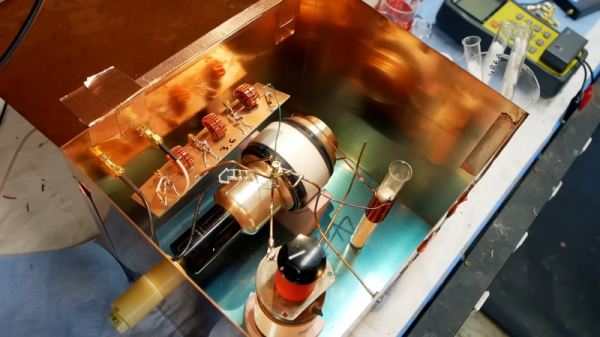
Looking for a neat trick to do with your Tesla coil? [The Action Lab] uses his coil to make a metal plasma — in particular, sodium. You can see the results in the video below.

To create a metal plasma, you need a metal vapor and sodium can create a vapor at a relatively low temperature, especially in a vacuum. The resulting glow is pretty to look at, but you will need a bit of lab gear to pull it off.

Continue reading “Tesla Coil Makes Sodium Plasma”

Honey, We Shrunk The Nuclear Reactor

[Power Engineering] took a trip to the Westinghouse facility that provides maintenance for nuclear reactors. The research division there has a new microreactor called eVinci and — according to the company — it is a disruptor. Technically, the device is a heat pipe-based passive cooling design that can generate 5 MW of electricity or 13 MW of heat from a 15 MW heater core. You can see a video about the device below.

The company says its initial targets are remote areas like mines that usually depend on diesel generators. Hundreds of passive heat pipes inside a graphite core which contains TRISO (tristructural isotropic) fuel pellets. The heat pipes allow efficient transfer of thermal energy with no pumps.

Continue reading “Honey, We Shrunk The Nuclear Reactor”

Racing Cars On A PCB

Carl Friedrich Gauss was, to put it mildly, a polymath responsible for a large percentage of the things we take for granted in the modern world. As a physicist and mathematician he pioneered several fields of study including within the field of magnetism. But since he died decades before the first car was built, it’s unlikely he could have imagined this creation, a magnetic slot-car race track called the Gauss Speedway by [Jeff McBride], which bears the name of the famous scientist.

The Gauss Speedway takes its inspiration from a recent development in robotics, where many small robots can travel around a large area with the help of circuit traces integrated into their operating area. With the right current applied to these traces, magnetic fields are generated which propel the robots. [Jeff] wanted to build something similar, integrated into a printed circuit board directly, and came up with the slot car idea. The small cars have tiny magnets in them which interact with the traces in the PCB, allowing the cars to move with high precision around the track. He did abandon the traditional slot car controller in favor of a push-button style one directly on the PCB too, which means everything is completely integrated.

While this was more of a demonstration or proof-of-concept, some of the features of this style of robot can be seen in this video, which shows them moving extremely rapidly with high precision, on uneven surfaces, or even up walls. Magnetic robots like these are seeing quite a renaissance, and we’ve even seen some that use magnetism to shape-shift.

Continue reading “Racing Cars On A PCB”

Fuel Cell Catalyst: Less Is More

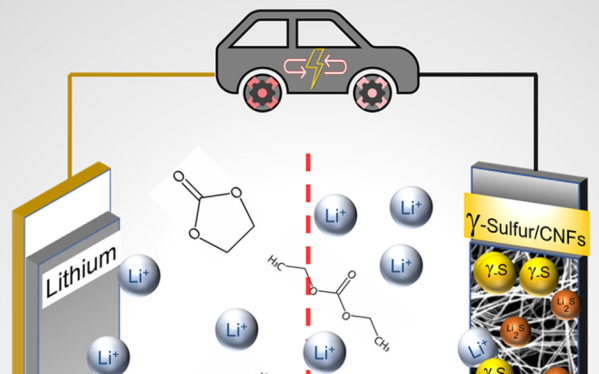
A fuel cell is almost like a battery that has replenishable fuel. Instead of charging a battery with an electric current, you recharge a fuel cell with something like hydrogen or you simply consume it from a tank much as an internal combustion engine consumes gasoline. However, fuel cells usually use a catalyst — it isn’t consumed in the reaction, but it is necessary and many fuel cells use platinum as a catalyst which is expensive. But what if you could use less catalyst and get a better result? That’s what researchers in Canada and the US are claiming in a recent paper. The key isn’t how much catalyst they are using, but rather the shape of the catalyst.

Of course, everyone wants to use less of the expensive catalyst but polymer electrolyte fuel cells have had a particular problem where reducing the amount of catalyst used causes a disproportionate drop in cell performance. This new approach uses spherical catalyst support that improves the distribution and utilization of the catalyst.

Continue reading “Fuel Cell Catalyst: Less Is More”

New Metric Prefixes Get Bigger And Smaller

It always fascinates us that every single thing that is made had to be designed by someone. Even something as simple as a bag and box that holds cereal. Someone had to work out the dimensions, the materials, the printing on it, and assign it a UPC code. Those people aren’t always engineers, but someone has to think it out no matter how mundane it is before it can be made. But what about the terms we use to express things? Someone has to work those out, too. In the case of metric prefixes like kilo, mega, and pico, it is apparently the General Conference on Weights and Measures that recently had its 27th session. As a result of that, we have four more metric prefixes to learn: ronna, quetta, ronto, and quecto.

Apparently, the new prefixes are to accommodate “big data” which is rapidly producing more data than there are atoms in the Universe. There were actually proposed earlier in a slightly different form but accepted at the conference. Apparently quecca is too close to a Portuguese swear word. So what do these actually mean? A QB (quettabyte) would be 1030 bytes while an RB (ronnabyte) is only 1027.  So 1 QB would be 1,000,000 yottabytes (YB) the previous top of the scale.

Continue reading “New Metric Prefixes Get Bigger And Smaller”

FDA’s Approval Of Cell Culture Chicken: The Rise Of Fresh Meat Without The Animal?

On November 14th of this year, the FDA cleared the path for Upside Foods to sell its cell-culture-based chicken products within the US. This is the first product of its kind to be cleared for commercial sale within the Americas, with only Singapore having previously cleared a similar product for sale, back in December of 2020. This latter product comes courtesy of another California start-up called Eat Just.

Since that initial approval in Singapore, Eat Just has begun to set up a 2,800 square meter (~30,000 square feet) production facility in Singapore that is scheduled to begin producing thousands of kilograms of slaughter-free meat starting in the first quarter of 2023. This would make it the top-runner in the cultured meat industry, which to this point has seen dozens of start-ups, but precious few actual products for sale.

With CEO Josh Tetrick of Eat Just projecting price equality between their cultured meat and meat from animals by 2030, could the FDA’s approval herald the dawn of slaughter-free meat? There are obviously still hurdles, but as we’ll see, the idea is not nearly as far-fetched as one might think.

Continue reading “FDA’s Approval Of Cell Culture Chicken: The Rise Of Fresh Meat Without The Animal?”