When you think of a robot, you probably don’t think of a ball of underwater algae. But a team of university researchers used a 3D-printed exoskeleton and a ball of marimo algae to produce a moving underwater sensor platform. It is really at a proof-of-concept stage, but it seems as though it would be possible to make practical use of the technology.
Marimo are relatively rare balls of algae that occur in some parts of the world. A robot powered by algae runs on sunlight and could be electromagnetically quiet.
Humanity has been wondering about whether life exists beyond our little backwater planet for so long that we’ve developed a kind of cultural bias as to how the answer to this central question will be revealed. Most of us probably imagine that NASA or some other space agency will schedule a press conference, an assembled panel of scientific luminaries will announce the findings, and newspapers around the world will blare “WE ARE NOT ALONE!” headlines. We’ve all seen that movie before, so that’s the way it has to be, right?
Probably not. Short of an improbable event like an alien spacecraft landing while a Google Street View car was driving by or receiving an unambiguously intelligent radio message from the stars, the conclusion that life exists now or once did outside our particular gravity well is likely to be reached in a piecewise process, an accretion of evidence built up over a long time until on balance, the only reasonable conclusion is that we are not alone. And that’s exactly what the announcement at the end of last year that the Mars rover Perseverance had discovered evidence of organic molecules in the rocks of Jezero crater was — another piece of the puzzle, and another step toward answering the fundamental question of the uniqueness of life.
Discovering organic molecules on Mars is far from proof that life once existed there. But it’s a step on the way, as well as a great excuse to look into the scientific principles and engineering of the instruments that made this discovery possible — the whimsically named SHERLOC and WATSON.
Chinese researchers are reporting that applying an electric field to pea plants increased yields. This process — known as electroculture — has been tested multiple times, but in each case there are irregularities in the scientific process, so there is still an opportunity for controlled research to produce meaningful data.
This recent research used two plots of peas planted from the same pods. The plants were tended identically except one plot was stimulated by an electric field. The yield on the stimulated plot was about 20% more than the control plot.
The actual paper is paywalled in the journal Nature Food, but the idea seems simple enough. If you search for the topic, you’ll find there have been other studies with similar findings. There are also anecdotal reports of electrical plant stimulation going back to 1746.
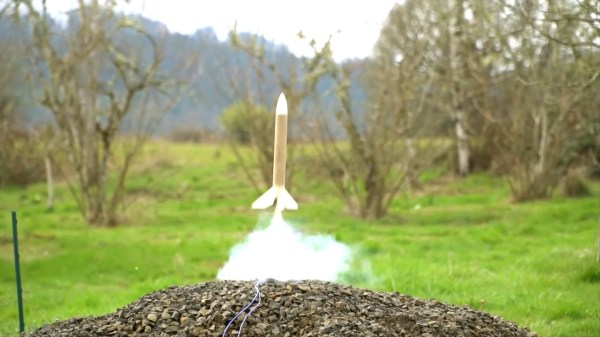
Imagine for a moment that you are a member of an early Mars colony. You’re stranded, and the only way to get a message home is to launch a radio well above the surface. To make matters worse, you’ve got no rockets! It was this thought experiment that has motivated [Thoisoi2] to experiment with making a rocket motor using only ingredients and methods available to your average Martian colonist. The methods he has chosen can be seen in the video below the break.
If you skipped Rocketry 101, a quick refresher might help: Rockets work by burning a fuel in an enclosed chamber and then expelling it at high speed in one direction. To get the fuel to burn more quickly (and therefore adding more oomph to the angry end) a complement to the fuel called an Oxidizer is added. It serves to create an oxygen rich environment for the fuel to burn in. It’s the same reason a oxy-propane torch burns hotter than propane by itself.
The Sugar Powered Rocket Motor says “Boom!”
Firstly, a stranded Martian would need rocket fuel. If you recall the 1999 movie October Sky, four high school kids used table sugar as their fuel. You might also recall that those tended to get all explody. This volatility caused [Thoisoi2] to eschew sugar as a fuel in favor of a fuel that would also be available to any Martian colonist but be far less likely to cause Rapid Unplanned Disassembly.
What about the oxidizer? In October Sky, the boys experimented with Potassium Chlorate. This is commonly used in rockets but may be more difficult to obtain for your average Mars colonist. But, it turns out that Potassium Chlorate and Sodium Chlorate which can be prepared from table salt will work equally. It’s quite a bit more involved than that however.
Simply adding salt and fuel does not a rocket motor make. The nuances, the science, and the chemistry are all laid out in the wonderful video that [Thoisoi2] has put together, and we are sure you’ll enjoy it as much as we did.
You’ll also get to find out if our stranded Martian ever makes it home or if his potato farming was for naught.
We’d also like to echo the warning in the video: This is an experiment that is pretty dangerous, so don’t try this at home! Definitely try it at somebody else’s house first. Or on the surface of Mars.
Photovoltaic solar panels are wonderful things, capable of capturing mere light and turning it into useful electricity. They’re often installed on residential and commercial rooftops for offsetting energy use at the source.
However, for grid-scale generation, they’re usually deployed in huge farms on tracts of land in areas that receive plenty of direct sunlight. These requirements can often put solar farms in conflict with farm-farms — the sunlight that is good for solar panels is also good for growing plants, specifically those we grow for food.
One of the more interesting ideas, however, is to create solar arrays that float on water. Unlike some of the wackier ideas out there, this one comes with some genuinely interesting engineering benefits, too!
If you want to measure radioactivity, nothing really beats a Geiger counter: compact, rugged, and reasonably easy to use, they’re by far the most commonly used tool to detect ionizing radiation. However, several other methods have been used in the past, and while they may not be very practical today, recreating them can make for an interesting experiment.
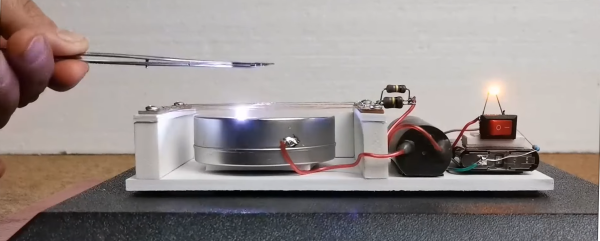
[Mirko Pavleski] used easily obtainable components to build one such device known as an alpha radiation spark detector. Invented in 1945, a spark detector contains a strong electric field into which discharges are triggered by ionizing radiation. Unlike a Geiger-Müller tube, it uses regular air, which makes it sensitive only to alpha radiation; beta and gamma rays don’t cause enough ionization at ambient pressure. Fortunately, alpha radiation is the main type emitted by the americium tablets found in old smoke detectors, so a usable source shouldn’t be too hard to find.
The construction of this device is very simple: a few thin copper wires are suspended above a round metal can, while a cheap high-voltage source provides a strong electric field between them. Sparks fly from the wires to the can when an alpha source is brought nearby; a series resistor limits the current to ensure the wires don’t overheat and melt.
Although not really practical as a measurement device, the spark detector can nevertheless be used to perform simple experiments with radioactivity. As an example, [Mirko] demonstrates in the video embedded below that alpha particles are stopped by a piece of paper and therefore present no immediate danger to humans. The high voltage present in the device does however, so care must be taken with the detector more than with the radiation source.
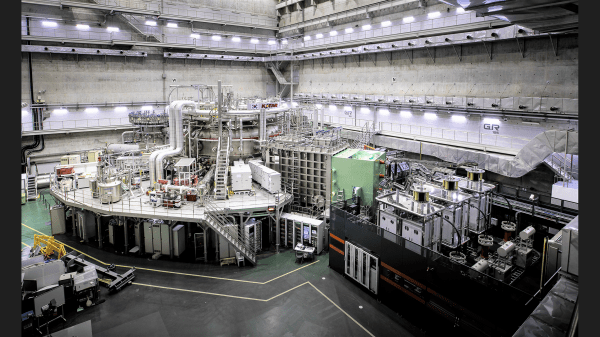
The news reports seem to be using Celsius and Kelvins interchangeably, but at millions of degrees, that’s probably much smaller than measurement error. These various milestones are but stepping stones along the path to create a demonstration large fusion reactor, the goal of the global ITER mega-project. Currently China, the EU including Switzerland and the UK, India, Japan, Russia, South Korea, and the United States are members of ITER, and Australia, Canada, Kazakhstan, and Thailand are participants. The ITER demonstration reactor is being constructed at the Cadarache facility located 60 km northeast of Marseille, France, and is on track for commissioning phase to begin in 2025, going operational ten years later.