A row of electromagnetic coils fastened to a metal track

Propel Paper Planes, Bisect Sausages With Electromagnets

Are you still launching paper airplanes using your hands? That’s like a baby’s toy! [Tom Stanton] and his homebrew electromagnetic rail launcher are sure to bring your paper airplane game into the 21st century.

To be fair, these kinds of linear motors can be used for more than just launching paper airplanes, and can already be found in niche industrial applications, mass transportation systems and roller coasters. And, yes, the potential to leverage electromagnetism in the theater of war is also being vigorously explored by many of the world’s superpowers in the form of Gauss rifles and railguns. In the meantime, the video (after the break) proves that it’s entirely possible to build a rudimentary yet effective linear motor in your makerspace, using relatively basic components and fundamental physics.

In short, these launch systems use electromagnetism and well timed electronics to propel a mass of magnetic material down a straight (or sometimes curved) track. Multiple pairs of coils are placed along the track, with each pair subsequently energized by high current as the payload approaches. By using many coils in succession, the mass and its payload can be accelerated to high speed.

While a homemade rail launcher is unlikely to turn the tides of war, [Tom Stanton] explores their lethal potential with an experiment involving high-speed video and supermarket sausages, with gruesome results.

If you’re looking for more, why not check out our our previous coverage on electromagnetic weaponry?

Continue reading “Propel Paper Planes, Bisect Sausages With Electromagnets”

Forget Radio! Transmitting With Neutrons

Throughout history, people have devised ways to send information across long distances. For centuries we relied on smoke signals, semaphores, and similar physical devices. Electricity changed everything. First the telegraph and then radio transformed communications. Now researchers at the University of Lancaster have demonstrated another way to send wireless data without using electromagnetic radiation. They’ve harnessed fast neutrons from californium-252 and modulated them with information with 100% success.

The setup was interesting. The radioactive material was encased in a cubic meter steel tank filled with water. A pneumatic system can move the material to one edge of the tank which allows fast neutrons to escape. A scintillating detector can pick up the increased neutron activity. It seems like it is akin to using what hams call CW and college professors call OOK (on off keying). You can do that with just about anything you can detect. A flashlight, knocking on wood, or — we suppose — neutrons.

We wondered what the practical application of this might be. The paper suggests that the technique could send data through metal containment structures like those of a nuclear reactor or, perhaps, a spacecraft where you don’t want anything unnecessarily breaching the containment. After all, neutrons cut through things that would stop a conventional radio wave cold.

It seems like you only have to prove you can detect something to make this work — it really doesn’t matter what it is you are detecting. It seems like it would be much harder to do more advanced types of modulation using neutrons. Maybe this is why we don’t hear aliens. They are all Morse code operators with neutron-based telegraphs.

Exploring The Healing Power Of Cold Plasma

It probably won’t come as much surprise to find that a blast of hot plasma can be used to sterilize a surface. Unfortunately, said surface is likely going to look a bit worse for wear afterwards, which limits the usefulness of this particular technique. But as it turns out, it’s possible to generate a so-called “cold” plasma that offers the same cleansing properties in a much friendlier form.

While it might sound like science fiction, prolific experimenter [Jay Bowles] was able to create a reliable source of nonthermal plasma for his latest Plasma Channel video with surprisingly little in the way of equipment. Assuming you’ve already got a device capable of pumping out high-voltage, all you really need to recreate this phenomenon is a tank of helium and some tubing.

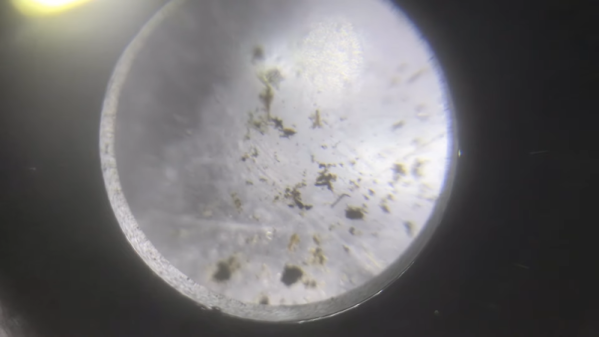
Cold plasma stopped bacterial growth in the circled area.

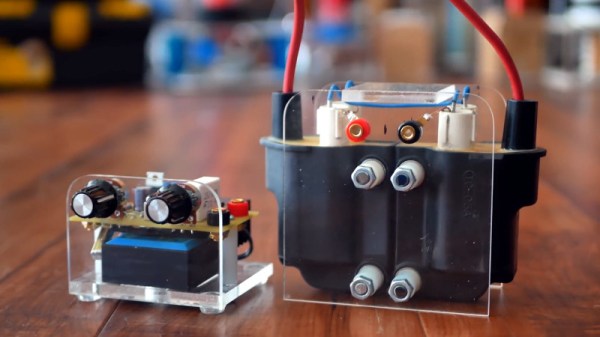
[Jay] takes viewers through a few of the different approaches he tried before finally settling on the winning combination of a glass pipette with a copper wire run down the center. When connected to a party store helium tank and the compact Slayer Exciter coil he built last year, the setup produced a focused jet of plasma that was cool enough to touch.

It’s beautiful to look at, but is a pretty light show all you get for your helium? To see if his device was capable of sterilizing surfaces, he inoculated a set of growth plates with bacteria collected from his hands and exposed them to the cold plasma stream. Compared to the untreated control group the reduction in bacterial growth certainly looks compelling, although the narrow jet does have a very localized effect.

If you’re just looking to keep your hands clean, some soap and warm water are probably a safer bet. But this technology does appear to have some fascinating medical applications, and as [Jay] points out, the European Space Agency has been researching the concept for some time now. Who knows? In the not so distant future, you may see a similar looking gadget at your doctor’s office. It certainly wouldn’t be the first time space-tested tech came down to us Earthlings.

Continue reading “Exploring The Healing Power Of Cold Plasma”

Quantum computer

Scientific Honesty And Quantum Computing’s Latest Theoretical Hurdle

Quantum computers are really in their infancy. If you created a few logic gates with tubes back in the 1930s, it would be difficult to predict all the ways we would use computers today. However, you could probably guess where at least some of the problems would lie in the future. One of the things we are pretty sure will limit quantum computer development is error correction.

As far as we know, every quantum qubit we’ve come up with so far is very fragile and prone to random errors. That’s why every practical design today incorporates some sort of QEC — quantum error correction. Of course, error correction isn’t news. We use it all the time on unreliable storage media or communication channels and high-reliability memory. The problem is, you can’t directly clone a qubit (a quantum bit), so it is hard to use traditional error correction techniques with qubits.

After all, the whole point to a qubit is we don’t measure it until the end of the computation which, like Schrödinger’s cat, seals its fate. So if you were to “read” a bunch of qubits to form a checksum or a CRC, you’d destroy their quantum nature in the process making your computer not very useful. You can’t even copy a bit to use something like triple redundancy, either. There seems to be no way to practically duplicate a qubit.

Continue reading “Scientific Honesty And Quantum Computing’s Latest Theoretical Hurdle”

Sulfur Hexafluoride: The Nightmare Greenhouse Gas That’s Just Too Useful To Stop Using

Sulfur hexafluoride (SF6) is not nearly as infamous as CO2, with the latter getting most of the blame for anthropogenic climate change. Yet while measures are being implemented to curb the release of CO2, for SF6 the same does not appear to be the case, despite the potentially much greater impact that SF6 has. This is because when released into the atmosphere, CO2 only has a global warming potential (GWP) of 1, whereas that of methane is about 28 over 100 years, and SF6 has a GWP of well over 22,000 over that same time period.

Also of note here is that while methane will last only about 12.4 years in the atmosphere, SF6 is so stable that it lasts thousands of years, currently estimated at roughly 3,200 years. When we touched upon sulfur hexafluoride back in 2019 in the context of greenhouse gases, it was noted that most SF6 is used for — and leaks from — high-voltage switchgear (mechanical switches), transformers and related, where the gas’ inert and stable nature makes it ideal for preventing and quenching electrical arcing.

With the rapid growth of highly distributed energy production in the form of mostly (offshore) wind turbines and PV solar parks, this also means that each of these is equipped with its own (gas-filled) switchgear. With SF6 still highly prevalent in this market, this seems like an excellent opportunity to look into how far SF6 usage has dropped, and whether we may be able to manage to avert a potential disaster.

Continue reading “Sulfur Hexafluoride: The Nightmare Greenhouse Gas That’s Just Too Useful To Stop Using”

Brain Implant Offers Artificial Vision To The Blind

Nothing makes you appreciate your vision more than getting a little older and realizing that it used to be better and that it will probably get worse. But imagine how much more difficult it would be if you were totally blind. That was what happened to [Berna Gomez] when, at 42, she developed a medical condition that destroyed her optic nerves leaving her blind in a matter of days and ending her career as a science teacher. But thanks to science [Gomez] can now see, at least to some extent. She volunteered after 16 years to have a penny-sized device with 96 electrodes implanted in her visual cortex. The research is in the Journal of Clinical Investigation and while it is a crude first step, it shows lots of promise and uses some very novel techniques to overcome certain limitations.

The 96 electrodes were in a 10×10 grid with the four corner electrodes missing. The resolution, of course, is lacking, but the project turned to a glasses-mounted camera to acquire images and process them, reducing them to signals for the electrodes that may not directly map to the image.

Continue reading “Brain Implant Offers Artificial Vision To The Blind”

Supersonic Baseball Hitting A Gallon Of Mayo Is Great Flow Visualization

Those of us who enjoy seeing mechanical carnage have been blessed by the rise of video sharing services and high speed cameras. Oftentimes, these slow motion videos are heavy on destruction and light on science. However, this video from [Smarter Every Day] is worth watching, purely for the fluid mechanics at play when a supersonic baseball hits a 1-gallon jar of mayo. 

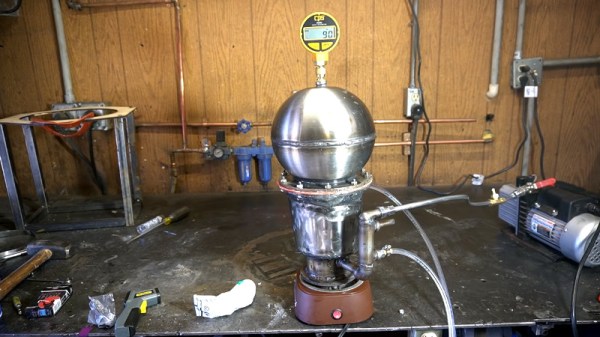
The experiment uses the baseball cannon that [Destin] of [Smarter Every Day] built last year. Ostensibly, the broader aim of the video is to characterize the baseball cannon’s performance. Shots are fired with varying pressures applied to the air tank and vacuum levels applied to the barrel, and the data charted.

However, the real glory starts 18:25 into the video, where a baseball is fired into the gigantic jar of mayo. The jar is vaporized in an instant from the sheer power of the collision, with the mayo becoming a potent-smelling aerosol in a flash.

Amazingly, the slow-motion camera reveals all manner of interesting phenomena. There’s a flash of flame as the ball hits the jar, suggesting compression ignition happened at impact with the jar’s label. A shadow from the shockwave ahead of the ball can be seen in the video, and particles in the cloud of mayo can be seen changing direction as the trailing shock catches up.

The slow-motion footage deserves to be shown in flow-visualization classes, not only because it’s awesome, but because it’s a great demonstration of supersonic flow phenomena. Video after the break.

Continue reading “Supersonic Baseball Hitting A Gallon Of Mayo Is Great Flow Visualization”