Where The Rubber Meets The Computer

If you ever get a chance to go to Leiden, take it. It is a beautiful little city that hides some high-power university research. It also boasts the world’s first rubber computer. You won’t be running Crysis on it anytime soon, though. The fledgling computer has memory and can count to two — really more of a state machine. It is easier to watch the video below than try to fully explain it. Or you can read through the actual paper.

If you watch the video, you’ll see that deformation in the corrugated rubber structure is apparently repeatable and represent bits in the machine. Pressing and releasing pressure on the structure forms both input and clock and it is possible for the material to go from state A to B on compression, but when you release pressure, it reaches state C. The compression and the angle of the pressure allow for different input conditions. One example rubber state machine counts how many times you compress the piece of rubber.

What do you do with a piece of smart rubber? We don’t know. Maybe if you wanted shoes to count steps so you could transmit the count once a minute to save on battery? The researchers have admitted they don’t have any specific applications in mind either, but presume someone will want to use their work.

Of course, the video’s title: “The Rubber Computer” is a bit of hyperbole, but we can forgive it. Most people wouldn’t get “The Rubber Finite State Machine.” While mechanical computing might seem a bit passe, turns out at the molecular level it may become very important. Besides, you can make a computer out of cardboard (or simulate that computer in an FPGA or spreadsheet, if you prefer).

Continue reading “Where The Rubber Meets The Computer”

Hydrogen Generation Made Easy

Even if you never want to generate hydrogen, [Maciej Nowak’s] video (embedded below) is interesting to watch because of the clever way the electrode is formed from stainless steel washers. You’ll need heat shrink tubing, but you ought to have that hanging around anyway. Building the electrode using the techniques in the video results in a lot of surface area which is important for an electrochemical reaction.

A standard rechargeable cell provides power for the generator which resides in a modified plastic bottle. The overall build looks good even though it is all repurposed material.

Continue reading “Hydrogen Generation Made Easy”

Your Next Oscilloscope Might Be Optical

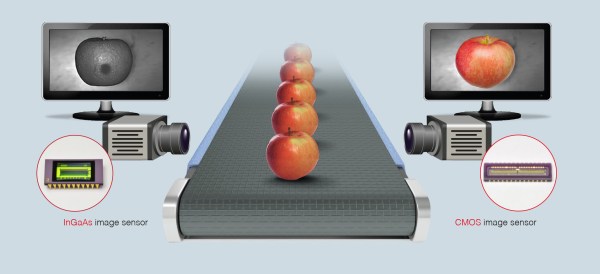
What’s better than a 100MHz scope? How about an optical one? Researchers at the University of Central Florida think that’s just the ticket, and they’ve built an oscilloscope that can measure the electric field of light. You can find the full paper online.

Reading the electrical field of light is difficult with traditional tools because of the very high frequency involved. According to [Michael Chini], who worked on the new instrument, the oscilloscope can be as much as 10,000 times faster as a conventional one.

The measurement of a few cycles of light requires some special techniques as you might expect. According to the paper:

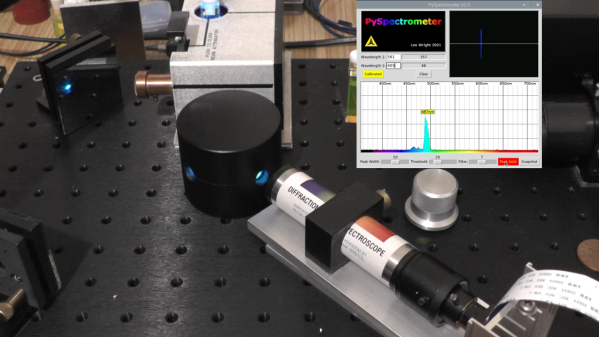
[A]n intense fundamental pulse with a central wavelength of 3.4 µm creates charge packets in the pixels of a silicon-based image sensor via multiphoton excitation, leading to detectable photocurrents. The probability of excitation is perturbed by the field of a weak perturbation pulse, leading to a modulation in the excitation probability and therefore in the magnitude of the detected photocurrent. We have previously shown that, for collinear fundamental and perturbation pulses, the dependence of the modulation in the excitation probability on the time delay between the two pulses encodes the time-varying electric-field waveform of the laser pulse. Here, by using a crossed-beam geometry with cylindrical focusing, we map the time delay onto a transverse spatial coordinate of the image sensor chip to achieve single-shot detection.

Did you get that? In other words, instead of measuring the light pulse directly, they measure the change it makes on another known signal. We think…

Unless you’re moving high-speed data across fiber optic, we aren’t sure you really need this. However, the concept is intriguing and not previously unheard of. For example, we’ve seen capacitance meters that measure the change in frequency caused by adding an unknown capacitor into an existing oscillator.

If you want something more conventional, maybe look at some popular scopemeters. Of course, something this high speed might be able to apply time-domain reflectometry to fiber optics. Maybe.

The Real Science (Not Armchair Science) Of Consciousness

Among brain researchers there’s a truism that says the reason people underestimate how much unconscious processing goes on in your brain is because you’re not conscious of it. And while there is a lot of unconscious processing, the truism also points out a duality: your brain does both processing that leads to consciousness and processing that does not. As you’ll see below, this duality has opened up a scientific approach to studying consciousness.

Are Subjective Results Scientific?

Researcher checking fMRI images.
Checking fMRI images.

In science we’re used to empirical test results, measurements made in a way that are verifiable, a reading from a calibrated meter where that reading can be made again and again by different people. But what if all you have to go on is what a person says they are experiencing, a subjective observation? That doesn’t sound very scientific.

That lack of non-subjective evidence is a big part of what stalled scientific research into consciousness for many years. But consciousness is unique. While we have measuring tools for observing brain activity, how do you know whether that activity is contributing to a conscious experience or is unconscious? The only way is to ask the person whose brain you’re measuring. Are they conscious of an image being presented to them? If not, then it’s being processed unconsciously. You have to ask them, and their response is, naturally, subjective.

Skepticism about subjective results along with a lack of tools, held back scientific research into consciousness for many years. It was taboo to even use the C-word until the 1980s when researchers decided that subjective results were okay. Since then, here’s been a great deal of scientific research into consciousness and this then is a sampling of that research. And as you’ll see, it’s even saved a life or two.

Continue reading “The Real Science (Not Armchair Science) Of Consciousness”

Orbital Safety: The Challenges Of Surviving Space Junk

Hanging around in earth orbit is like walking into the middle of a Wild West gunfight — bullets are flying around everywhere, and even though none are purposefully aimed at you, one might have your name on it. Many of these bullets are artificial satellites that are actively controlled and monitored, but we also find dead satellites, remnants of satellites, discarded rocket stages, tools lost during spacewalks, and even flecks of paint and rust, much of it zipping around at multiple kilometers per second without any guidance.

While removing this space debris directly would be ideal, the reality is that any spacecraft and any spacesuit that has to spend time in orbit needs to be capable of sustaining at least some hits by space debris impacting it.

Orbital Mechanics

That it’s easy to create new debris should come as no surprise to anyone. What may take a bit more imagination is just how long it can take for this debris to make its way towards earth’s atmosphere, where it will uneventfully burn up. Everything in orbit is falling toward the earth, but its tangential velocity keeps it from hitting — like a marble spinning around the hole in a funnel. Drag from the planet’s atmosphere is the friction that eventually slows the object down, and where it orbits in the planet’s atmosphere determines how long this descent will take. Continue reading “Orbital Safety: The Challenges Of Surviving Space Junk”

Keynote Video: Dr. Keith Thorne Explains The Extreme Engineering Of The LIGO Hardware

The Laser Interferometer Gravitational-Wave Observatory (LIGO) is a huge installation measured in kilometers that is listening for wrinkles in space-time. Pulling this off is a true story of hardware and software hacking, and we were lucky to have Dr. Keith Thorne dive into those details with his newly published “Extreme Instruments for Extreme Astrophysics” keynote from the 2021 Hackaday Remoticon.

Gravity causes space-time to stretch — think back to the diagrams you’ve seen of a massive orb (a star or planet) sitting on a plane with grid lines drawn on it, the fabric of that plane being stretch downward from the mass of the orb. If you have two massive entities like black holes orbiting each other, they give off gravitational waves. When they collide and merge, they create a brief but very strong train of waves. Evidence of these events are what LIGO is looking for.

Laser Interferometer diagramRai Weiss had the idea to look for gravitational waves using laser interferometers in about 1967, but the available laser technology was too new to accomplish the feat. In an interferometer, a laser is shot through a beam splitter and one beam reflects out and back over a distance, and is then recombined with the other half using a photodetector to measure the intensity of light. As the distance in the long leg changes, the relative phase of the lasers shift, and the power detected will vary.

LIGO is not your desktop interferometer. It uses a 5 kW laser input. The 4 km legs of the interferometer bounce the light back and forth 1,000 times for an effective 4,000 km travel distance. These legs are kept under extreme vacuum and the mirrors are held exceptionally still. It’s worth it; the instrument can measure at a precision of 1/10,000 the diameter of a proton!

Continue reading “Keynote Video: Dr. Keith Thorne Explains The Extreme Engineering Of The LIGO Hardware”

Mixing synthetic blood

The Challenges Of Finding A Substitute For Human Blood

Throughout history, the human body has been the subject of endless scrutiny and wonder. Many puzzled over the function of all these organs and fluids found inside. This included the purpose of blood, which saw itself alternately disregarded as being merely for ‘cooling the body’, to being responsible for regulating the body’s humors, leading to the practice of bloodletting and other questionable remedies. As medical science progressed, however, we came to quite a different perspective.

Simply put, our circulatory system and the blood inside it, is what allows us large, multi-celled organisms to exist. It carries oxygen and nutrients to cells, while enabling the removal of waste products as well as an easy path for the cells that make up our immune system. Our blood and the tissues involved with it are crucial to a healthy existence. This is something which becomes painfully clear when we talk about injuries and surgeries that involve severe blood loss.

While the practice of blood transfusions from donated blood has made a tremendous difference here, it’s not always easy to keep every single type of blood stocked, especially not in remote hospitals, in an ambulance, or in the midst of a war zone. Here the use of artificial blood — free from complicated storage requirements and the need to balance blood types — could be revolutionary and save countless lives, including those whose religion forbids the transfusion of human blood.

Although a lot of progress has been made in this field, with a limited number of practical products, it’s nevertheless proving to be a challenge to hit upon a replacement that ticks all of the boxes needed to make it generic and safe.

Continue reading “The Challenges Of Finding A Substitute For Human Blood”