jellyandmarshmallows windTunnel close-up

Perfecting Paper Planes Peering Past Perspex Portals

This wind tunnel is a pile of junk and we love it! When making science and engineering accessible to kids, it really helps to show that it doesn’t require a fancy research lab. [Jelly & Marshmallows] show kids that it takes little more than cardboard, duct tape, and dumpster-diving to up your paper airplane game to NASA levels of engineering.
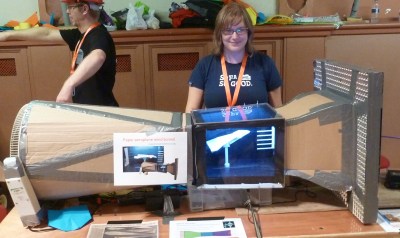
[Jelly & Marshmallows] built their wind tunnel for a Maker Faire using the aforementioned cheap and free materials for the straightener, collector, diffuser, and fan sections. We especially love the efficient hack of using stacked ceiling light diffusers rather than hundreds of straws for the straightener.


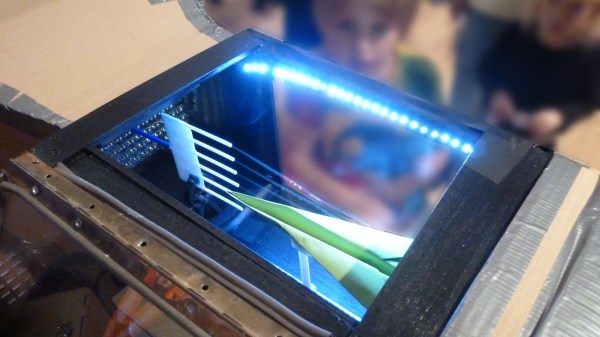
The most time went into the working section, custom-built from plywood frames and acrylic windows. Many 3D printed parts came together to convert a smoke-ring gun to emit smoke trails and LEDs were employed to make those trails a little easier to see. We think the magnetic clips for quick changes of aircraft and their position along a steel ruler were inspired.
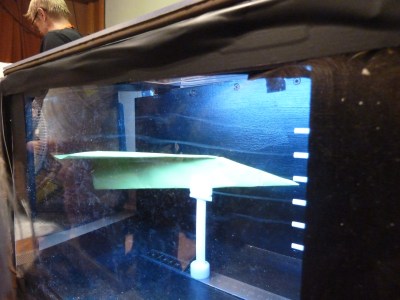
The kids attending the Maker Faire (we miss those!) loved the exhibit, having the best time hitting a big green arcade button to spin up the fan. It’s the little things in life. How would you get the kids even more involved with analyzing aerodynamics and make the smoke trails more visible?


Thanks for the tip [Rómulo Antão]
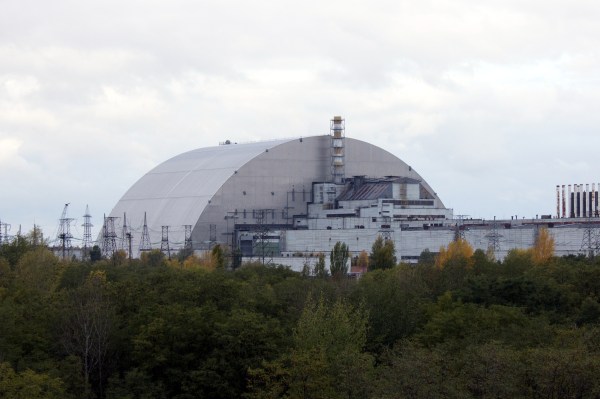
Increased Neutron Levels At Chernobyl-4: How Dangerous Is Corium?

When the Chernobyl nuclear plant suffered the power output surge that would destroy its #4 reactor, a substance called ‘corium‘ was formed. This originally lava-like substance formed out of the destroyed fuel rods along with surrounding materials, like concrete, that made up the reactor. The corium ultimately cooled down and left large amounts of solid corium in the rooms where it had pooled.

Over the past few days there have been numerous reports in the media regarding a ‘sudden surge’ in neutron flux levels from this corium, with some predicting a ‘second Chernobyl disaster’. Obviously, this has quite a few people alarmed, but how dire are these neutron output changes exactly, and what do they tell us about the condition of the corium inside the ruins of the #4 reactor building? Continue reading “Increased Neutron Levels At Chernobyl-4: How Dangerous Is Corium?”

Nuclear Reactors Get Small

Steve Martin was ahead of his time when he told us “Let’s get small!” While you usually think of a nuclear reactor as a big affair, there’s a new trend towards making small microreactors to produce power where needed instead of large centralized generation facilities. The U.S. Department of Energy has a video about the topic, you can watch below.

You probably learned in science class how a basic nuclear fission reactor works. Nuclear fuel produces heat from fission while a moderator like water prevents it from melting down both by cooling the reactor and slowing down neutrons. Control rods further slow down the reaction or — if you pull them out — speed it up. Heat creates steam (either directly or indirectly) and the steam turns a conventional electric generator that is no more high tech than it ever has been.

Continue reading “Nuclear Reactors Get Small”

Something’s Up In Switzerland: Explaining The B Meson News From The Large Hadron Collider

Particle physics is a field of extremes. Scales always have 10really big number associated. Some results from the Large Hadron Collider Beauty (LHCb) experiment have recently been reported that are statistically significant, and they may have profound implications for the Standard Model, but it might also just be a numbers anomaly, and we won’t get to find out for a while. Let’s dive into the basics of quantum particles, in case your elementary school education is a little rusty.

It all starts when one particle loves another particle very much and they are attracted to each other, but then things move too fast, and all of a sudden they’re going in circles in opposite directions, and then they break up catastrophically…

Continue reading “Something’s Up In Switzerland: Explaining The B Meson News From The Large Hadron Collider”

The Mysterious Wobble Of Muons

You might think that particle physicists would be sad when an experiment comes up with different results than their theory would predict, but nothing brightens up a field like unexplained phenomena.  Indeed, particle physicists have been feverishly looking for deviations from the Standard Model. This year, there have been tantalizing signs that a long unresolved discrepancy between theory and experiment will be confirmed by new experimental results.

In particular, the quest to measure the magnetic moment of muons started more than 60 years ago, and this has been measured ever more precisely since. From an experiment in 1959 at CERN in Switzerland, to the turn of the century at Brookhaven, to this year’s result at Fermilab, the magnetic moment of the muon seems to be at odds with theoretical predictions.

Although a statistical fluke is basically excluded, this value also relies on complex theoretical calculations that are not all in agreement. Instead of heralding a new era of physics, it might just be another headline too good to be true. But some physicists are mumbling “new particle” in hushed tones. Let’s see what all the fuss is about.

Continue reading “The Mysterious Wobble Of Muons”

The Laser Power Record Has Been Broken

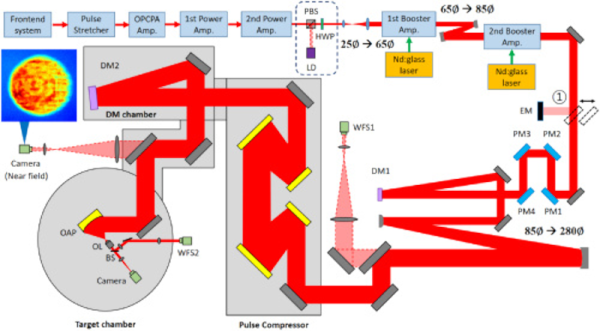
Lasers do all sorts of interesting things and — as with so many things — more is better. Korean scientists announced recently they’ve created the most powerful laser beam. 1023 watts per square centimeter, to be exact. It turns out that 1022 Watts/cm2 may not be commonplace, but has been done many times already at several facilities, including the CoReLS petawatt (PW) laser used by the researchers.

Just as improving a radio transmitter often involves antenna work instead of actual power increases, this laser setup uses an improved focus mechanism to get more energy in a 1.1 micron spot. As you might expect, doing this requires some pretty sophisticated optics.

Continue reading “The Laser Power Record Has Been Broken”

The Fine Structure Constant In A Blink

Electronics is really an applied branch of physics, so it isn’t surprising that if you are serious about your electronics, you probably know a little physics, too. If you’ve ever heard the term “fine structure constant” and weren’t entirely sure what it means, [Parth G] wants to explain it to you in about a minute. His video explanation appears below.

You may know that the constant, often represented by α, is approximately 1/137, but what does that mean? The answer relates to the orbit of electrons. You might remember from school that electrons orbit in shells around the nucleus.  That is, an atom might have some electrons in the innermost shell, and more electrons in an outer shell.

Continue reading “The Fine Structure Constant In A Blink”