A few years ago we talked about the chance that the first known extrasolar visitor — Oumuamua — might be a derelict solar sail. That notion has been picking up steam in the popular press lately, and it made us think again about the chances that the supposed rock was really a solar sail discarded or maybe even a probe flying with a solar sail. At the same time, Mars is as close as it ever gets so there is a gaggle of our probes searching the red planet, some of them looking for signs of past life.
All this makes us think: if we did find life or even artifacts of intelligent life, would we realize it? Sure, we can usually figure out what’s alive here on Earth. But to paraphrase Justice Potter Stewart, “We know it when we see it.” Defining life turns out to be surprisingly tricky, recognizing alien technology would be even harder.
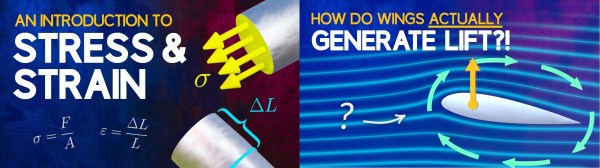
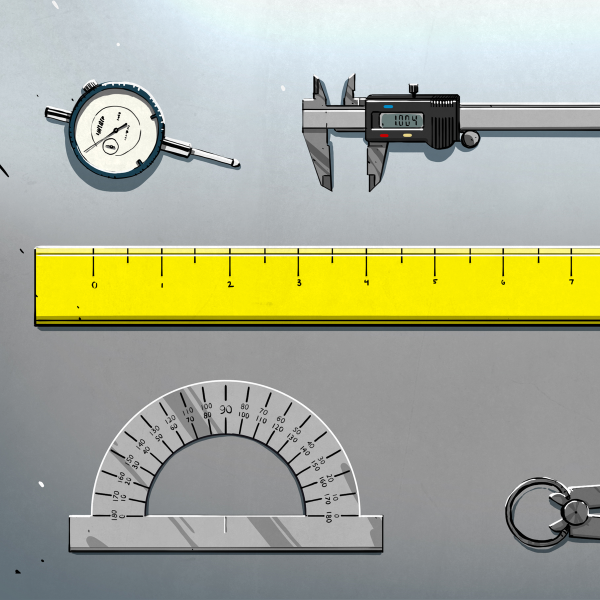
All feats of engineering build on a proper understanding of the basic engineering concepts. Learning these concepts from a book or class tends to be a rather uninspiring exercise, unfortunately. To make this task a lot more enjoyable, [The Efficient Engineer] has produced a series of high-quality, easy-to-watch videos on the concepts.
The videos focus mainly on mechanical and structural engineering and contain excellent animations and just enough math to give you a basic understanding. There are 22 videos so far and cover a wide variety of topics, including FEA analysis, stress and strain, aerodynamics, and Young’s modulus. Each video starts with the basics, then digs down into the topic, all the while visualizing the subject being discussed. For example, for FEA he starts with the applications, then covers discretization (meshing) and how to solve the calculations.
Many years ago, I took a summer trip to the Maryland shore with some friends. One of my buddies and I got bored with playing football on the beach, so we decided to take a hike on one of the many trails back into the wooded area behind the dunes. At the trailhead we noticed a prominent sign, warning about the presence of “very aggressive mosquitos” and not to enter without first applying ample insect repellent. We scoffed at the warning as only young idiots could and soldiered on, bare-legged and confident that we’d be fine.
About three minutes into our hike, a small group came pelting down the trail in a panic. “It’s true! Turn back!” they shouted as they flew past us. Undeterred, or at least unwilling to appear that way to each other, we pressed on, only to discover a few minutes later that we were making a substantial blood sacrifice to the next generation of mosquitos on Assateague Island. We couldn’t bear more than a few seconds before turning tail and running back to the beach and jumping into the ocean to get rid of the last few dozen bloodsuckers.
I learned a valuable lesson from that experience, as well as developing a deep and abiding hatred of mosquitos. It turns out I’m in good company — pretty much everyone hates mosquitos, which are not just a nuisance but can be downright dangerous to be around. But if tests with genetically engineered mosquitos currently underway in Florida turn out well, we may be able to finally turn the tide against mosquito-borne diseases, simply by killing all the females before they ever reach adulthood.
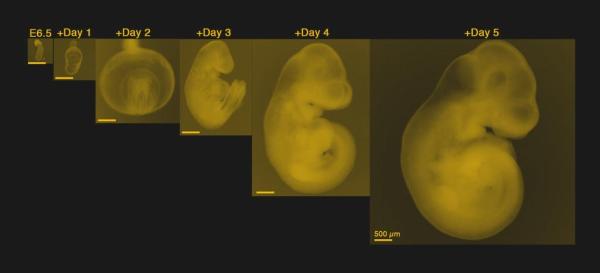
Well, it looks like those fetus fields from The Matrix (1999) just became a little bit more plausible. Although people-growing is probably a long way off, mice can now mostly develop inside an artificial uterus (try private window if you hit a paywall) thanks to a breakthrough in developmental biology. So far, the mice can only be kept alive halfway through gestation. There’s a point at which the nutrient formula provided to them isn’t enough, and they need a blood supply to continue growing. That’s the next goal. For now, let’s talk about that mechanical womb setup.
Carousel of Care
The mechanical womb was developed to better understand how various factors such as gene mutations, nutrients, and environmental conditions affect murine fetuses in development. Why do miscarriages occur, and why do fertilized eggs fail to implant in the first place? How exactly does an egg explode into 40 trillion cells when things do work out? This see-through uterus ought to reveal a few more of nature’s gestational secrets.
Do you need a well-equipped lab to measure the size of an atom (German, machine translation)? According to [stoppi], no. You need sunflower oil, some bear moss spores, and a bit of gasoline. You’ll also need some common things like a syringe, a baking sheet, and a jar. You can see the whole process in the video below. The measurement isn’t really for a specific atom, but it is an average for a lipid molecule, which is still impressive.
You essentially measure the diameter of an oil drop spread over water. Since the oil is mostly oleic acid, the height of the layer is known as 167 atoms. After that, it is some simple measurements and math to get the height and find the average atom height.
The Van de Graaff generator is a staple of science museums, to the point that even if the average person might not know its name, there’s an excellent chance they’ll be familiar with the “metal ball that makes your hair stand up” description. That’s partly because they’re a fairly safe way to show off high voltages, but also because they’re surprisingly cheap and easy to build.
In his latest Plasma Channel video [Jay Bowles] builds a large Van de Graaff generator that wouldn’t look out of place in a museum or university, which he estimates is producing up to 500,000 volts. It can easily throw impressive looking (and sounding) sparks 10 inches or more, and as you can see in the video below, is more than capable of pulling off those classic science museum tricks.
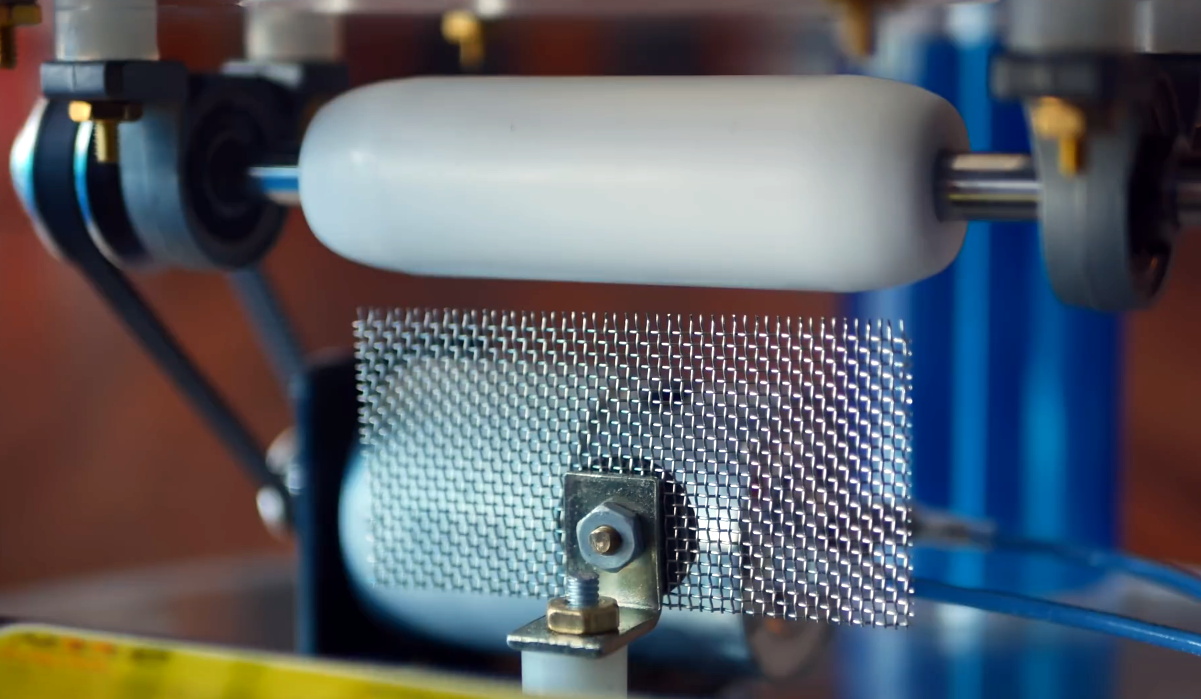
Lower pulley assembly.
It’s really quite amazing to see just how little it takes to generate these kinds of voltages with a Van de Graaff. In fact there’s nothing inside that you’d immediately equate with high voltage, the only electronic component in the generator’s base beyond the battery pack is a motor speed controller. While everything else might look suspiciously like magic, our own [Steven Dufresne] wrote up a properly scientific explanation of how it all works.
In this particular case, the motor spins a nylon pulley in the base of the generator, which is connected to a Teflon pulley in the top by way of a neoprene rubber belt. Combs made from fine metal mesh placed close to the belt at the top and bottom allow the Van de Graaff to build up a static charge in the sphere. Incidentally, it sounds like sourcing the large metal sphere was the most difficult part of this whole build, as it took [Jay] several hours to modify the garden gazing ball to fit atop the acrylic tube that serves as the machine’s core.
If there’s one thing humans hate, it’s exercising willpower. Whether its abstaining from unhealthy foods, going to bed early, or using less energy and reducing greenhouse gas emissions, we’re famously bad at it. Conversely, if there’s one thing humans love, it’s a workaround. Something that lets us live our lives as the carefree hedonists we are, and deals with the sticky consequences so we don’t have to.