A Miniature Radio Telescope In Every Backyard

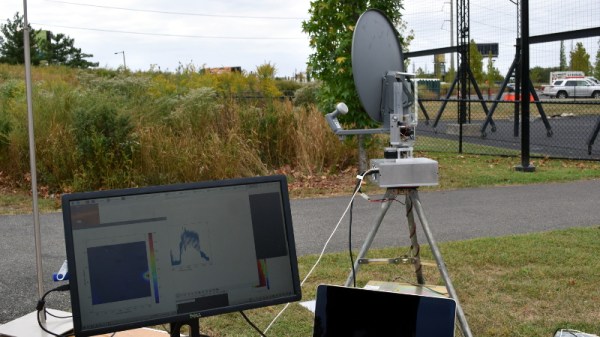
You probably wouldn’t expect to see somebody making astronomical observations during a cloudy day in the center of a dense urban area, but that’s exactly what was happening at the recent 2019 Philadelphia Mini Maker Faire. Professor James Aguirre of the University of Pennsylvania was there demonstrating the particularly compact Mini Radio Telescope (MRT) project built around an old DirecTV satellite dish and a smattering of low-cost components, giving visitors a view of the sky in a way most had never seen before.
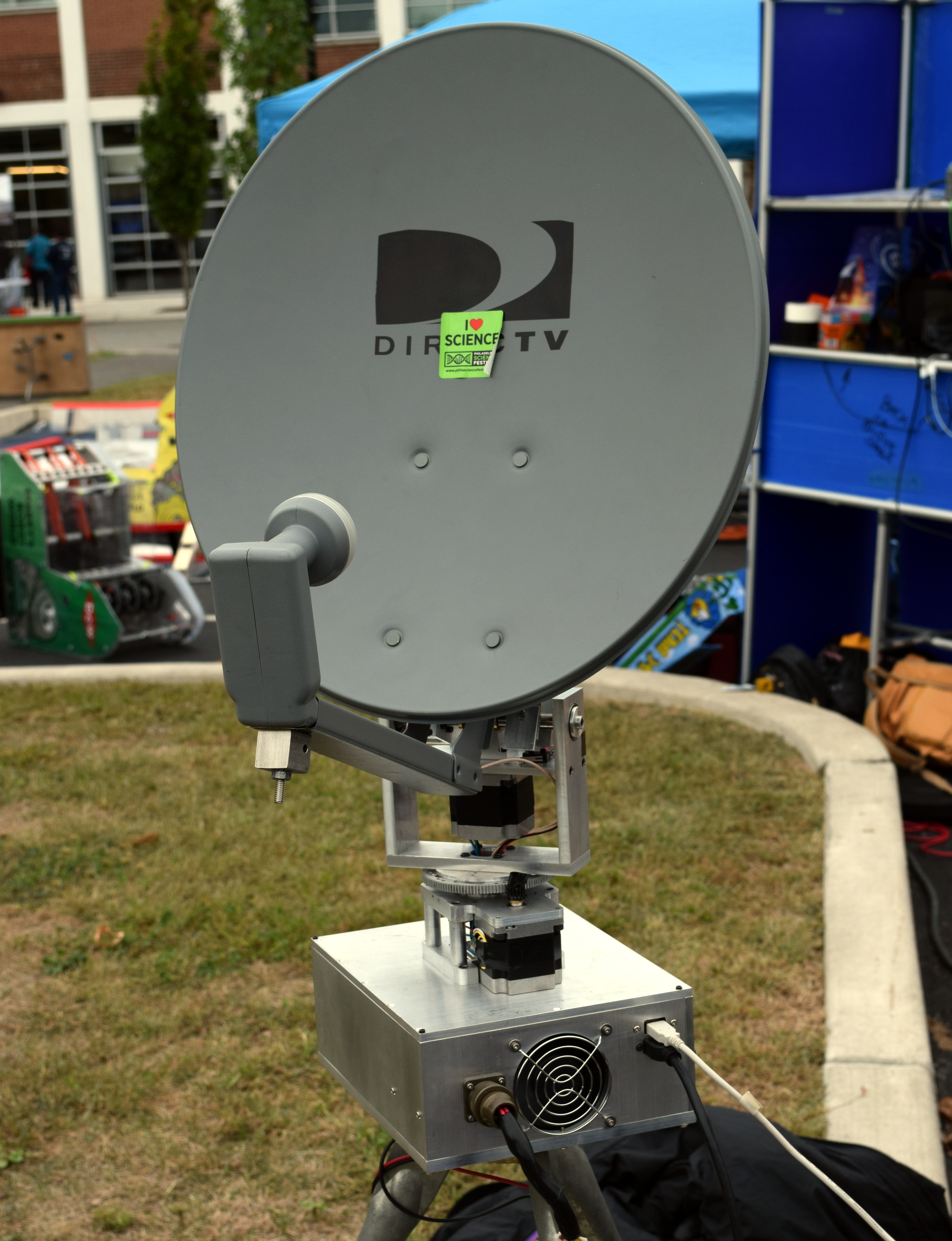
Thanks to the project’s extensive online documentation, anyone with a spare satellite dish and a couple hundred dollars in support hardware can build their very own personal radio telescope that’s capable of observing objects in the sky no matter what the time of day or weather conditions are. Even if you’re not interested in peering into deep space from the comfort of your own home, the MRT offers a framework for building an automatic pan-and-tilt directional antenna platform that could be used for picking up signals from orbiting satellites.

With the slow collapse of satellite television in the United States these dishes are often free for the taking, and a fairly common sight on the sidewalk come garbage day. Perhaps there’s even one (or three) sitting on your own roof as you read this, waiting for a new lease on life in the Netflix Era.

Whether it’s to satisfy your own curiosity or because you want to follow in Professor Aguirre’s footsteps and use it as a tool for STEM outreach, projects like MRT make it easier than ever to build a functional DIY radio telescope.

Continue reading “A Miniature Radio Telescope In Every Backyard”

The Long History Of Fast Reactors And The Promise Of A Closed Fuel Cycle

The discovery of nuclear fission in the 1930s brought with it first the threat of nuclear annihilation by nuclear weapons in the 1940s, followed by the promise of clean, plentiful power in the 1950s courtesy of nuclear power plants. These would replace other types of thermal plants with one that would produce no exhaust gases, no fly ash and require only occasional refueling using uranium and other fissile fuels that can be found practically everywhere.

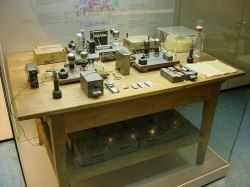
The equipment with which nuclear fission was experimentally proven in 1938.

As nuclear reactors popped up ever faster during the 1950s and 1960s, the worry about running out of uranium fuel became ever more present, which led to increased R&D in so-called fast reactors, which in the fast-breeder reactor (FBR) configuration can use uranium fuel significantly more efficiently by using fast neutrons to change (‘breed’) 238U into 239Pu, which can then be mixed with uranium fuel to create (MOX) fuel for slow-neutron reactors, allowing not 1% but up to 60% of the energy in uranium to be used in a once-through cycle.

The boom in uranium supplies discovered during the 1970s mostly put a stop to these R&D efforts, with some nations like France still going through its Rapsodie, Phénix and SuperPhénix designs until recently finally canceling the Generation IV ASTRID demonstrator design after years of trying to get the project off the ground.

This is not the end of fast reactors, however. In this article we’ll look at how these marvels of engineering work and the various fast reactor types in use and under development by nations like Russia, China and India.

Continue reading “The Long History Of Fast Reactors And The Promise Of A Closed Fuel Cycle”

Better Battery Management Through Chemistry

The lead-acid rechargeable battery is a not-quite-modern marvel. Super reliable and easy to use, charging it is just a matter of applying a fixed voltage to it and waiting a while; eventually the battery is charged and stays topped off, and that’s it. Their ease is countered by their size, weight, energy density, and toxic materials.

The lithium battery is the new hotness, but their high energy density means a pretty small package that can get very angry and dangerous when mishandled. Academics have been searching for safer batteries, better charge management systems, and longer lasting battery formulations that can be recharged thousands of times, and a recent publication is generating a lot of excitement about it.

Consider the requirements for a battery cell in an electric car:

  • High energy density (Lots of power stored in a small size)
  • Quick charge ability
  • High discharge ability
  • MANY recharge cycles
  • Low self-discharge
  • Safe

Lithium ion batteries are the best option we have right now, but there are a variety of Li-ion chemistries, and depending on the expected use and balancing and charging, different chemistries can be optimized for different performance characteristics. There’s no perfect battery yet, and conflicting requirements mean that the battery market will likely always have some options.

Continue reading “Better Battery Management Through Chemistry”

Darwin Approves: Berkeley Evolves Analog Design

Digital design is hard. But in the right environment, digital circuits are more forgiving than analog. That 3.3V signal coming out of the chip has to drop a lot along the way to not be a logic level at the destination. If you are trying to push the boundary then digital design has much of analog design, but mostly you get a bit of a pass on many things that plague analog designers. Berkeley’s AI research group has been experimenting with using deep learning to evolve analog IC design.

Analog ICs are plagued with noise sources and often don’t have the margins that digital circuit designers enjoy. According to the post by [Kourosh Hakhamaneshi], designers often build a few blocks and attempt to lay them out in a way that should work and meet other requirements. Then they employ simulation, make changes as required, and simulate again. Accurate simulations can be very time intensive. You can read the actual paper, too, should you want to dig into the details.

Continue reading “Darwin Approves: Berkeley Evolves Analog Design”

Dealing With Invasive Species Through Robotics

Throughout its history, humankind’s travels have often brought unwelcome guests along for the ride, and sometimes introduced species into a new environment for a variety of reasons. These so-called invasive species are all too often responsible for widespread devastation in ecosystems, wiping out entire species and disrupting the natural balance. Now researchers are testing the use of robots for population control of these invasive species.

The mosquitofish is the target of current research by NYU Tandon School of Engineering and the University of Western Australia. Originally from parts of the US and Mexico, it was introduced elsewhere for mosquito control, including in Australia. There it has become a massive problem, destroying native species that used to eat mosquitoes. As a result the mosquito problem has actually worsened.

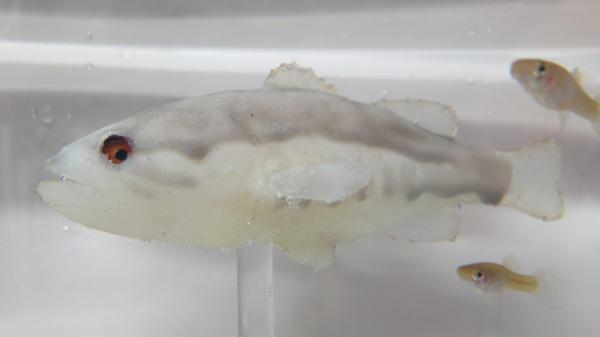
As the main issue with these invasive species is that they do not have any natural predators that might control their numbers, the researchers created robots which mimic the look and motion of natural predators. In the case of the mosquitofish the largemouth bass is its primary predator. The theory was that by exposing the mosquitofish to something that looks and moves just like one of these predator fish, they would exhibit the same kind of stress response.

So far laboratory tests under controlled condition have confirmed these expectations, with the mosquitofish displaying clear signs of stress upon exposure to the robotic largemouth bass. Even better, they displayed decreasing weight and were found to avoid potentially dangerous areas, indicating that instead of focusing on foraging, they were in survival mode. This should limit their environmental impact, including their ability to procreate.

Who knows, before long the surface waters of Australia may be home to the first robotic species of fish.

(Thanks, [Qes])

Moon Elevator Could Be Sooner Than You Think

The big expense in getting people to orbit or the moon or any other space destination is the cost of escaping the Earth’s gravity. One often-proposed solution involves building a giant space elevator from some point on the Earth to orbit. That sounds great, but the reality is the materials needed to make a giant stalk reaching from the ground to orbit don’t exist today. Cables or other structures for such an elevator would have to be so impossibly thick as to break under their own weight. However, a recent paper from a researcher at Cambridge and another at Columbia suggest that while you can’t build an elevator from the Earth’s surface to orbit, we may have the technology to build a tunnel that anchors on the moon and lets out in Earth’s orbit.

Before you dismiss the idea out of hand, have a look at the paper. A classic space elevator proposal has one point on Earth and the far end balanced with a counterweight keeping the cables under tension. The proposed lunar elevator would minimize these problems by having most of the bulk in space and on the moon.

Continue reading “Moon Elevator Could Be Sooner Than You Think”

Black Hole Imaging Scientists Win 2020 Breakthrough Prize

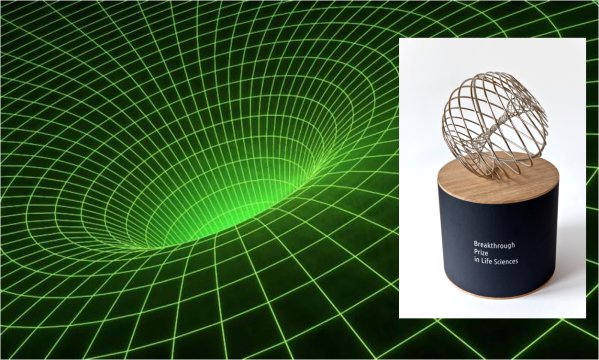
Making a monumental scientific breakthrough is really kind of its own reward. Even so, it’s always nice to get extra recognition in the form of unexpected money. For the 347 scientists around the world who made history when they captured the first image of a black hole, the event itself is pretty sweet. The cake of notoriety recently gained some icing, because the group has been awarded a $3 million Breakthrough Prize.

The prize, known as “the Oscars of science”, was created eight years ago with the goal of furthering scientific advancements in the areas of physical science, mathematics, and life science. Created by tech investor Yuri Milner, the Breakthrough Prize is funded by other deep-pocketed notables like Sergey Brin and the Zuckerbergs. This year’s theme is “seeing the invisible”. Prizes will also be awarded for discoveries toward non-opioid pain relievers and the study of neuro-degenerative disorders.

Each of the black hole imaging scientists will receive $8,645.53 when the prize is awarded in a televised ceremony on November 3rd, which is going down at NASA’s Ames Research Center in Mountain View, CA. In lieu of parading all 347 scientists across the stage, [Shep Doeleman] of the Harvard-Smithsonian Center for Astrophysics and Director of the Event Horizon Telescope project, will accept the award on their behalf.

What exactly are black holes, and how did they come about? Explore their origins with [Will Sweatman] in this feature from 2018.

Black hole wire frame CC0 Public Domain via Phys.org

Black hole image via NASA