Most people’s personal experience with seismographs begins and ends with simple childhood science experiments. Watching a pendulum make erratic marks on a piece of paper while your classmates banged on the table gave you an idea on how the device worked, and there’s an excellent chance that’s the last time you gave the concept much thought. Even among hackers, whose gear in general tends to be more technologically equipped than the norm, you’re unlikely to find a dedicated seismograph up and running.
But that’s not because the core technology is hard to come by or particularly expensive. In fact, one could say with almost absolute certainty that if you aren’t actively reading these words on a device with a sensitive accelerometer onboard, you have one (or perhaps several) within arm’s reach. Modern smartphones, tablets, and even some laptops, now pack in sensors that could easily be pushed into service as broad strokes seismometers; they just need the software to collect and analyze the data.
Or at least, they did. By the time you read this article, Google will have already started rolling out an update to Android devices which will allow them to use their onboard sensors to detect possible earthquakes. With literally billions of compatible devices in operation all over the planet, this will easily become the largest distributed sensor network of its type ever put into operation. But that doesn’t mean you’re going to be getting a notification on your phone to duck and cover anytime soon.
To adequately study a body of water such as a lake, readings and samples need to be taken from an array of depths and locations. Traditionally this is done by a few researchers on a small boat with an assortment of tools that can be lowered to the desired depth, which is naturally a very slow and expensive process. As the demand for ever more granular water quality analysis has grown, various robotic approaches have been suggested to help automate the process.
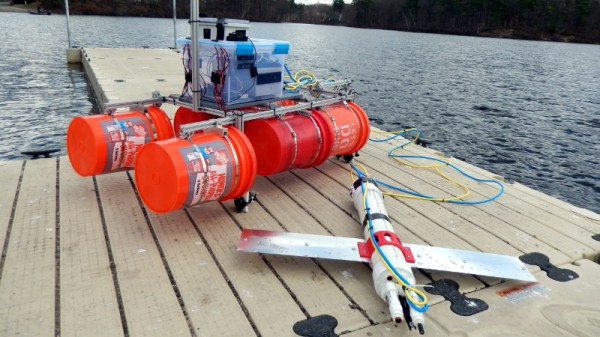
A group of students from Northeastern University in Boston have been working on Project Albatross, a unique combination of semi-autonomous vehicles that work together to provide nearly instantaneous data from above and below the water’s surface. By utilizing open source software and off-the-shelf components, their system promises to be affordable enough even for citizen scientists conducting their own environmental research.
The surface vehicle, assembled from five gallon buckets and aluminum extrusion, uses a Pixhawk autopilot module to control a set of modified bilge pumps acting as thrusters. With ArduPilot, the team is able to command the vehicle to follow pre-planned routes or hold itself in one position as needed. Towed behind this craft is a sensor laden submersible inspired by the Open-Source Underwater Glider (OSUG) that won the 2017 Hackaday Prize.
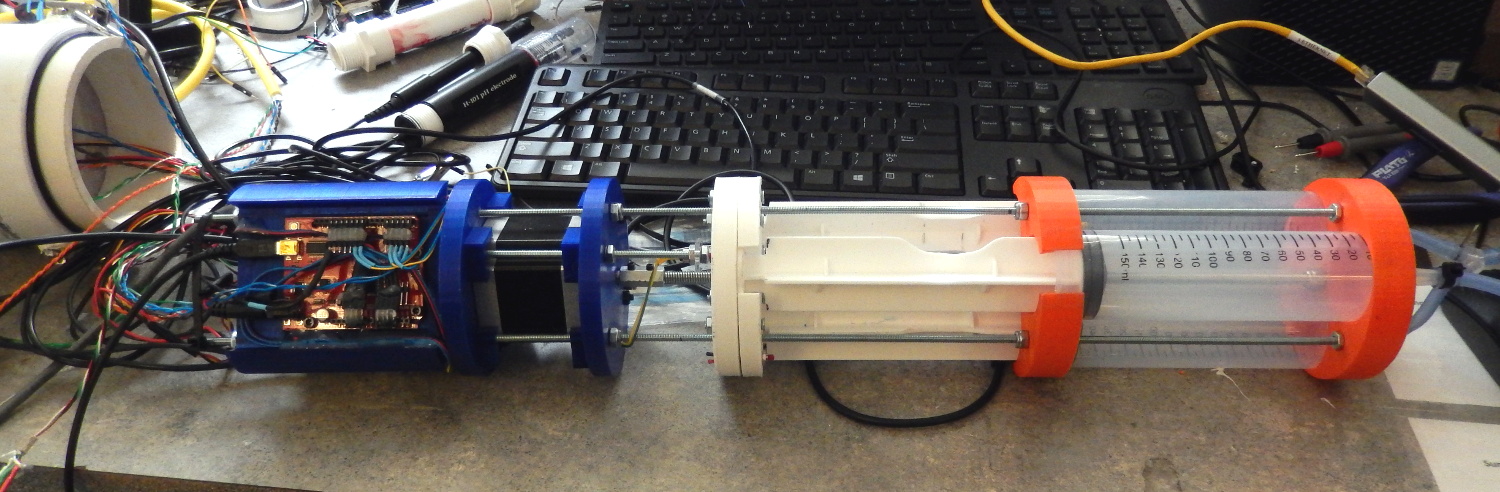
Using an array of syringes operated by a NEMA 23 stepper motor, the glider is able to control its depth in the water by adjusting its buoyancy. The aluminum “wings” on the side of the PVC pipe body prevent the vehicle from rolling will moving through the water. As with the surface vehicle, many of the glider components were sourced from the hardware store to reduce its overall cost to build and maintain.
The tether from the surface vehicle provides power for the submersible, greatly increasing the amount of time it can spend underwater compared to internal batteries. It also allows readings from sensors in the tail of the glider to be transmitted to researchers in real-time rather than having to wait for it to surface. While the team says there’s still work to be done on the PID tuning which will give the glider more finely-grained control over its depth, the results from a recent test run already look very promising.
The holy grail of every particle physics experiment is the discovery of a new particle. Finding a new constituent of matter may earn you eternal glory within the history of physics. Unfortunately, since the last missing piece of the Standard Model, the Higgs boson, was discovered in 2012, and with still no clue about the nature of dark matter and dark energy, there is not much hope to stumble upon a new fundamental building block of matter any time soon.
How cool would it be if there was a material that couldn’t be cut or drilled into? You could make the baddest bike lock, the toughest-toed work boots, or the most secure door. Really, the list of possibilities just goes on and on.
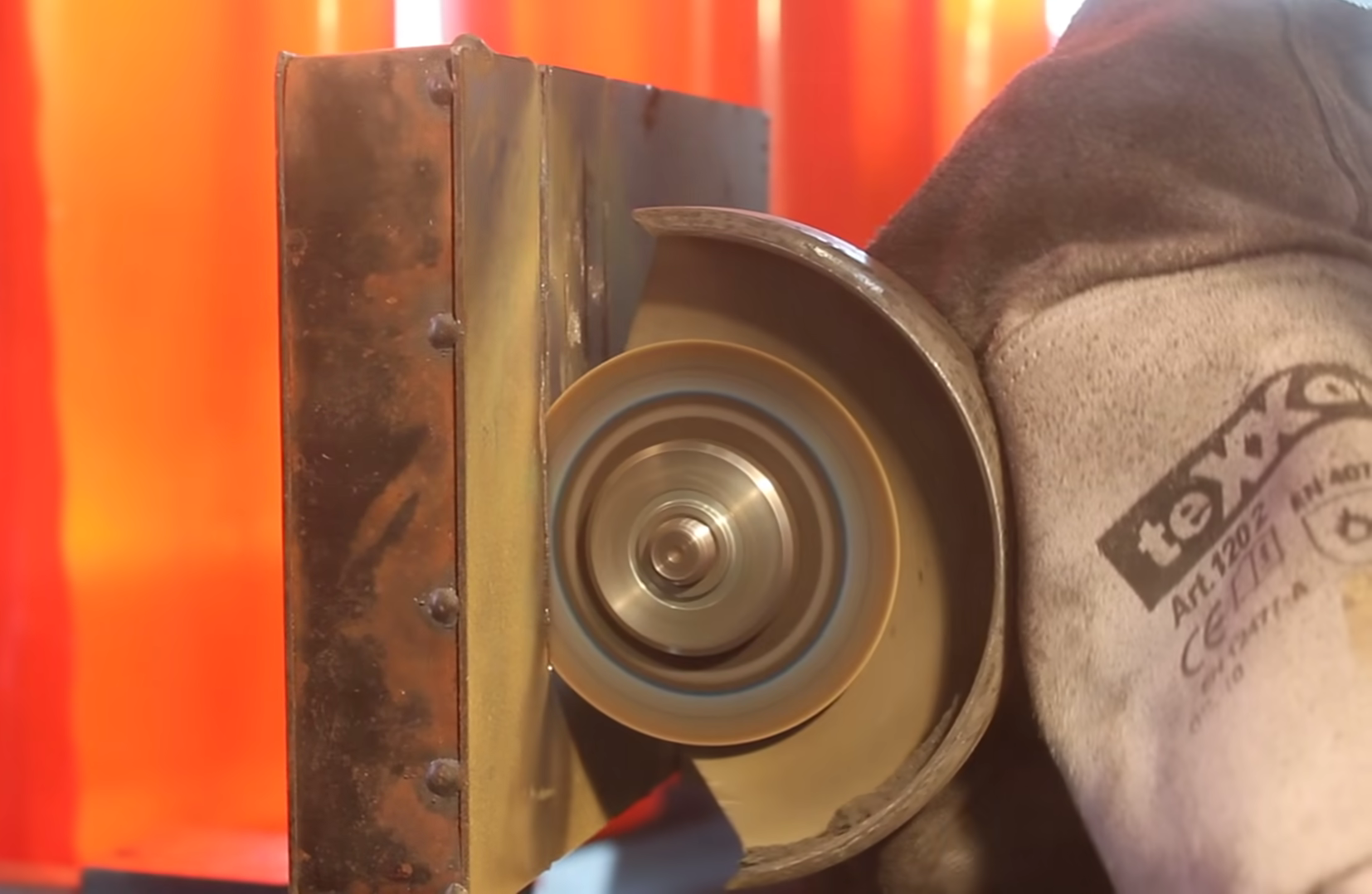
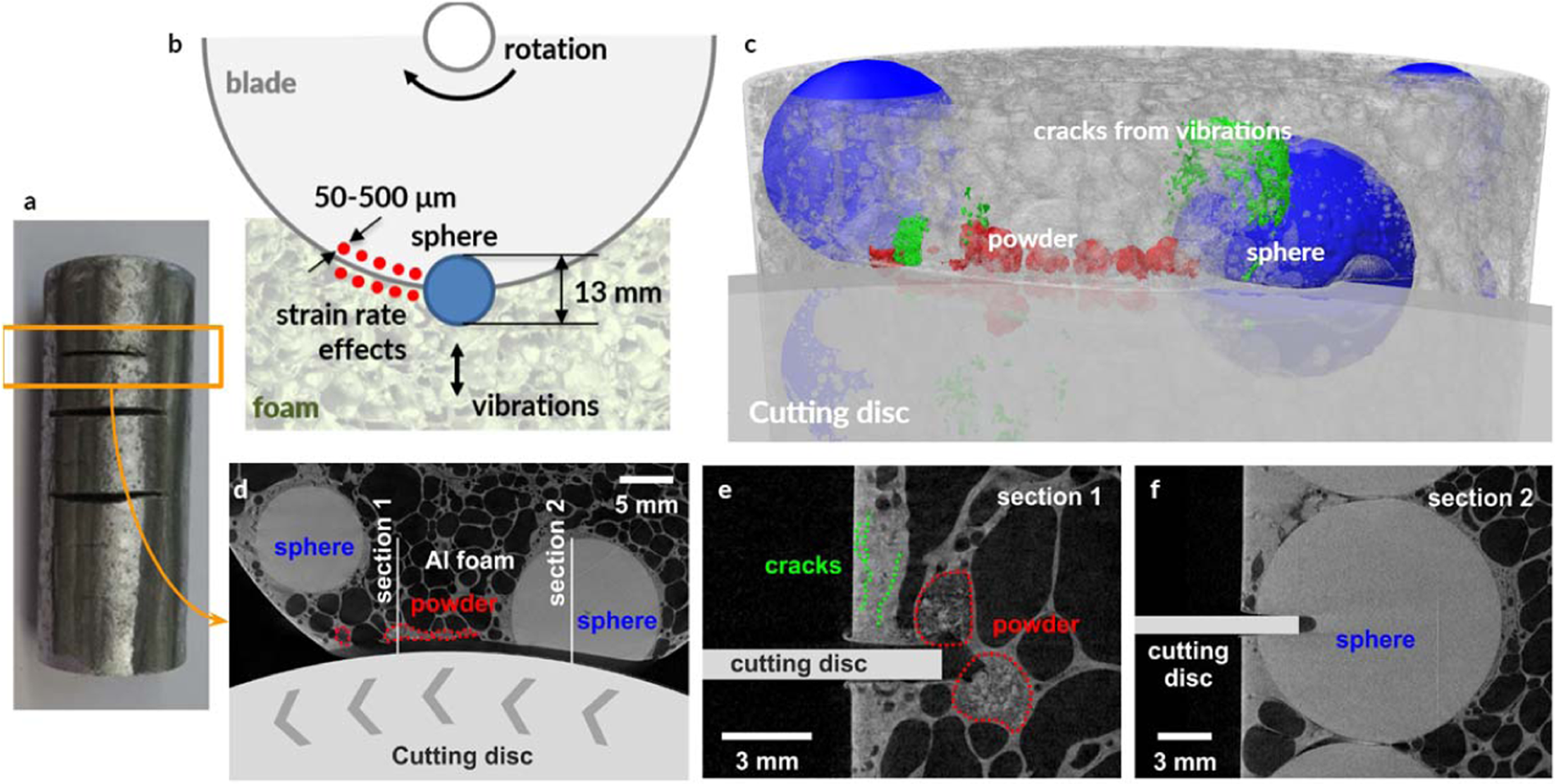
Proteus chews through an angle grinder disc in seconds.
The material is made of aluminium foam that’s embedded with a bunch of small ceramic spheres. It works by inducing retaliatory vibrations into the cutting tools, which turns the tools’ force back on themselves and quickly dulls their edges.
The creators have named the material Proteus after the elusive and shape-shifting prophet of Greek mythology who would only share his visions of the future with those who could get their arms around him and keep him still. It sounds like this material could give Proteus a run for his money.
The ceramic spheres themselves aren’t indestructible, but they’re not supposed to be. Abrading the spheres only makes Proteus stronger. As the cutting tool contacts them, they’re crushed into dust that fills the voids in the aluminium foam, strengthening the material’s destructive vibratory effect. The physical inspiration for Proteus comes from protective hierarchical structures in nature, like the impact-resistant rind of grapefruit and the tendency of abalone shells to resist fracture under the impact of shark teeth.
How It’s Made
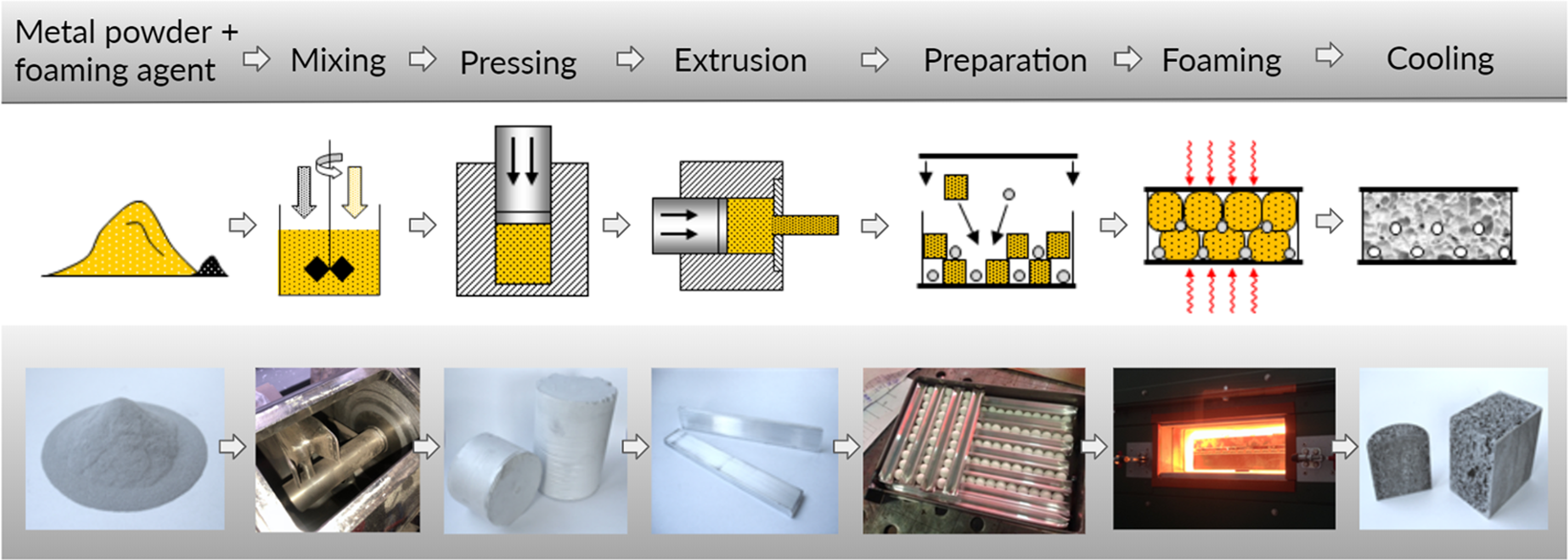
Proteus recipe in pictures.
At this point, Proteus is a proof of concept. Adjustments would likely have to be made before it can be produced at any type of scale. Even so, the recipe seems pretty straightforward. First, an aluminium alloy powder is mixed with a foaming agent. Then the mixture is cold compacted in a compressor and extruded in dense rods. The rods are cut down to size and then arranged along with the ceramic spheres in a layered grid, like a metallurgical lasagna.
The grid is spot-welded into a steel box and then put into a furnace for 15-20 minutes. Inside the furnace, the foaming agent releases hydrogen gas, which introduces voids into the aluminium foam and gives it a cellular structure.
Effects of cutting into a cylinder of Proteus with an angle grinder.
According to their paper, the researchers tried to penetrate the material with an angle grinder, a water jet cutter, and a drill. Of these, the drill has the best chance of getting through because the small point of contact can find gaps more easily, so it’s less likely to hit a ceramic sphere. The researchers also made cylindrical samples without steel cladding which they used to test the compressive strength and prove Proteus’ utility as a structural material for beams and columns. It didn’t fare well initially, but became less compressible as the foam matrix collapsed.
The creation process lends some leeway for customization, because the porosity of the aluminium foam can be varied by changing the bake time. As for the drill bit problem, tightening up security is as easy as adjusting the size and/or density of the ceramic spheres.
In the video after the break, you can watch a chunk of Proteus eat up an angle grinder disc in under a minute. Some may argue about the tool wielder’s technique, but we think there’s something to be said for any material that can destroy a cutting disc that fast. They don’t claim that Proteus is completely impenetrable, but it does look impressive. We wish they would have tried more cutting tools like a gas torch, or experimented with other destructive techniques, like plastic explosives, but we suppose that research budgets only go so far.
You’d be hard pressed to find a hacker or maker who doesn’t have a soft spot for the tantalizing buzz and snap of a high voltage spark gap, but it remains the sort of project that most of us don’t take on personally. There’s a perceived complexity in building a device capable of shooting a proper spark through several inches of open air, with connotations of exotic components and massive hand-wound coils. Plus, nobody wants to inadvertently singe off their eyebrows.
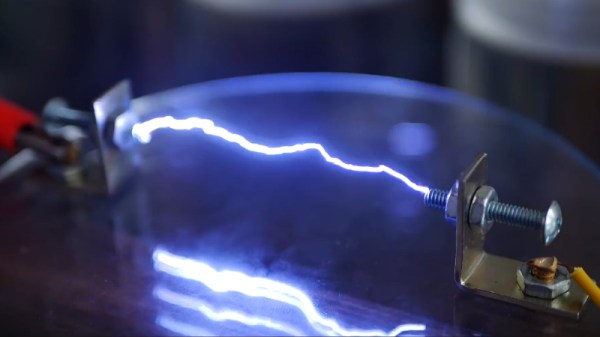
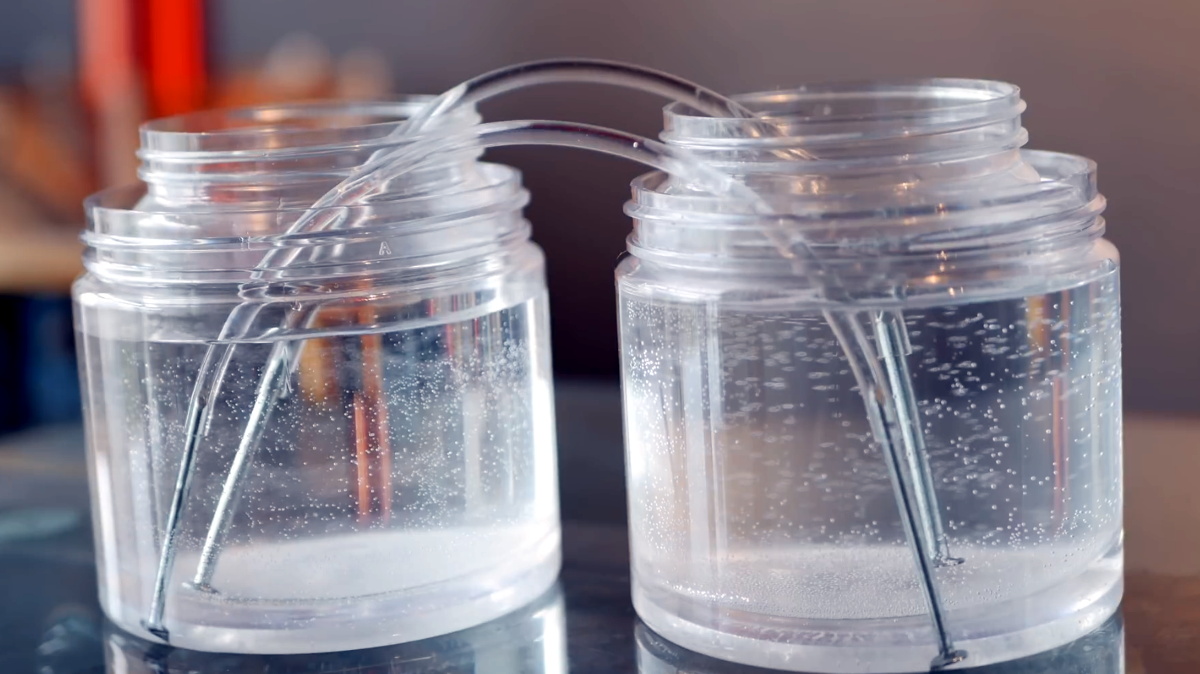
While the latest video from [Jay Bowles] might not assuage anyone’s fear of performing impromptu electrolysis, it does at least prove that you don’t need to have a laboratory full of gear to produce six figure voltages. In fact, you don’t even need much in the way of electronics: the key components of this DIY Marx generator are made with little more than water and some household items.
This is made possible by the fact that the conductivity of water can be changed depending on what’s been dissolved into it. Straight tap water is a poor enough conductor that tubes of it can be used in place of high voltage resistors, while the addition of some salt and a plastic insulating layer makes for a rudimentary capacitor. You’ll still need wires to connect everything together and some bits of metal to serve as spark gaps, but nothing you won’t find lurking in the parts bin.
Of course, water and a smattering of nails won’t spontaneously generate electricity. You need to give it a bit of a kick start, and for that [Jay] is using a 15,000 volt DC flyback power supply that looks like it may have been built with components salvaged from an old CRT television. While the flyback transformer alone could certainly generate some impressive sparks, this largely liquid Marx generator multiplies the input voltage to produce a serious light show.
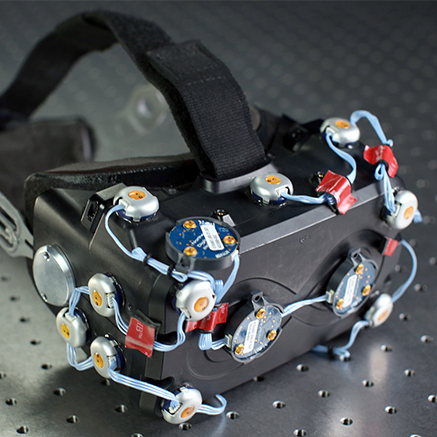
VR headsets are more and more common, but they aren’t perfect devices. That meant [Douglas Lanman] had a choice of problems to address when he joined Facebook Reality Labs several years ago. Right from the start, he perceived an issue no one seemed to be working on: the fact that the closer an object in VR is to one’s face, the less “real” it seems. There are several reasons for this, but the general way it presents is that the closer a virtual object is to the viewer, the more blurred and out of focus it appears to be. [Douglas] talks all about it and related issues in a great presentation from earlier this year (YouTube video) at the Electronic Imaging Symposium that sums up the state of the art for VR display technology while giving a peek at the kind of hard scientific work that goes into identifying and solving new problems.
Early varifocal prototype
[Douglas] chose to address seemingly-minor aspects of how the human eye and brain perceive objects and infer depth, and did so for two reasons: one was that no good solutions existed for it, and the other was that it was important because these cues play a large role in close-range VR interactions. Things within touching or throwing distance are a sweet spot for interactive VR content, and the state of the art wasn’t really delivering what human eyes and brain were expecting to see. This led to years of work on designing and testing varifocal and multi-focal displays which, among other things, were capable of presenting images in a variety of realistic focal planes instead of a single flat one. Not only that, but since the human eye expects things that are not in the correct focal plane to appear blurred (which is itself a depth cue), simulating that accurately was part of things, too.
The entire talk is packed full of interesting details and prototypes. If you have any interest in VR imaging and headset design and have a spare hour, watch it in the video embedded below.
A few years ago, I needed a teeny, tiny potentiostat for my biosensor research. I found a ton of cool example projects on Hackaday and on HardwareX, but they didn’t quite fulfill exactly what I needed. As any of you would do in this type of situation, I decided to build my own device.
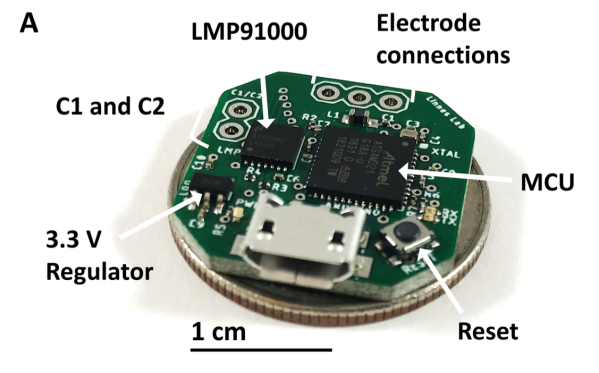
Now, we’ve talked about potentiostats before. These are the same devices used in commercial glucometers, so they are widely applicable to a number of biosensing applications. In my internet perusing, I stumbled upon a cool chip from Texas Instruments called the LMP91000 that initially appeared to do all the hard work for me. Unfortunately, there were a few features of the LMP91000 that were a bit limiting and didn’t quite give me the range of flexibility I required for my research. You see, electrochemistry works by biasing a set of electrodes at a given potential and subsequently driving a chemical reaction. The electron transfer is measured by the sensing electrode and converted to a voltage using a transimpedance amplifier (TIA). Commercial potentiostats can have voltage bias generators with microVolt resolution, but I only needed about ~1 mV or so. The problem was, the LMP91000 has a resolution of ~66 mV on a 3.3 V supply, mandating that I augment the LMP991000 with an external digital-to-analog converter (DAC) as others had done.
However, changing the internal reference of the LMP91000 with the DAC confounded the voltage measurements from the TIA, since the TIA is also referenced to the same internal zero as the voltage bias generator. This seemed like a problem other DIY solutions I came across should have mentioned, but I didn’t quite find any other papers describing this problem. After punching myself a little, I thought that maybe it was a bit more obvious to everyone else except me. It can be like that sometimes. Oh well, it was a somewhat easy fix that ended up making my little potentiostat even more capable than I had originally imagined.
I could have made a complete custom potentiostat circuit like a few other examples I stumbled upon, but the integrated aspect of the LMP91000 was a bit too much to pass up. My design needed to be as small as possible since I would eventually like to integrate the device into a wearable. I was using a SAMD21 microcontroller with a built-in DAC, therefore remedying the problem was a bit more convenient than I originally thought since I didn’t need an additional chip in my design.
I am definitely pretty happy with the results. My potentiostat, called KickStat, is about the size of a US quarter dollar with a ton of empty space that could be easily trimmed on my next board revision. I imagine this could be used as a subsystem in any number of larger designs like a glucometer, cellphone, or maybe even a smartwatch.
Check out all the open-source files on my research lab’s GitHub page. I hope my experience will be of assistance to the hacker community. Definitely a fun build and I hope you all get as much kick out of it as I did.