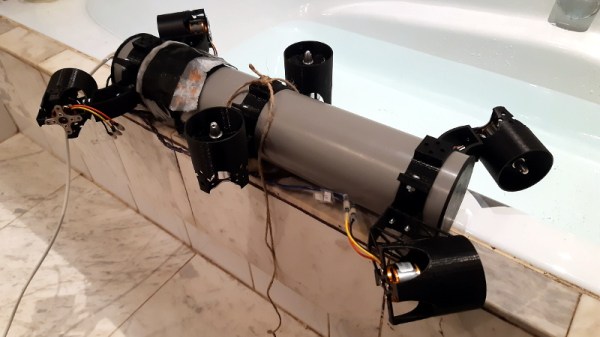
Aruna: An Open Source ROV For Affordable Research

Underwater exploration and research can be exceedingly dangerous, which is why remotely operated vehicles (ROVs) are so commonly used. Operators can remotely command these small submersibles to capture images or collect samples at depths which would otherwise be unreachable. Unfortunately, such technology comes at a considerable price.

Believing that the high cost of commercial ROVs is a hindrance to aquatic conservation efforts, [Noeël Moeskops] has been developing an open source modular ROV he calls Aruna. Constructed largely from off-the-shelf components and 3D-printed parts, the Aruna promises to be far more affordable than anything currently on the market. Hopefully cheap enough to allow local governments and even citizens to conduct their own underwater research and observations.

More than just the ROV itself, Aruna represents an entire system for developing modular underwater vehicles. Whether you decide to build the boilerplate ROV documented and tested by [Noeël], or implement individual components into your own design, the project is a valuable source of hardware and software information for anyone interested in DIY underwater robotics.

Continue reading “Aruna: An Open Source ROV For Affordable Research”
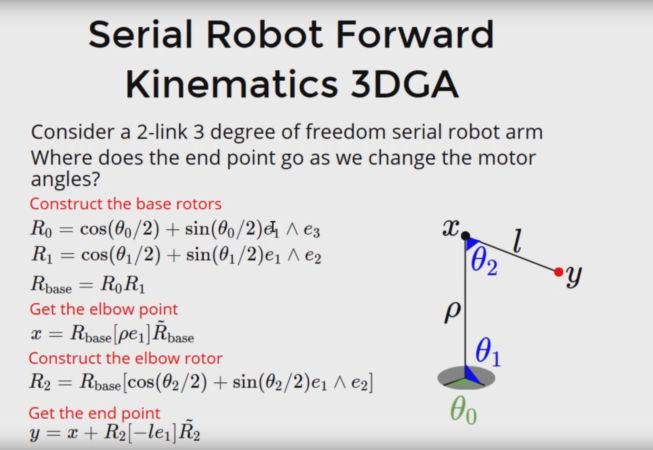
Getting Started With Geometric Algebra For Robotics, Computer Vision And More

[Hugo Hadfield] wrote to let us know about an intriguing series of talks that took place in February of this year at GAME2020, on the many applications of geometric algebra. The video playlist of these talks can be found here along with the first video embedded after the break. For those of us who did not take advanced algebra during university, one can picture geometric algebra (GA) as an extension of vector algebra, adding more algebraic structures.

The essential difference is that GA adds a new vectors product, called the ‘geometric product’. The Cliff’s Notes version is that this is very useful for doing for example transformations, like in 3D spaces. For a quick algebraic introduction to GA for those familiar with vector algebra, the associated biVector website is helpful, from where one can also find additional information, software and other resources on getting started with GA.

These talks will take the viewer through the use of GA with robot kinematics (co-presented by [Hugo]), in astrophysics and AI. Definitely worth a watch, even algebra isn’t one’s strongest points.

Continue reading “Getting Started With Geometric Algebra For Robotics, Computer Vision And More”

Welcome To Solar Cycle 25; Our Sun Enters A New 11-Year Period

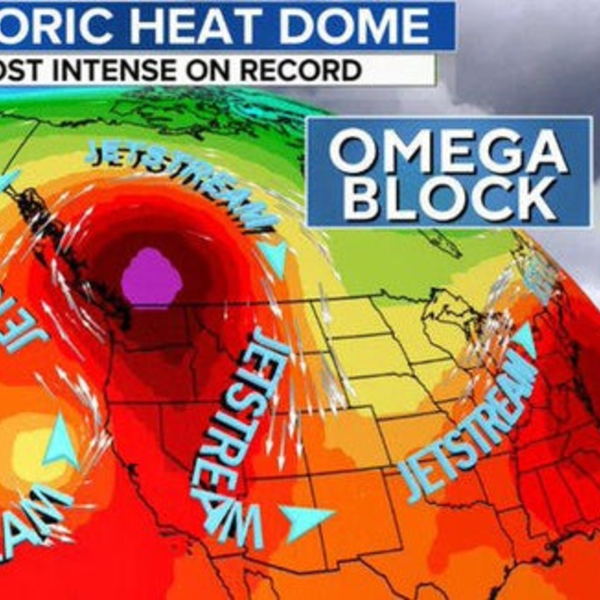
Most of us perceive time as an arrow, a one-way trip into the future. And while that’s true, nature has a way of interpolating circular patterns onto that linear model — day follows night, the seasons progress through the year, and generations are born, live, and die after creating the next generation to do experience the same cycles in the future.

Our star, too, follows this cyclical model, and goes through observable, periodic changes that are of keen interest to solar scientists. So it was with some fanfare that they recently announced that the sun had transitioned into Solar Cycle 25. But what exactly does that mean? Does the Sun’s changing face make much difference to the average person’s daily life? History shows that it can, so it pays to know what we’re in store for over the next couple of decades. Welcome to your primer on Solar Cycle 25.

Continue reading “Welcome To Solar Cycle 25; Our Sun Enters A New 11-Year Period”

Graphene Generates A Little Power

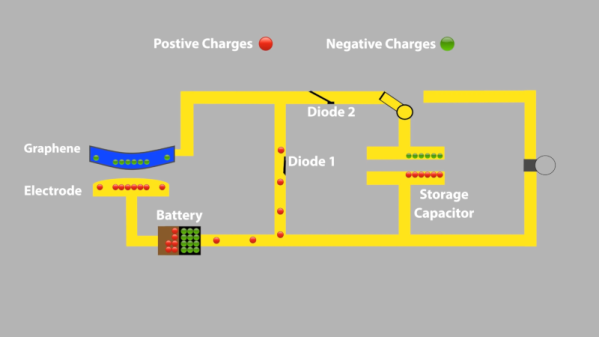
We never know exactly what to make of university press releases, as we see plenty of them with breathless claims of new batteries or supermaterials, but then we don’t see much else. Sometimes, the claims in the press release don’t hold up in the paper, while other times the claims seem to be impractical for use in real life. We aren’t quite sure what to make of a press release from the University of Arkansas claiming they can draw current from a sheet of freestanding graphene purely from its temperature fluctuations.

The press release seems to claim that this is a breakthrough leading to “clean, limitless power.” But if you look at the actual paper, normal room temperature is causing tiny displacements in the graphene sheet as in Brownian motion. A scanning tunneling microscope with two diodes can detect current flowing even once the system reaches thermal equilibrium. Keep in mind, though, that this in the presence of a bias voltage and we are talking about nanometer-scale displacements and 20 pA of current. You can see a simple video from the university showing a block diagram of the setup.

Continue reading “Graphene Generates A Little Power”

Certifying Nuclear Reactors: How The NRC Approved Its First Small Modular Reactor Design

The US Nuclear Regulatory Commission (NRC) recently announced that it had approved certification of NuScale’s SMR (small modular reactor) design, completing its Phase 6 review of NuScale’s Design Certification Application (DCA). What this means is that SMRs using NuScale’s reactor design can legally be constructed within the US as soon as the rulemaking process completes. An NRC certification would also mean that certification of the design in other countries should pose no significant hurdles.

A question that remains unanswered at this point for most is how this certification process at the NRC actually works. Are there departments full of engineers at the NRC who have been twiddling their thumbs for the past decades while the US nuclear industry has been languishing? What was in the literally millions of documents that NuScale had to send to the NRC as part of the certification process, and what exactly are these six phases?

Stay tuned for a crash course in nuclear reactor certification, after a bit of SMR history.

Continue reading “Certifying Nuclear Reactors: How The NRC Approved Its First Small Modular Reactor Design”

Fiber Optics, But… Wetter?

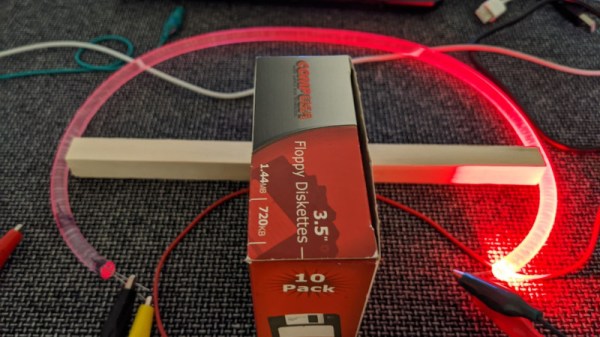
Fiber optics are a great way to transfer huge quantity of data at lightning speed. Thanks to the property of total internal reflection, which allows light to flow through a glass fiber like fluid through a pipe, they can be used for communications at long distances and form the backbone of modern communication networks. However, water is also able to pull off the total internal reflection party trick, and [Mike Kohn] decided to see if it could be used as a communication medium, too.

The experimental setup consists of an ATTiny85 that receives signals over its serial port, and outputs the received bits by flashing an LED. This LED is attached to a plastic tube filled with water. On the receiving end, another ATTiny85 reads the voltage level of a photodiode placed in the other end of the tube. When the ADC detects voltage over a certain level, it toggles a pin connected to the serial RX pin.

Hooking the setup to a pair of terminals, [Mike] was able to successfully transmit 9600 baud serial data through a tube full of water with just an LED and a small microcontroller. To verify the success, he ran the test again with an air-filled tube instead, which failed. In doing so, he proved that the water was doing the work.

We’ve seen other optical data hacks, too – like this awesome laser ethernet build. Video after the break.

Continue reading “Fiber Optics, But… Wetter?”

NASA Claims Cold Fusion Without Naming It

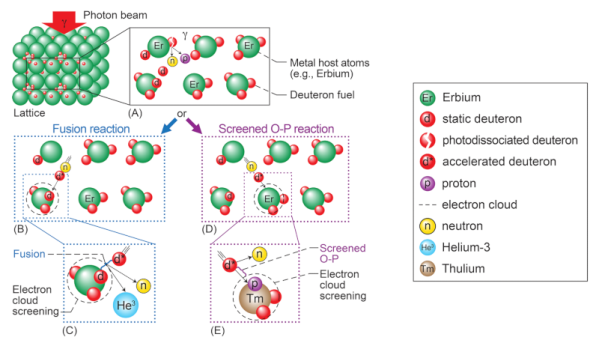
Do you remember in 1989 when two chemists announced they’d created a setup that created nuclear fusion at room temperature? Everyone was excited, but it eventually turned out to be very suspect. It wasn’t clear how they detected that fusion occurred and only a few of the many people who tried to replicate the experiment claimed success and they later retracted their reports. Since then, mentioning cold fusion is right up there with perpetual motion. Work does continue though, and NASA recently published several papers on lattice confinement fusion which is definitely not called cold fusion, although it sounds like it to us.

The idea of trapping atoms inside a metallic crystal lattice isn’t new, dating back to the 1920s. It sounds as though the NASA method uses erbium packed with deuterium. Photons cause some of the deuterium to fuse. Unlike earlier attempts, this method produces detectable neutron emissions characteristic of fusion.

Continue reading “NASA Claims Cold Fusion Without Naming It”