Arduino-Powered Rocket Test Stand

If you’re into amateur rocketry, you pretty quickly outgrow the dinky little Estes motors that they sell in the toy stores. Many hobbyists move on to building their own homebrew solid rocket motors and experimenting with propellant mixtures, but it’s difficult to know if you’re on the right track unless you have a way to quantify the thrust you’re getting. [ElementalMaker] decided he’d finally hit the point where he needed to put together a low-cost test stand for his motors, and luckily for us decided to document the process and the results.

The heart of the stand is a common load cell (the sort of thing you’d find in a digital scale) coupled with a HX711 amplifier board mounted between two plates, with a small section of vertical PVC pipe attached to the topmost plate to serve as a motor mount. This configuration is capable of measuring up to 10 kilograms with an 80Hz sample rate, which is critically important as these type of rocket motors only burn for a few seconds to begin with. The sensor produces hundreds of data points during the short duration of the burn, which is perfect for graphing the motor’s thrust curve over time.

Given such a small window in which to make measurements, [ElementalMaker] didn’t want to leave anything to chance. So rather than manually igniting the motor and triggering the data collection, the stand’s onboard Arduino does both automatically. Pressing the red button on the stand starts a countdown procedure complete with flashing LED, after which a relay is used to energize a nichrome wire “electronic match” stuck inside the motor.

In the video after the break you can see that [ElementalMaker] initially had some trouble getting the Arduino to fire off the igniter, and eventually tracked the issue down to an overabundance of current that was blowing the nichrome wire too fast. Swapping out the big lead acid battery he was originally using with a simple 9V battery solved the problem, and afterwards his first test burns on the stand were complete successes.

If model rockets are your kind of thing, we’ve got plenty of content here to keep you busy. In the past we’ve covered building your own solid rocket motors as well as the electronic igniters to fire them off, and even a wireless test stand that lets you get a bit farther from the action at T-0.
Continue reading “Arduino-Powered Rocket Test Stand”

Mini Van De Graaff Is A Shocking Desk Toy

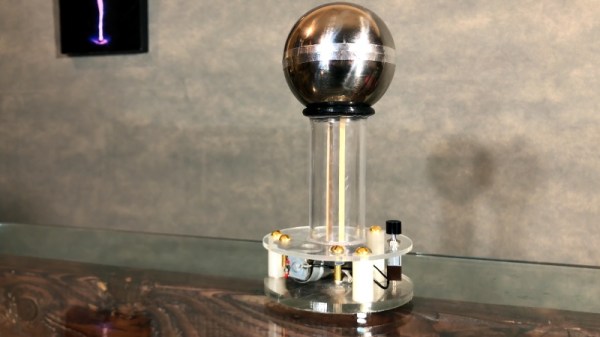
The Van De Graff generator is a device capable of generating potentially millions of volts of electricity which you can build in an afternoon, probably from parts you’ve got in the junk bin. This is not a fact that’s escaped the notice of hackers for decades, and accordingly we’ve seen several Van De Graaff builds over the years. So has high voltage hacker [Jay Bowles], but he still thought he could bring something new to the table.

The focus of his latest build was to not only produce one of the most polished and professional versions of this venerable piece of high voltage equipment, but also make it accessible for others by keeping the design simple and affordable. The final result is a 40,000 volt Van De Graaff generator that’s powered by two AA batteries and can fit in the palm of your hand.

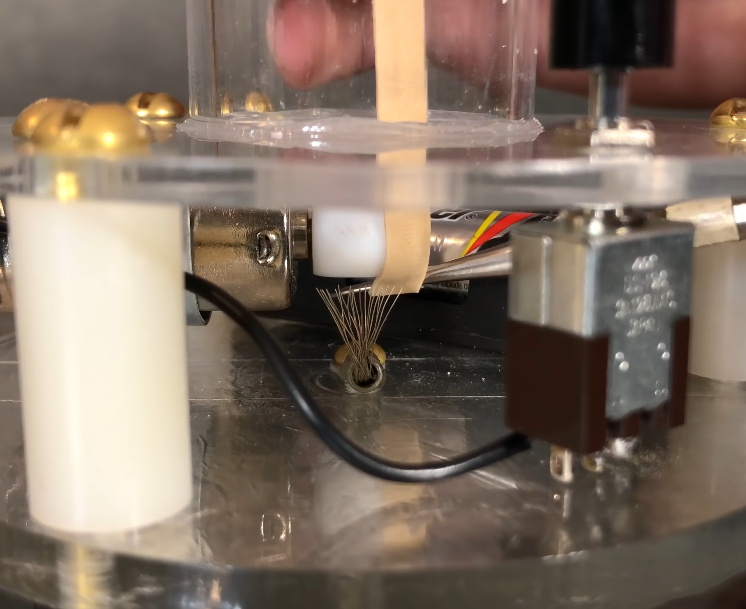
Put simply, a Van De Graaff generator creates static electricity from the friction of two metal combs rubbing against a moving belt, which is known as the triboelectric effect. The belt is stretched between the two combs and passes through an insulated tube, which serves to “pump” electrons from one side to the other. The end result is that a massive charge builds up on the positive side of the Van De Graaff generator, which is all too willing to send a spark firing off towards whatever negatively charged object gets close enough.

The video after the break guides viewers through the process of turning this principle into a practical device, illustrating how remarkably simple it really is. A common hobby motor is used to get the belt going, in this case just a wide rubber band, and the rest of the components are easily sourced or fabricated. Even for what’s arguably the most intricate element of the build, the combs themselves, [Jay] uses nothing more exotic than aluminum foil tape and a piece of stranded wire splayed out.

Combined with the acrylic base and the purpose-made metal sphere (rather than using a soda can or other upcycled object), the final result not only generates healthy sparks but looks good doing it. Though if the final fit and finish isn’t important, you could always build one out of stuff you found in the trash.

Continue reading “Mini Van De Graaff Is A Shocking Desk Toy”

New Transistor Uses Metal And Air Instead Of Semiconductors

The more things change, the more things stay the same. Early electronic devices used a spark gap. These have been almost completely replaced with tubes and then semiconductor devices such as transistors. However, transistors will soon reach a theoretical limit on how small they can be which is causing researchers to find the next thing. If the  Royal Melbourne Institute of Technology has its way, we’ll go back to something that has more in common with a spark gap than a conventional transistor. You can find the source paper on the Nano Papers website although the text is behind a paywall.

The transistor uses metal, but instead of a semiconductor channel — which is packed with atoms that cause collisions as electrons flow through the channel — the new device uses an air gap. You might well think that if fewer atoms in the channel are better, why not use a vacuum?

Continue reading “New Transistor Uses Metal And Air Instead Of Semiconductors”

Simple, Low-Cost Rig Lets The Budding Biohacker Run DNA Gels

We all the know the basic components for building out an electronics lab: breadboards, bench power supply, a selection of components, a multimeter, and maybe an oscilloscope. But what exactly do you need when you’re setting up a biohacking lab?

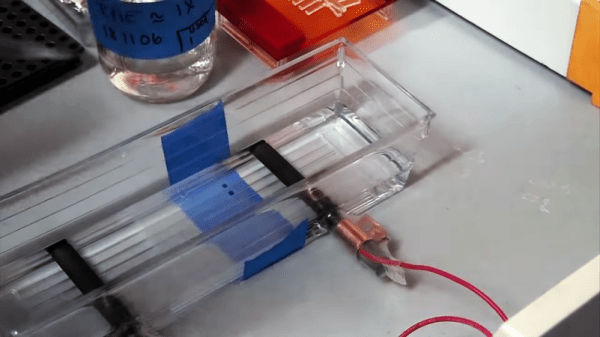
That’s the question that [Justin] from The Thought Emporium is trying to answer with a series of videos where he does exactly that – build a molecular biology lab from scratch. In the current installment, [Justin] covers the basics of agarose gel electrophoresis, arguably the fundamental skill for aspiring bio-geeks. Electrophoresis is simply using an electric field to separate a population of macromolecules, like nucleic acids and proteins, based on their sizes. [Justin] covers the basics, from building a rig for running agarose gels to pouring the gels to doing the actual separation and documenting the results. Commercial grade gear for the job is priced to squeeze the most money out of a grant as possible, but his stuff is built on the cheap, from dollar-store drawer organizers and other odd bits. It all works, and it saves a ton of money that can be put into the things that make more sense to buy, like fluorescent DNA stain for visualizing the bands; we’re heartened to see that the potent carcinogen ethidium bromide that we used back in the day is no longer used for this.

We’re really intrigued with [Justin]’s bio lab buildout, and it inspires us to do the same here. This and other videos in the series, like his small incubators built on the cheap, will go a long way to helping others get into biohacking.

Continue reading “Simple, Low-Cost Rig Lets The Budding Biohacker Run DNA Gels”

72 Tranducers For Acoustic Levitation

Levitation has a way of arousing curiousity and wonder wherever it appears. There’s a multitude of ways to do it, each with their own strengths and weaknesses and ideal use cases. [Julius Kramer] tried his hand at acoustic levitation, and decided to share his build.

The build relies on an astounding number of ultrasonic transducers – 72, in fact. The device operates at 40 kHz to be well above the human range of hearing. 36 each are placed in the top and bottom shells of the device’s 3D printed chassis. Through careful construction, the transducers are placed an integer multiple of half the wavelength apart. This allows the device to create a standing wave, with several low-energy nodes in which small objects can be levitated. In this case, [Julius] uses small scraps of styrofoam, but notes that water droplets can also be used if one is careful to avoid spilling any on the electronics.

The transducers are energised with a square wave generated by an Arduino Nano. This allows the possibility of the frequency and phase of the wave to be altered, which can help tune the device and allow some movement in the vertical axis. Unfortunately, movement in the other axes isn’t possible as the transducers appear to be connected in parallel. However, this could be a good upgrade in a later revision.

This project shows that a device relying on incredibly precise measurement and control can now be constructed at home with a 3D printer and some off the shelf electronics.

Now that you’ve whet your whistle, perhaps you’d like to tackle laser levitation?

[Thanks to Baldpower for the tip!]


Sci-Hub: Breaking Down The Paywalls

There’s a battle going on in academia between the scientific journal publishing companies that have long served as the main platform for peer review and spreading information, and scientists themselves who just want to share and have access to the work of their fellows. arxiv.org launched the first salvo, allowing researchers in physics to self-publish their own papers, and has gained some traction in mathematics and computer science. The Public Library of Science journals focus on biology and medicine and offer peer review services. There are many others, and even the big firms have been forced to recognize the importance of open science publication.

But for many, that’s still not enough. The high prestige journals, and most past works, are stuck behind paywalls. Since 2011, Sci-Hub has taken science publishing open by force, illegally obtaining papers and publishing them in violation of copyright, but at the same time facilitating scientific research and providing researchers in poorer countries with access that their rich-world colleagues take for granted. The big publishing firms naturally fought back in court and won, and with roughly $20 million of damages, drove Sci-Hub’s founder underground.

Continue reading “Sci-Hub: Breaking Down The Paywalls”

The Metal That Never Forgets: Nitinol And Shape-Memory

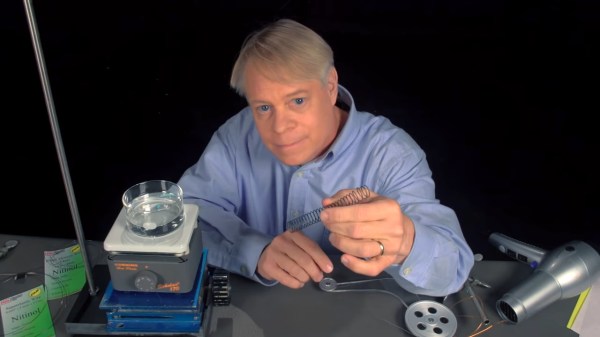
You’ve likely heard of Nitinol wire before, but we suspect the common base knowledge doesn’t go much beyond repeating that it’s a shape-memory alloy. [Bill Hammack], the Engineer Guy, takes us on a quick journey of all the cool stuff there is to know about Nitinol and shape-memory alloys.

The name itself is like saying Kleenex when you mean tissue, or using the V-word when you mean hook and loop fasteners. The first few letters of Nickel Titanium Naval Ordnance Laboratories combine to form the name of what is essentially a nickel-titanium alloy developed in 1962: Nitinol. It’s called shape-memory because you can stretch or bend it at room temperature and it will return to the original shape when heated at around 75 C (167 F). This particular metal can do that because its bonds form a “twinned structure” of rhombus shapes — bending or stretching moves those rhombuses (or rhombi, take your pick) but doesn’t change which atoms are bonded to one another.

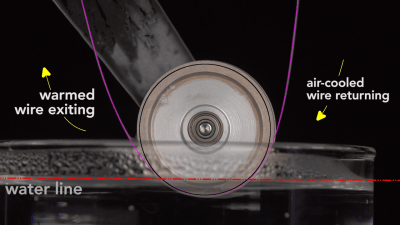
Has this material science excursion bored you to tears yet? That’s why we love [Bill’s] work. He has always done a fantastic job of demystifying common mysticism and this is no different. The video below does a much better job of illustrating what we’ve described above, but also pull out a Nitinol engine for added wow-factor. A straight piece of Nitinol is bent into a loop around two pulleys. The lower pulley is submerged in hot water, causing the Nitinol to want to straighten out, but it loops back to the top pulley, bending and cooling in the air and creating a lever effect that drives the engine. We saw a more complex version of this concept last year.

You know those eyeglass frames you can bend in any way and they’ll  pop back to the original shape? They’re taking advantage of the super-elasticity of Nitinol. [Bill] also recounts uses as stents for medical applications, and oddball engineering tricks in the automotive industry.

It’s great to see the Engineer Guy back. Favorites of ours have been the science behind disposable diapers and the aluminum beverage can. More recently he released Faraday’s lecture series, wrote a book on airships, appeared on Outlaw Tech on the Science Channel, and started a family. Thanks for fitting these illustrative videos in when you can [Bill]!

Continue reading “The Metal That Never Forgets: Nitinol And Shape-Memory”