Oceanography As Open As The Seas

With Earth in the throes of climate change and no suitable Planet B lined up just yet, oceanography is as important now as it has ever been. And yet, the instruments relied upon for decades to test ocean conditions are holding steady within the range of expensive to prohibitively expensive. Like any other area of science, lowering the barrier of entry has almost no disadvantages — more players means more data, and that means more insight into the inner workings of the briny deep.
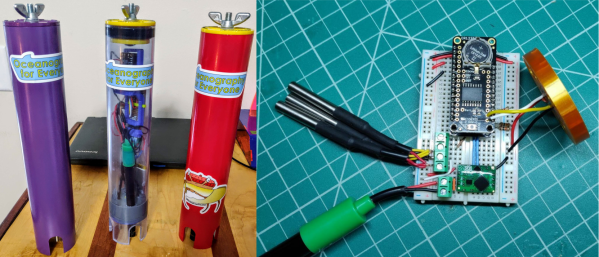
[Oceanography for Everyone] aims to change all that by showing the world just how easy it is to build an oceanographic testing suite that measures conductivity (aka salinity), temperature, and depth using common components. OpenCTD is designed primarily for use on the continental shelf, and has been successfully tested to a depth of 100 meters.

An Adalogger M0 and RTC Featherwing run the show from their waterproof booth in the center of the PVC tube. There’s a 14-bar pressure sensor for depth, a trio of DS18B20s for temperature averaging, and a commercial conductivity probe that gathers salinity data. These sensors are fed through a 3D-printed base plate and ultimately potted in stainless steel epoxy. The other end of the tube is sealed with a mechanical plug that seats and unseats with the whirl of a wingnut.

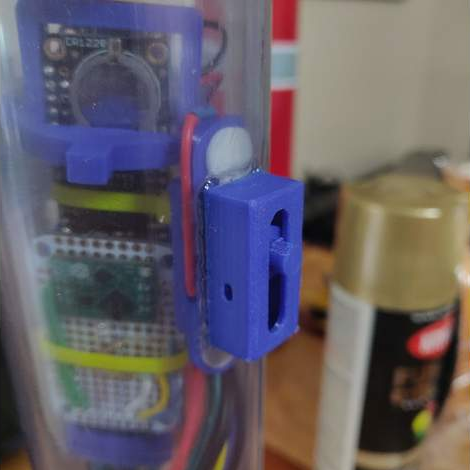
We particularly like the scratch-built magnetic slide switch that turns OpenCTD on and off without the need to open the cylinder. If you’d like to build one of these for yourself, take a deep dive into [Oceanography for Everyone]’s comprehensive guide — it covers the components, construction, and calibration in remarkable detail. The switch is explained starting on page 50. You can find out more about the work Oceanography for Everyone is doing at their site.

As far as cheap waterproof enclosures go, PVC is a great choice. It works well for underwater photography, too.


A Safer, Self-Healing Polymer Battery

Lithium-ion batteries are notorious for spontaneously combusting, with seemingly so many ways that it can be triggered. While they are a compact and relatively affordable rechargeable battery for hobbyists, damage to the batteries can be dangerous and lead to fires.

Several engineers from the University of Illinois have developed a solid polymer-based electrolyte that is able to self-heal after damage, preventing explosions.The material can also be recycled without the use of high temperatures or harsh chemical catalysts. The results of the study were published in the Journal of the American Chemical Society.

As the batteries go through cycles of charge and discharge, they develop branch-like structures known as dendrites. These dendrites, composed of solid lithium, can cause electrical shorts and hotspots, growing large enough to puncture internal parts of the battery and causing explosive chemical reactions between the electrodes and electrolyte liquids. While engineers have been looking to replace liquid electrolytes in lithium-ion batteries with solid materials, many have been brittle and not highly conductive.

The high temperatures inside a battery melt most solid ion-conducting polymers, making them a less attractive option for non-liquid electrolytes. Further studies producing solid electrolytes from networks of cross-linked polymer strands delays the growth of dendrites but produces structures that are too complex to be recovered after damage. In response, the researchers at University of Illinois developed a similar network polymer electrolyte where the cross-link point undergoes exchange reactions and swaps out polymer strands. The polymers stiffen upon heating, minimizing the dendrite problem and more easily breaking down and resolidifying the electrolyte after damage.

Unlike conventional polymer electrolytes, the new polymer also shows properties of conductivity and stiffness increasing with heating. The material dissolves in water at room temperature, making it both energy-efficient and environmentally friendly as well.

Tetraethyl Lead: The Solution To One, And Cause Of Many New Problems

From the 1920s until the 1970s, most gasoline cars in the USA were using fuel that had lead mixed into it. The reason for this was to reduce the engine knocking effect from abnormal combustion in internal combustion engines of the time. While lead — in the form of tetraethyllead — was effective at this, even the 1920s saw both the existence of alternative antiknock agents and an uncomfortable awareness of the health implications of lead exposure.

We’ll look at what drove the adoption of tetraethyllead, and why it was phased out once the environmental and health-related issues came into focus. But what about its antiknock effects? We’ll also be looking at the alternative antiknock agents that took its place and how this engine knocking issue is handled these days.

Continue reading “Tetraethyl Lead: The Solution To One, And Cause Of Many New Problems”

Particle Accelerators That Fit On A Chip

If you were asked to imagine a particle accelerator, you would probably picture a high-energy electron beam contained within a kilometers-long facility, manned by hundreds of engineers and researchers. You probably wouldn’t think of a chip smaller than a fingernail, yet that’s exactly what the SLAC National Accelerator Laboratory’s Accelerator on a Chip International Program (ACHIP) has accomplished.

The Stanford University team developed a device that uses lasers to accelerate electrons along etched channels on a silicon chip. The idea for a miniature accelerator has existed since the laser’s invention in 1960, but the requirement for a device to generate electrons made the early proof-of-concepts difficult to manufacture in bulk.

via Scientific American

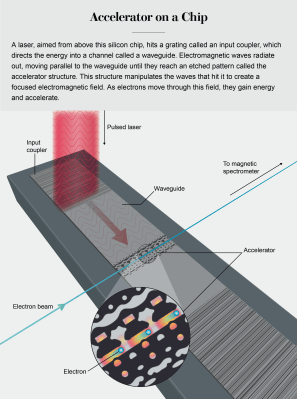
The electromagnetic waves produced by lasers have much shorter wavelengths than the microwaves used in full-scale accelerators, allowing them to accelerate electrons in a far more confined space – channels can be shrunk to three one-thousandths of a millimeter wide. In order to couple the lasers and electrons properly, the light waves must push the particles in the correct direction with as much energy as possible. This also requires the device to generate electrons and transmit them via the proper channel. With an accelerator engraved in silicon, multiple components can fit on the same chip.

Within the latest prototype, a laser hits a grating from above the chip, directing the energy into a waveguide. The electromagnetic waves radiate out, moving with the waveguide until they reach an etched pattern that creates a focused electromagnetic field. As electrons move through the field, they accelerate and gain energy.

The results showed that the prototype could boost the electrons by 915 electron volts, equivalent to the electrons gaining 30 million electron volts over a meter. While the change is not on the scale of SLAC, it does scale up more easily since researchers can fit multiple accelerating paths onto future designs without the bulk of a full-scale accelerator. The chip exists as a single stage of the accelerator, allowing more researchers to conduct experiments without the need to reserve space in expensive full-scale particle accelerators.

Continue reading “Particle Accelerators That Fit On A Chip”

Anti-Bacterial Plastic Wrap Clings To Hope Of Stopping Superbugs’ Spread

Researchers at McMaster University in Ontario have developed a plastic wrap that repels viruses and bacteria, including some of the scariest antibiotic-resistant superbugs known to science. With the help of a scanning electron microscope, the researchers were able to watch superbugs like MRSA and Pseudomonas bounce right off the surface.

The wrap can be applied to things temporarily, much like that stuff you wrestle from the box and stretch over your leftovers. It can also be shrink-wrapped to any compatible surface without losing effectiveness. The ability to cover surfaces with bacteria-shielding armor could have an incredible impact on superbug populations inside hospitals. It could be shrink-wrapped to all kinds of things, from door handles to railings to waiting room chair armrests to the pens that everyone uses to sign off on receiving care.

Continue reading “Anti-Bacterial Plastic Wrap Clings To Hope Of Stopping Superbugs’ Spread”

A DNA-Based Computer Calculates Square Roots Up To 900

While DNA-based computing may not be taking over silicon quite so soon, there is progress in the works. In a paper published by Small, researchers from the University of Rochester demonstrate a molecular computing system capable of calculating square roots of integers up to 900. The computer is built from synthetic biochemical logic gates using hybridization, a process where two strands of DNA join to form double-stranded DNA, and strand displacement reactions.

DNA-based circuits have already been shown to implement complex logic functions, but most existing circuits prior to the recent paper were unable to calculate square root operations. This required 4-bit binary numbers – the new prototype implements a 10-bit square root logic circuit, operating up to the decimal integer 900.

The computer uses 32 strands of DNA for storing and processing information. The process uses three modules, starting off with encoding a number on the DNA. Each combination is attached to a florescent marker, which changes signal during hybridization in the second module. The process for calculating the square root controls the signals, with the results deducted from the final color according to a threshold set in the third module.

We’re beginning to see the end of Moore’s Law approaching, with companies like Intel and AMD struggling to shrink transistors 10 nm wide. Nevertheless, with DNA molecules still about 10 time smaller than the best transistors today and DNA computing systems continuing to gain in sophistication, biochemical circuits could potentially be holding solutions to increasing the speed of computing beyond silicon computing.

Titanium Coating Is Actually Pretty Straightforward

[Justin] enjoys tinkering in his home lab, working on a wide variety of experiments. Recently, he’d found much success in coating objects with thin layers of various metals with the help of a DC sputtering magnetron. However, titanium simply wouldn’t work with this setup. Instead, [Justin] found another way.

As it turns out, coating with titanium is quite achievable for even the garage operative. Simply run current through a titanium wire, heating it above 900 degrees in a vacuum. This will create a shower of titanium atoms that will coat virtually anything else in the chamber. [Justin] was able to achieve this with little more than some parts from Home Depot, a vacuum pump, and a cheap glass jar. He was able to produce a nice titanium oxide finish on a knife blade, giving that classic rainbow look. Coating crystals was less straightforward, but the jet black finish achieved was impressive nonetheless.

[Justin] plans to upgrade his vacuum rig further, and with better process control, we’d expect even better results. The earlier work is also very relevant if you’re interested in creating fine coatings of other materials. Video after the break. Continue reading “Titanium Coating Is Actually Pretty Straightforward”