Why X86 Needs To Die

As I’m sure many of you know, x86 architecture has been around for quite some time. It has its roots in Intel’s early 8086 processor, the first in the family. Indeed, even the original 8086 inherits a small amount of architectural structure from Intel’s 8-bit predecessors, dating all the way back to the 8008. But the 8086 evolved into the 186, 286, 386, 486, and then they got names: Pentium would have been the 586.

Along the way, new instructions were added, but the core of the x86 instruction set was retained. And a lot of effort was spent making the same instructions faster and faster. This has become so extreme that, even though the 8086 and modern Xeon processors can both run a common subset of code, the two CPUs architecturally look about as far apart as they possibly could.

So here we are today, with even the highest-end x86 CPUs still supporting the archaic 8086 real mode, where the CPU can address memory directly, without any redirection. Having this level of backwards compatibility can cause problems, especially with respect to multitasking and memory protection, but it was a feature of previous chips, so it’s a feature of current x86 designs. And there’s more!

I think it’s time to put a lot of the legacy of the 8086 to rest, and let the modern processors run free. Continue reading “Why X86 Needs To Die”
The F Number On A Lens Means Something? Who Knew!

The Raspberry Pi has provided experimenters with many channels of enquiry, and for me perhaps the furthest into uncharted waters it has led me has come through its camera interface. At a superficial level I can plug in one of the ready-made modules with a built-in tiny lens, but as I experiment with the naked sensors of the HD module and a deconstructed Chinese miniature sensor it’s taken me further into camera design than I’d expected.

I’m using them with extra lenses to make full-frame captures of vintage film cameras, in the first instance 8 mm movie cameras but as I experiment more, even 35 mm still cameras. As I’m now channeling the light-gathering ability of a relatively huge area of 1970s glass into a tiny sensor designed for a miniature lens, I’m discovering that maybe too much light is not a good thing. At this point instead of winging it I found it was maybe a good idea to learn a bit about lenses, and that’s how I started to understand what those F-numbers mean.

More Than The Ring You Twiddle To Get The Exposure Right

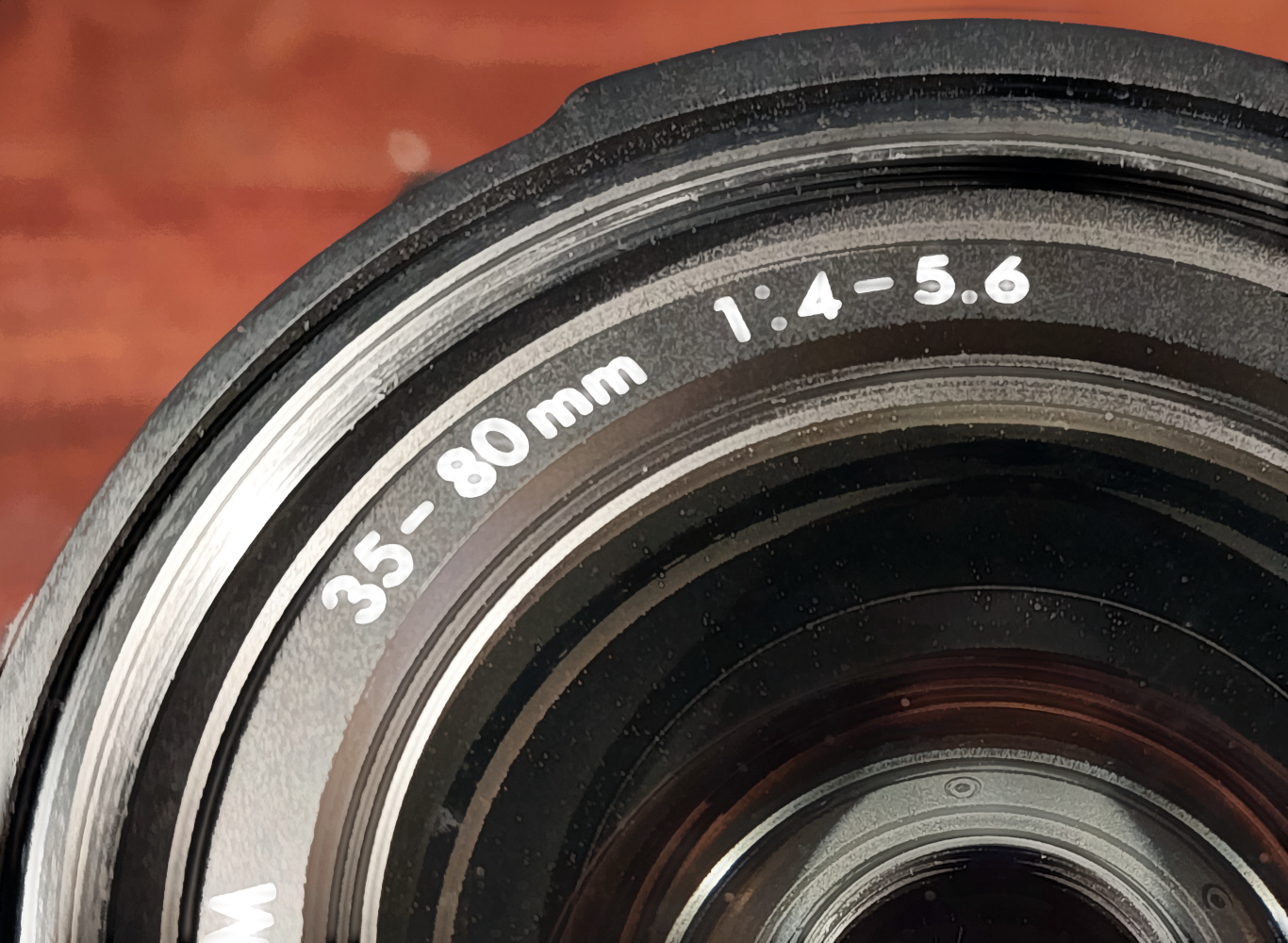
lose-up of the end of a lens, showing the F-number range
The F-number range of a 1990s Sigma consumer-grade zoom lens.

I’m not a photographer, instead I’m an engineer who likes tinkering with cameras and who takes photographs as part of her work but using the camera as a tool. Thus the f-stop ring has always been for me simply the thing you twiddle when you want to bring the exposure into range, and which has an effect on depth of field.

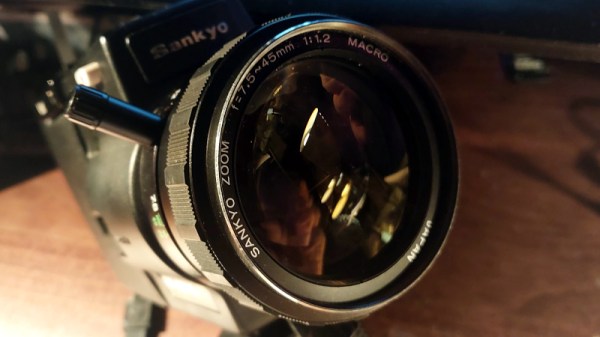
The numbers were always just numbers, until suddenly I had to understand them for my projects to work. So the first number I had to learn about was the F-number of the lens itself. It’s usually printed on the front next to the focal length and expressed as a ratio of the diameter of the light entrance to the lens focal length. Looking around my bench I see numbers ranging from 1:1 for a Canon 8mm camera to 1:2.8 for a 1950s Braun Paxette 35 mm camera, but it seems that around 1:1.2 is where most 8 mm cameras sit and 1:2 is around where I’m seeing 35 mm kit lenses. The F-stop ring controls an adjustable aperture, and the numbers correspond to that ratio. So that 1:2 kit lens is only 1:2 at the F2 setting, and becomes 1:16 at the F16 setting.

Continue reading “The F Number On A Lens Means Something? Who Knew!”

Illustrated Kristina with an IBM Model M keyboard floating between her hands.

Keebin’ With Kristina: The One With The Offset-Stem Keycaps

Image by [Leo_keeb] via reddit
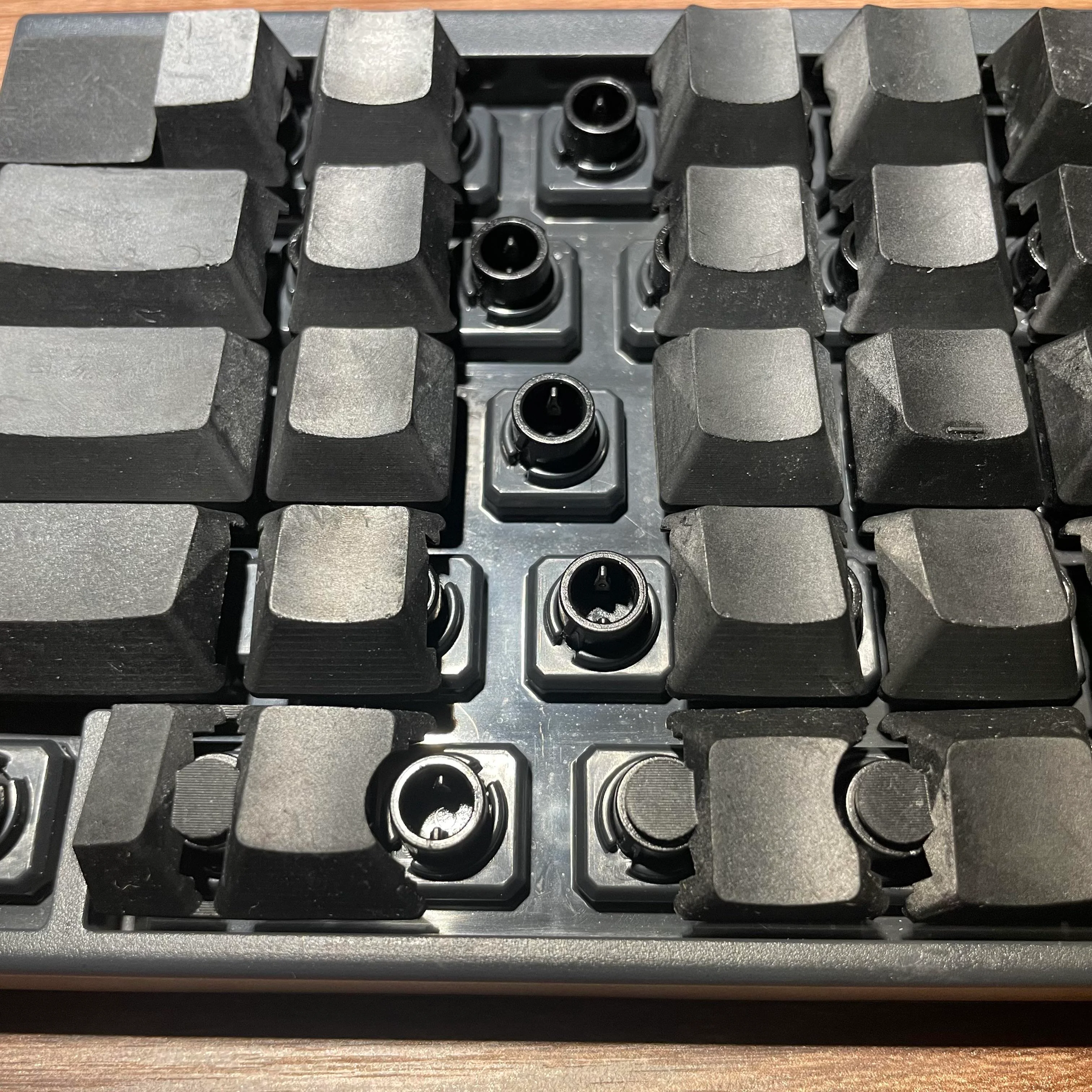
Love it or hate it, I think this is a really cool idea. [Leo_keeb] has designed a new set of keycaps for the Happy Hacking Keyboard (HHKB). The keycaps’ stems are offset to the left or right in order to turn this once-staggered keyboard into an ortholinear object.

So, how do they feel? There is a slight wobble to them, according to [Leo_keeb] — it’s a bit like pressing the left or right side of Tab. But the actuation is smooth, they say.

As you can see, these resin keycaps weren’t designed with the typical Cherry MX profile in mind, they are made for the Topre capacitive key switches of the HHKB. (No, those aren’t weird rubber domes.)

When I asked about sharing the STLs, [Leo_keeb] advised me that they might be willing to release STLs for  Cherry MX switches in the US layout if there is enough interest.

Continue reading “Keebin’ With Kristina: The One With The Offset-Stem Keycaps”

Hackaday Links Column Banner

Hackaday Links: March 17, 2024

A friend of ours once described computers as “high-speed idiots.” It was true in the 80s, and it appears that even with the recent explosion in AI, all computers have managed to do is become faster. Proof of that can be found in a story about using ASCII art to trick a chatbot into giving away the store. As anyone who has played with ChatGPT or its moral equivalent for more than five minutes has learned, there are certain boundary conditions that the LLM’s creators lawyers have put in place to prevent discussion surrounding sensitive topics. Ask a chatbot to deliver specific instructions on building a nuclear bomb, for instance, and you’ll be rebuffed. Same with asking for help counterfeiting currency, and wisely so. But, by minimally obfuscating your question by rendering the word “COUNTERFEIT” in ASCII art and asking the chatbot to first decode the word, you can slip the verboten word into a how-to question and get pretty explicit instructions. Yes, you have to give painfully detailed instructions on parsing the ASCII art characters, but that’s a small price to pay for forbidden knowledge that you could easily find out yourself by other means.

Continue reading “Hackaday Links: March 17, 2024”

Hackaday Podcast Episode 262: Wheelchair Hacking, Big Little Science At Home, Arya Talks PCBs

Join Hackaday Editors Elliot Williams and Tom Nardi as they go over their favorite hacks and stories from the past week.  This episode starts off with an update on Hackaday Europe 2024, which is now less than a month away, and from there dives into wheelchairs with subscription plans, using classic woodworking techniques to improve your 3D printer’s slicer, and a compendium of building systems. You’ll hear about tools for finding patterns in hex dumps, a lusciously documented gadget for sniffing utility meters, a rare connector that works with both HDMI and DisplayPort, and a low-stress shortwave radio kit with an eye-watering price tag. Finally, they’ll take a close look at a pair of articles that promise to up your KiCAD game.

Check out the links below if you want to follow along, and as always, tell us what you think about this episode in the comments!

Direct download in DRM-free MP3.

Continue reading “Hackaday Podcast Episode 262: Wheelchair Hacking, Big Little Science At Home, Arya Talks PCBs”

This Week In Security: Apple Backdoors Curl, Tor’s New Bridge, And GhostRace

OK, that headline is a bit of a cheap shot. But if you run the curl binary that Apple ships, you’re in for a surprise if you happen to use the --cacert flag. That flag specifies that TLS verification is only to be done using the certificate file specified. That’s useful to solve certificate mysteries, or to make absolutely sure that you’re connecting to the server you expect.

What’s weird here is that on a MacOS, using the Apple provided curl binary, --cacert doesn’t limit the program to the single certificate file. On an Apple system, the verification falls back to the system’s certificate store. This is an intentional choice by Apple, but not one that’s aimed particularly at curl. The real magic is in Apple’s SSL library, which forces the use of the system keychain.

The current state of things is that this option is simply not going to do the right thing in the Apple provided binary. It’s documented with the note that “this option is supported for backward compatibility with other SSL engines, but it should not be set.” It’s an unfortunate situation, and we’re hopeful that a workaround can be found to restore the documented function of this option. Continue reading “This Week In Security: Apple Backdoors Curl, Tor’s New Bridge, And GhostRace”

Retrotechtacular: Air Mail For The Birds

Today, if you want to send a message to a distant location, you’ll probably send an e-mail or a text message. But it hasn’t always been that easy. Military commanders, in particular, have always needed ways to send messages and were early adopters of radio and, prior to that, schemes like semaphores, drums, horns, Aldis lamps, and even barrels of water to communicate over distances.

One of the most reliable ways to pass messages, even during the last world war, was by carrier pigeon.  Since the U.S. Army Signal Corps handled anything that included messages, it makes sense that the War Department issued TM 11-410 about how to use and care for pigeons. Think of it as the network operations guide of 1945. The practice, though, is much older. There is evidence that the Persians used pigeons in the 6th century BC, and Julius Caesar’s army also used the system.

You wouldn’t imagine that drawing an assignment in the Signal Corps might involve learning about breeding pigeons, training them, and providing them with medical attention, but that’s what some Signal Corps personnel did. The Army started experimenting with pigeons in 1878, but the Navy was the main user of the birds until World War I, when the U.S. Pigeon Intelligence Service was formed. In World War II, they saw use in situations where radio silence was important, like the D-Day invasion.

The Navy also disbanded its earlier Pigeon Messenger Service. It then returned to avian communications during the World Wars, using them to allow aviators to send messages back to base without radio traffic. The Navy had its own version of the pigeon manual.

Continue reading “Retrotechtacular: Air Mail For The Birds”