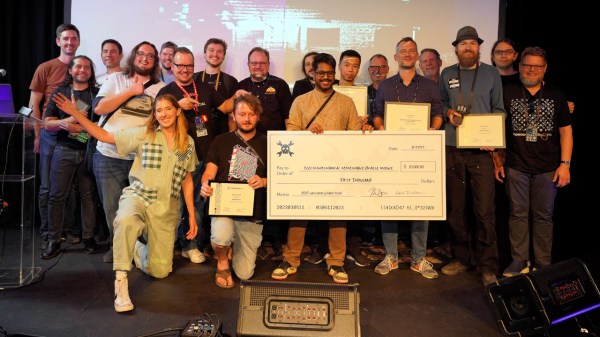
It’s a fact of life — all good things must eventually come to an end. The trick is not to focus so much on the chapter that’s closing, but look ahead to what comes next. This is precisely how the Hackaday Prize ended its incredible ten-year run on Saturday during Supercon.
This final year of the competition saw some of the most impressive entries we’ve ever had, leaving us with five exceptionally promising winners. These projects exemplify the qualities that the Hackaday Prize was designed to seek out and amplify and make a perfect capstone for this grand experiment in philanthropic hacking.
Although it probably feels like forever to many of us since Category 5 Ethernet cabling became prevalent, now that 2.5 and even 5 Gbit Ethernet has trickled into the mainstream, a pertinent question that many probably end up asking, is when you should replace Cat-5e wiring with Cat-6, or even Cat-7. Since most of us are likely to use copper network wiring for the foreseeable future in our domiciles and offices, it is a good question that deserves a good answer. Although swapping a Cat-5e patch cable with a Cat-7 one between a network port and computer is easy enough, replacing all the network cable already pulled through the conduits of a ‘future-proofed’ home is not.
The good news is probably that Category 8 Class II (Cat-8.2) is all you need to run your 40 Gbit Ethernet network with standard twisted pair wiring. The bad news is that you’re limited to runs of only thirty meters before signal degradation begins to kick in. If you take things down a notch to Cat-6A or Cat-7 (ISO/IEC 11801 Class EA and F, respectively), you can do 100 meter runs at 10 Gbit/s just like 100 meters runs at 1 Gbit/s were possible with Cat-5e before. Yet what differentiates these categories exactly?
As I write this, Supercon 2023 is in full swing down in Pasadena — 80 degrees and sunny at the moment, as opposed to 50 and pouring rain where I am, not that I’m bitter. Luckily, though, we can all follow along with the proceedings thanks to the livestreams on the Hackaday channel, which of course will all be available once they’re edited in case you miss anything live. There are a ton of interesting talks coming up, so there’ll be a lot to catch up on when the dust settles. And that won’t be far from now; by the time this post publishes, Supercon will be all but over, which makes it the Thanksgiving dinner of cons — all that work and it’s over in just a few minutes.
We’ve talked a few times here about the issues with the CVSS system. We’ve seen CVE farming, where a moderate issue, or even a non-issue, gets assigned a ridiculously high CVSS score. There are times a minor problem in a library is a major problem in certain use cases, and not an issue at all in others. And with some of those issues in mind, let’s take a look at the fourth version of the Common Vulnerability Scoring System.
One of the first tweaks to cover is the de-emphasis of the base score. Version 3.1 did have optional metrics that were intended to temper the base score, but this revision has beefed that idea up with Threat Metrics, Environmental Metrics, and Supplemental Metrics. These are an attempt to measure how likely it is that an exploit will actually be used. The various combinations have been given names. Where CVSS-B is just the base metric, CVSS-BT is the base and threat scores together. CVSS-BE is the mix of base and environmental metrics, and CVSS-BTE is the combination of all three.
Another new feature is multiple scores for a given vulnerability. A problem in a library is first considered in a worst-case scenario, and the initial base score is published with those caveats made clear. And then for each downstream program that uses that library, a new base score should be calculated to reflect the reality of that case. Continue reading “This Week In Security: CVSS 4, OAuth, And ActiveMQ”→
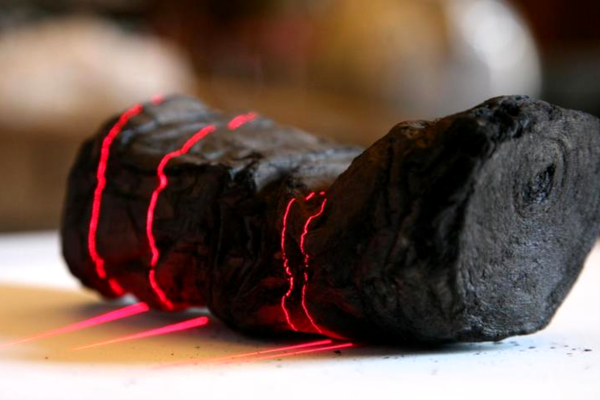
Imagine trying to read a 2000-year old scroll from an ancient civilization. Now imagine that scroll is rolled up, and in a delicate, charred, carbonized form, having been engulfed by the fiery eruption of a volcano. The task would seem virtually impossible, and the information in the scroll lost forever. Right?|
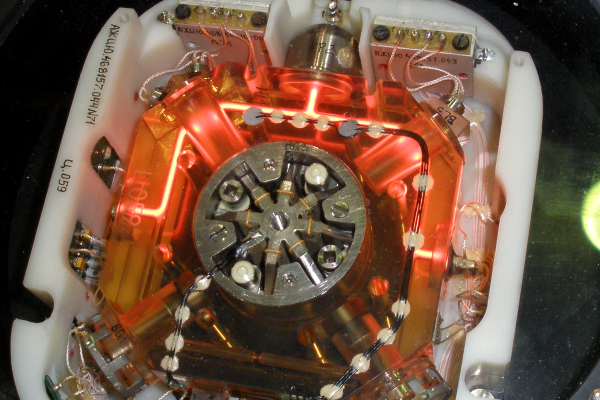
Back in the old days, finding out your location on Earth was a pretty involved endeavor. You had to look at stars, use fancy gimballed equipment to track your motion, or simply be able to track your steps really really well. Eventually, GPS would come along and make all that a bit redundant for a lot of use cases. That was all well and good, until it started getting jammed all over the place to frustrate militaries using super-accurate satellite-guided weapons.
Today, there’s a great desire for more accurate navigational methods that don’t require outside communications that can easily be jammed. High-tech gyroscopes have long been a big part of that effort, allowing the construction of inertial navigation systems with greater accuracy than ever before.
I never feel like I have enough space in my workshop. The promise of consolidating tools to make the most of limited space drew me to the Snapmaker Artisan, a plus-sized 3-in-1 tool combining 3D printer, laser engraver, and CNC machine.
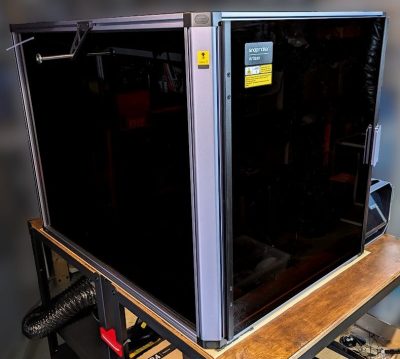
Smaller than three separate tools, but still big.
Jacks of all trades may be masters of none, but it is also true that a tool does not need to be a master of its functions to be useful. For many jobs, it enough to simply be serviceable. Does a machine like the Artisan offer something useful to a workshop?
Snapmaker was kind enough to send me an Artisan that I have by now spent a fair bit of time with. While I have come to expect the occasional glitch, having access to multiple functions is great for prototyping and desktop manufacturing.
This is especially true when it allows doing a job in-house where one previously had to outsource, or simply go without. This combo machine does have something to offer, as long as one can give it generous table space in return.
What It Is
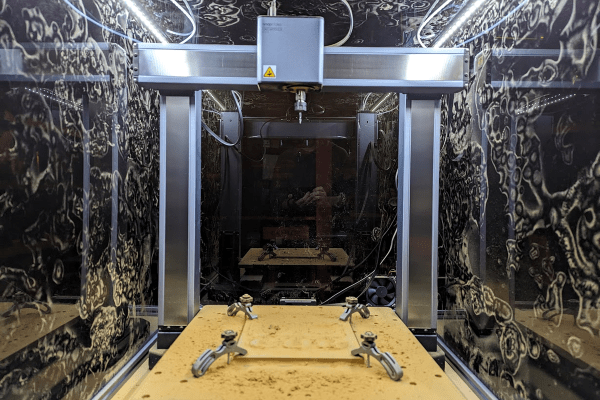
The Artisan is a large dual-extrusion 3D printer, CNC router, and diode-based laser engraver. To change functions, one physically swaps toolheads and beds. Very thankfully, there are quick-change fixtures for this.
Driving the Artisan is Snapmaker’s software Luban (GitHub respository). Named for the ancient Chinese master craftsman, it is responsible for job setup and control. For laser and CNC work, there are convenient built-in profiles for a variety of paper, plastic, leather, and wood products.
The unit is enclosed, nicely designed, and — while I have come to expect the occasional glitch — serviceable at all three of its functions. The size and stature of the machine warrants some special mention, however.