Decellularization: Apples To Earlobes

Our bodies are not like LEGO blocks or computers because we cannot swap out our parts in the living room while watching television. Organ transplants and cosmetic surgery are currently our options for upgrades, repairs, and augments, but post-transplant therapy can be a lifelong commitment because of rejection. Elective surgery costs more than a NIB Millenium Falcon LEGO set. Laboratories have been improving the processes and associated treatments for decades but experimental labs and even home laboratories are getting in on the action as some creative minds take the stage. These folks aren’t performing surgeries, but they are expanding what is possible to for people to do and learn without a medical license.

One promising gateway to human building blocks is the decellularization and recellularization of organic material. Commercial scaffolds exist but they are expensive, so the average tinkerer isn’t going to be buying a few to play with over a holiday weekend.

Let’s explore what all this means. When something is decellularized, it means that the cells are removed, but the structure holding the cells in place remains. Recellularizing is the process where new cells are grown in that area. Decellularizing is like stripping a Hilton hotel down to the girders. The remaining structures are the ECM or the Extra Cellular Matrix, usually referred to as scaffolding. The structure has a shape but no functionality, like a stripped hotel. The scaffolding can be repopulated with new cells in the same way that our gutted hotel can be rebuilt as a factory, office building, or a hospital.
Continue reading “Decellularization: Apples To Earlobes” →

Milspec Teardown: AH-64A Apache Data Entry Panel

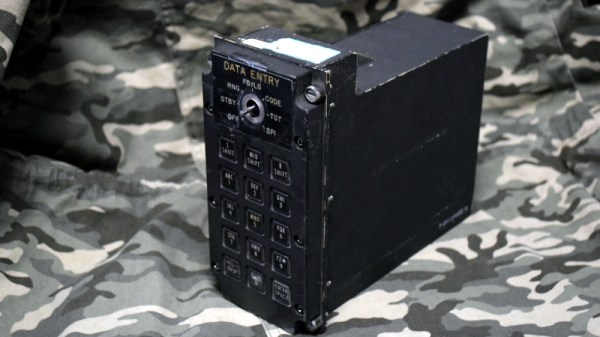
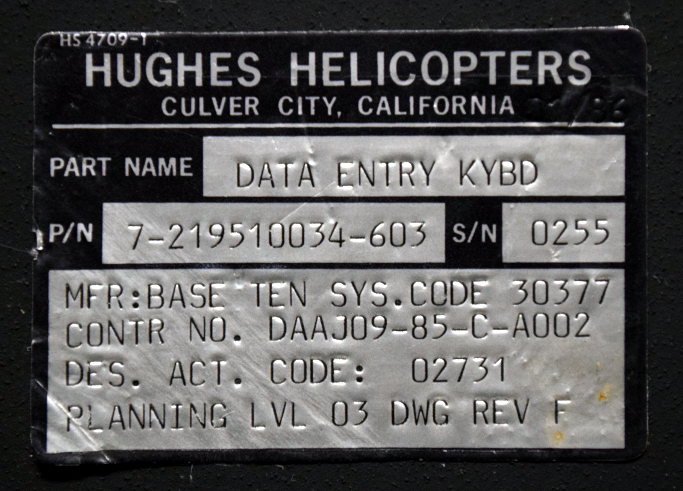
It’s time once again to see how those tax dollars are spent, this time in the form of a “Data Entry Keyboard” manufactured by Hughes Helicopters. This device was built circa 1986 or so, and was used in the AH-64A Apache. Specifically, this panel would have been located by the gunner’s left knee, and served as a general purpose input device for the Apache’s Fire Control System. Eventually the Apache was upgraded with a so-called “glass cockpit”; consolidating various vehicle functions into a handful of multi-purpose digital displays. As such, this particular device became obsolete and was pulled from the active Apache fleet.

The military vehicle aficionados out there may know that while the Apache is currently a product of Boeing, it was originally designed by Hughes Helicopter. In 1984, McDonnell Douglas purchased Hughes Helicopter and took over production of the Apache, and then McDonnell Douglas themselves were merged with Boeing in 1997.

So it’s somewhat interesting that this device bears the name of Hughes Helicopter, as of the time it was manufactured, they would have been known as McDonnell Douglas Helicopter Systems. Presumably they had to work through existing stock of components that already had Hughes branding on them, leaving some transitional examples such as this one.

But you didn’t come here for a history lesson on the American military-industrial complex, you want to know about the hardware itself. So let’s crack it open to see what we can learn about this piece of aviation history.

Continue reading “Milspec Teardown: AH-64A Apache Data Entry Panel” →

Hackaday Belgrade Schedule Announced

Hackaday Belgrade preparations have now passed the flash point and the hacker village that is set to descend on Serbia in a few weeks grows larger and more awesome by the day. Prepare for a massive data dump on what is in store. But before you go any further, make sure you have a ticket.

Continue reading “Hackaday Belgrade Schedule Announced” →

Core Memory Upgrade For Arduino

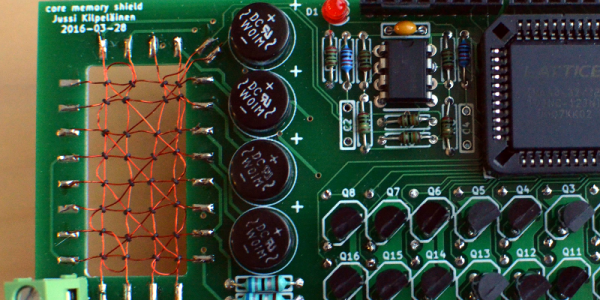
Linux programs, when they misbehave, produce core dumps. The reason they have that name is that magnetic core memory was the primary storage for computers back in the old days and many of us still refer to a computer’s main memory as “core.” If you ever wanted to have a computer with real core memory you can get a board that plugs into an Arduino and provides it with a 32-bit core storage. Of course, the Arduino can’t directly run programs out of the memory and as designer [Jussi Kilpeläinen] mentions, it is “hilariously impractical.” The board has been around a little while, but a recent video shined a spotlight on this retro design.

Impractical or not, there’s something charming about having real magnetic core memory on a modern CPU. The core plane isn’t as dense as the old commercial offerings that could fit 32 kilobits (not bytes) into only a cubic foot. We’ll leave the math about how much your 8-gigabyte laptop would have to grow to use core memory to you.

Continue reading “Core Memory Upgrade For Arduino” →

Mechanisms: The Lever, It’s Everywhere

Levers are literally all around us. You body uses them to move, pick up a pen to sign your name and you’ll use mechanical advantage to make that ballpoint roll, and that can of soda doesn’t open without a cleverly designed lever.

I got onto this topic quite by accident. I was making an ornithopter and it was having trouble lifting its wings. For the uninitiated, ornithopters are machines which fly by flapping their wings. The problem was that the lever arm was too short. To be honest, as I worked I wasn’t even thinking in terms of levers, and only realized that there was one after I’d fine-tuned its length by trial and error. After that, the presence of a lever was embarrassingly obvious.

I can probably be excused for not seeing a lever right away because it wasn’t the type we most often experience. There are different classes of levers and it’s safe to say that most people aren’t even aware of this. Let’s take a closer look at these super useful, and sometimes hidden mechanisms known as levers.

Continue reading “Mechanisms: The Lever, It’s Everywhere” →

First Lithographically Produced Home Made IC Announced

It is now six decades since the first prototypes of practical integrated circuits were produced. We are used to other technological inventions from the 1950s having passed down the food chain to the point at which they no longer require the budget of a huge company or a national government to achieve, but somehow producing an integrated circuit has remained out of reach. It’s the preserve of the Big Boys, move on, there’s nothing to see here.

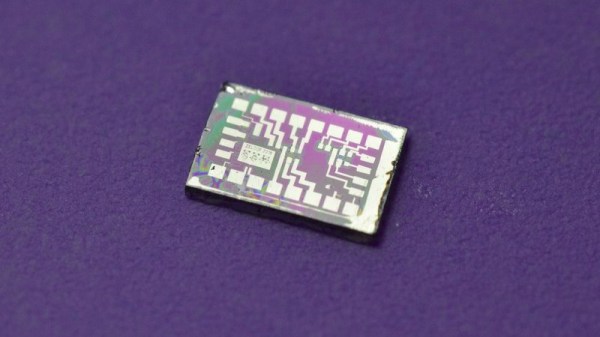
Happily for us there exists a dedicated band of experimenters keen to break that six-decade dearth of home-made ICs. And now one of them, [Sam Zeloof], has made an announcement on Twitter that he has succeeded in making a dual differential amplifier IC using a fully lithographic process in his lab. We’ve seen [Jeri Ellsworth] create transistors and integrated circuits a few years ago and he is at pains to credit her work, but her interconnects were not created lithographically, instead being created with conductive epoxy.

For now, all we have is a Twitter announcement, a promise of a write-up to come, and full details of the lead-up to this momentous event on [Sam]’s blog. He describes both UV lithography using a converted DLP projector and electron beam lithography using his electron microscope, as well as sputtering to deposit aluminium for on-chip interconnects. We’ve had an eye on his work for a while, though his progress has been impressively quick given that he only started amassing everything in 2016. We look forward to greater things from this particular garage.

Hackaday guide to Lathes

A Buyer’s Guide To Lathe Options

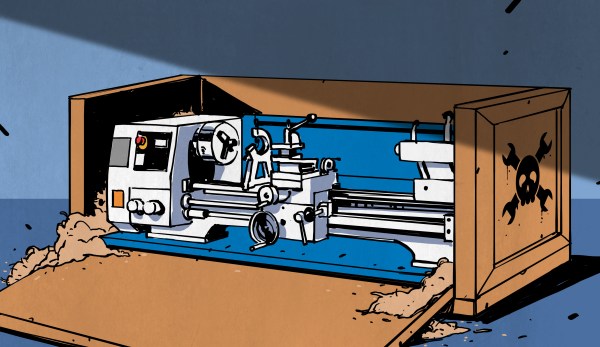
Lathes are complicated machines, and buying one requires weighing a lot of options. We’ve already talked about buying new Asian, or old American machines (with apologies to the Germans, British, Swiss, and all the other fine 20th century machine tool making-countries). We also talked about bed length and swing, and you ain’t got nothin’ if you ain’t got that swing. Let’s talk about the feature set now. If you’re buying new, you’ll shop on these details. If you’re buying used, knowing the differences will help you pick a good project machine.

Continue reading “A Buyer’s Guide To Lathe Options” →