Russian Rocket Tech Comes In From The Cold

Decades after the end of the space race, an American rocket took off from Cape Canaveral. This was a routine launch to send a communications satellite into orbit, but the situation was an historic first. The rocket in question was driven by a powerful Russian engine unlike any ever built in the States. Although this particular engine was new, the design dated back to the space age.

By the early 1960s, the Russians were leaps and bounds ahead of the United States in terms of space exploration. They had already launched Sputnik and sent Yuri Gagarin to orbit the Earth. All in all, the Russians seemed poised to send a man to the moon. Russian technology had the Americans worried enough to spy on them with satellites, and the images that came back revealed something spectacular. Out in the Kazakh desert, the Russians were building an enormous causeway and two launch pads. As it turns out, the US had every reason to be worried.

Continue reading “Russian Rocket Tech Comes In From The Cold” →

Joysix, Six Degree Of Freedom Mouse Made From Retractable Key Rings

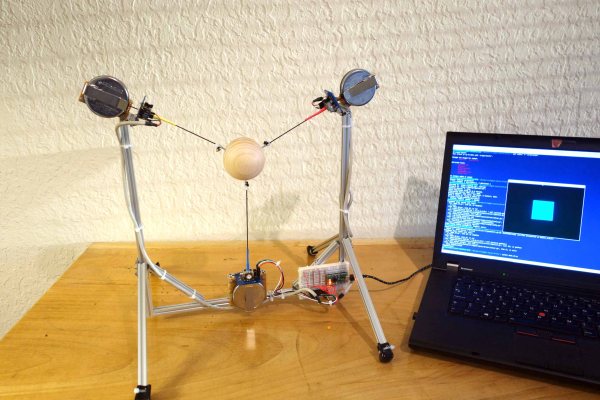
[Nicolas Berger] submits his six degree of freedom mouse project. He hopes to do things like control a robot arm or fly an alien mothership.

We thought the construction was really neat; suspending a wooden ball in the middle of three retractable key rings. By moving the ball around you can control the motion of a cube displayed on the computer. We first thought this was done by encoders or potentiometers measuring the amount of string coming out of the key fobs. However, what’s actually happening is a little bit cleverer.

[Nicolas] has joined each string with its own 2 axis joystick from Adafruit. He had some issues with these at first because the potentiometers in the joysticks weren’t linear, but he replaced them with a different module and got the expected output. He takes the angle values from each string, and a Python program numerically translates the output from the mouse into something the computer likes. The code is available on his GitHub. A video of the completed mouse is after the break.

Continue reading “Joysix, Six Degree Of Freedom Mouse Made From Retractable Key Rings” →

Experimental Gases, Danger, And The Rock-afire Explosion

DowntownExlosion12_1On the morning of September 26th, 2013 the city of Orlando was rocked by an explosion. Buildings shook, windows rattled, and Amtrak service on a nearby track was halted. TV stations broke in with special reports. The dispatched helicopters didn’t find fire and brimstone, but they did find a building with one wall blown out. The building was located at 47 West Jefferson Street. For most this was just another news day, but a few die-hard fans recognized the building as Creative Engineering, home to a different kind of explosion: The Rock-afire Explosion.

The Inventor and His Band of Robots

rockafireMany of us have heard of the Rock-afire Explosion, the animatronic band which graced the stage of ShowBiz pizza from 1980 through 1990. For those not in the know, the band was created by the inventor of Whac-A-Mole, [Aaron Fechter], engineer, entrepreneur and owner of Creative Engineering. When ShowBiz pizza sold to Chuck E. Cheese, the Rock-afire Explosion characters were replaced with Chuck E. and friends. Creative Engineering lost its biggest customer. Once over 300 employees, the company was again reduced to just [Aaron]. He owned the building which housed the company, a 38,000 square foot shop and warehouse. Rather than sell the shop and remaining hardware, [Aaron] kept working there alone. Most of the building remained as it had in the 1980’s. Tools placed down by artisans on their last day of work remained, slowly gathering dust.

Continue reading “Experimental Gases, Danger, And The Rock-afire Explosion” →

Build Your Swarm: Control Cockroaches For Under $30!

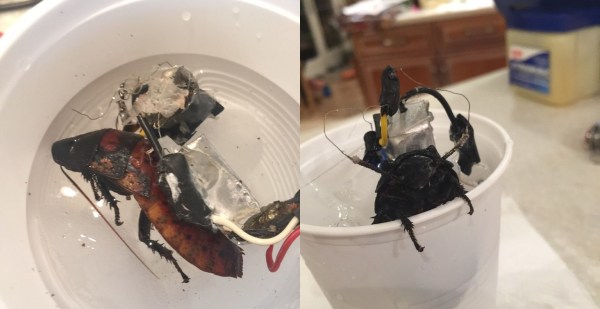
Have you ever wanted to control an army of cockroaches? We’ve all seen remote control cockroaches before — and they really are quite a fascinating specimen to work with — but did you know you can control one for about $30 worth of components, with a Arduino Micro?

It’s actually pretty simple. By stimulating a cockroaches antenna with variable frequencies (to mimic neural signals) you can convince the cockroach that they’ve hit a wall and should turn the other way. What results is a remote-controlled roach. How cool is that!

Continue reading “Build Your Swarm: Control Cockroaches For Under $30!” →

FTDI Drivers Break Fake Chips, Again

Just over a year ago, FTDI, manufacturers of the most popular USB to serial conversion chip on the market, released an update to their drivers that bricked FTDI clones. Copies of FTDI chips abound in the world of cheap consumer electronics, and if you’ve bought an Arduino for $3 from a random online seller from China, you probably have one of these fake chips somewhere in your personal stash of electronics.

After a year, we have the latest update to FTDI gate. Instead of bricking fake chips, the latest FTDI drivers will inject garbage data into a circuit. Connecting a fake FTDI serial chip to a computer running the latest Windows driver will output “NON GENUINE DEVICE FOUND!”, an undocumented functionality that may break some products.

FTDI gate mk. 1 merely bricked fake and clone chips, rendering them inoperable. Because fakes and clones of these chips are extremely common in the supply chain, and because it’s very difficult to both tell them apart and ensure you’re getting genuine chips, this driver update had the possibility to break any device using one of these chips. Cooler heads eventually prevailed, FTDI backed down from their ‘intentional bricking’ stance, and Microsoft removed the driver responsible with a Windows update. Still, the potential for medical and industrial devices to fail because of a random driver update was very real.

The newest functionality to the FTDI driver released through a Windows update merely injects unwanted but predictable data into the serial stream. Having a device spit out “NON GENUINE DEVICE FOUND!” won’t necessarily break a device, but it is an undocumented feature that could cause some devices to behave oddly. Because no one really knows if they have genuine FTDI chips or not – this undocumented feature could cause problems in everything from industrial equipment to medical devices, and of course in Arduinos whose only purpose is to blink a LED.

Right now, the only option to avoid this undocumented feature is to either use Linux or turn off Windows Update. Since the latter isn’t really a great idea, be prepared constantly roll back the FTDI driver to a known good version.


A Hackers Guide To Arts, Crafts, Food, And Music In Shenzhen

When you mention Shenzhen, many people think about electronic gadgets, cheap components, manufacturing, and technology. I’m there quite often and find that all of the technology and manufacturing related stress can be overwhelming at times. Sometimes I feel the need to escape it all so I go to markets and places that aren’t traditionally associated with technology so I can clear my head as well as expose myself to something different. It provides me with a constant source of new design ideas and also allows me to escape the persistent tech treadmill that Shenzhen runs on. There are a lot of places in Shenzhen that I consider hidden gems that don’t get a lot of press since mainstream media associates Shenzhen with either factories or technology. Here are my favorite places to window shop and de-stress in Shenzhen.

Continue reading “A Hackers Guide To Arts, Crafts, Food, And Music In Shenzhen” →

Hackaday And Adafruit Launch The Pi Zero Contest

Hackaday and Adafruit are teaming up to bring you the Pi Zero Contest. Unless you’ve been hiding out in your workshop for the past month or so, you probably already know The Pi Zero is the $5 Linux-based computer which has been taking the world by storm. Think you have the next great project for this single-board computer? Enter it for a chance to take home one of three $100 gift certificates to the Hackaday Store. We know Zeros have been hard to find, so we’ll be giving away 10 of them before the contest is over. Even if you don’t have a Pi Zero, read on!

This is all about documenting quality projects to Hackaday.io. We’re looking for well thought out, well documented builds intended for the Pi Zero. Any project submitted to this contest can also be rolled over to the 2016 Hackaday Prize. Think of it as getting a head start.

Here are the details:

  • From February 2nd, to February 20th, Lady Ada will make 10 ‘From the Desk of Lady Ada’ broadcasts focusing on this contest. During each broadcast she will present an idea for a Pi Zero Project. You don’t have to build Lady Ada’s projects, they’re starter ideas to get your wheels turning. If you don’t have a Raspberry Pi Zero, don’t worry! You can prototype with a Raspberry Pi Model B, or a Pi 2. There are also 10 Pi Zero boards up for grabs before the contest is over.
  • The deadline for winning a Pi Zero is 12:00am PST February 25th, 2016. The judges will pick the 10 most well thought out and well documented projects.
  • On February 29th, the judges will announce the winners of 10 Raspberry Pi Zero boards.
  • The grand prize for this contest is one of three $100 gift cards to the Hackaday store. The deadline to enter is 12:00 am PST March 14th, 2016.

Entering is easy.  All you have to do is submit your project. Just click the “Submit to” drop down list on your project page. Then select Adafruit Pi Zero Contest.

So fire up your soldering irons, warm up your 3D printers, and load up your favorite code editor. It’s time to start hacking!