Star Wars Car That Never Was: Obi-Shawn’s Custom Z-Wing

Star Wars never had cars. Sure, there was the Landspeeder, and the Speeder Bike, but both point to a lack of wheels a long time ago. So those who want to drive around a Star Wars craft are left to their own imagination to come up with one. This is exactly what [Obi-Shawn], aka [Shawn Crosby], did to build his Z-Wing.

Continue reading “Star Wars Car That Never Was: Obi-Shawn’s Custom Z-Wing”

Hackaday’s Omnibus Vol. 2, Now In Stock

Last month, we announced a preorder for volume two of the Hackaday Omnibus, a collection of content written over the course of this year that is the best we have to offer. Now, there is a warehouse full of deceptively heavy boxes, and the Hackaday Omnibus Vol. 2 is now in stock.

bus9Inside the second edition of the Hackaday Omnibus is 128 pages of actual, real content. There are zero ads, no sponsored content, and absolutely nothing that tells you to go out and buy something. Opening it is an experience unlike anything. Where can you read something for minutes at a time with no interruptions, no email, no Twitter, no Facebook, no text messages, and no ads? You won’t find something like this anywhere else.

The electronics, trade, and tech magazines have a long and storied history. In the 1930s, there were magazines that would teach you how to build a radio. In the 1950s, there were print articles saying fusion power was just fifty years away. The Hackaday Omnibus continues this tradition with relevant content for today: everything from car hacking and open source insulin, to retrospectives on oft-forgotten parts of our digital heritage are included. This is the best we have to offer, and we’re doing it without selling out.

Volume Two of the Hackaday Omnibus isn’t the end for our print endeavours – we’re just getting started. We’re committed to producing the best content in an interruption-free format. Print is dead, after all, and that’s why we put a skull on it.

You can purchase the Hackaday Omnibus Volume Two on the Hackaday Store.

FIRST Robotics Gives Us Hope In The Next Generation Of Hackers

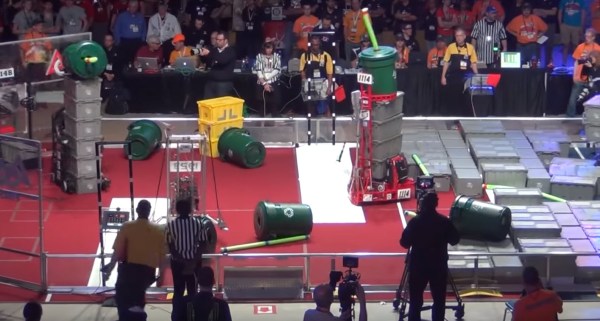
A top scoring team in FIRST Robotics shows off just what some high-school students are capable of. Called the Simbot SideSwipe, their 2015 robot is a slick piece of mechatronic genius, which according to our tipster was built in just six weeks by the students.

The robot is essentially a remote controlled palletizing forklift, capable of collecting and stacking six recycling totes, and a green bin. It’s an impressive combination of mechanical control and fabrication — though it is worth noting, these bots are remote controlled — not autonomous.

To encourage learning, the team has posted their engineering report, and even the CAD model online. They obviously had quite a bit of funding judging by their component selection, but regardless, we’re seriously impressed with both the design and execution of manufacturing their robot — especially if it was really built in just six weeks. Just take a look at the following videos:

Continue reading “FIRST Robotics Gives Us Hope In The Next Generation Of Hackers”

Piezoelectric Transformers Are A Thing, Have You Used One?

Cheap piezo buzzers are everywhere. They’re so cheap that they can be used in novelty birthday cards. Applying an alternating voltage across a piezo crystal makes it expand and contract, and fixing this crystal to a metal disk gives the piezo speaker its characteristic tinny sound that is anything but pleasant.

The piezoelectric effect works the other way too, and piezo elements are very useful as vibration sensors. Simply put one of your voltmeter leads on each of the piezo element’s wires and touch the element with your hand or knock it against your bench. You should see a voltage spike on your voltmeter which will change in magnitude with the amount of force you use when touching the element.

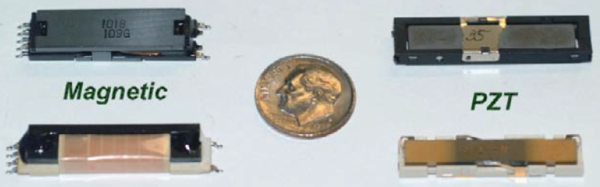
This ability to change shape when a voltage is applied and to create a voltage when they’re deformed is the basis of the piezoelectric transformer (PZT). While searching for a high voltage/low current transformer, Hackaday reader [Josh] was surprised to find a piezoelectric solution. He didn’t say whether he decided to use a PZT in his project but he did link us to a decent PDF on the subject.

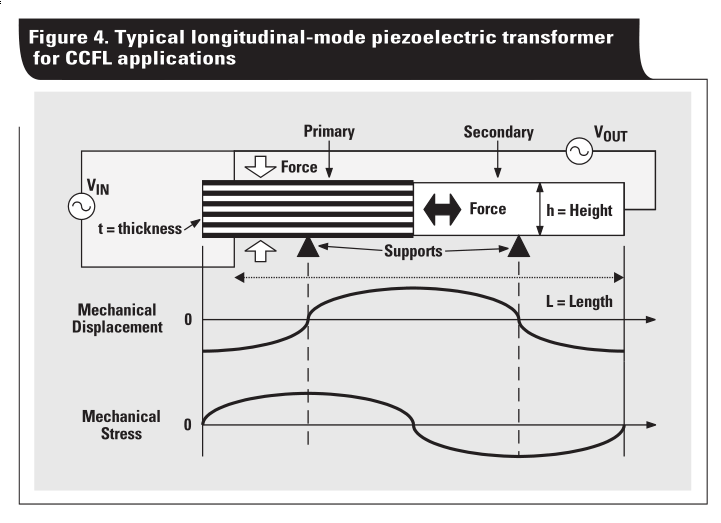
piezo_transformerIn a PZT, two piezo elements sit next to each other. The primary is made up of multiple thin layers that expand horizontally and press on a single secondary piezo element. The more and the thinner the primary layers, the more force is exerted on the secondary, and the more voltage it develops. There are a few equations involved which you can check out in the PDF linked above that go over this concept in painful detail if you’re into that sort of thing.

If you have never played with piezo element you should add one to your next parts order. They are cheap and easy to experiment with. We have seen piezo elements used in DIY speakers, sonar projects, and even as the sensor for an atomic force microscope, but we have yet to see a piezoelectric transformer in a hack. Surely someone has used one in a project they worked on, leave us a link in the comments if you’re the person we’re talking about.

Solder More USB Ports To The Raspberry Pi Zero

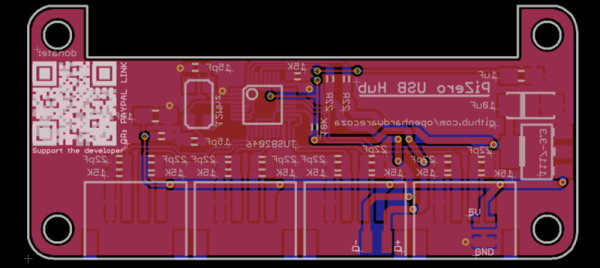
Slowly, Raspberry Pi Zeros are falling into the hands of everyone who wants one. Quickly, though, it was realized that one USB port wasn’t enough, and having a single USB OTG port was only just the most economical solution. The Pi Zero does have a lot of test points exposed on the back, and [Peter van der Walt] is clever enough to come up with a 4-port hub you can solder directly to the Pi Zero.

[Peter] has a bit of experience with USB ports on the Pi, and the test points available on the bottom of this cheap and wonderful board provide everything you need to break out the single USB OTG port to a USB hub. We’ve seen this done before with a few tenuous solder connections between the Zero and an off-the-shelf USB hub. [Peter]’s build does it by soldering a USB hub directly to the Pi through these test points. It’s the first purpose built bit of hardware designed for the express purpose of giving the Pi four USB ports while only making it a sliver thicker.

The chip [Peter] is using for the build is the TI TUSB2046B, a device that turns a single USB port into a 4-port hub. This is a part that only costs about $2 in quantity, and the USB connectors themselves are only about $0.60 if you want to build a thousand of these solderable USB hubs. Now you see why the Pi Foundation didn’t include a whole host of ports on the Pi Zero, but it does mean you should be able to pick this board up for under $10 when it’s inevitably cloned in China.

[Peter] doesn’t have this board working yet. In fact, he’s only just sent the Gerbers off to the PCB fab. There will be an update once [Peter] gets the boards back and solders up the tiny but tolerable 0603 parts.

Industrial Automation In Action: Steam Controller Assembly

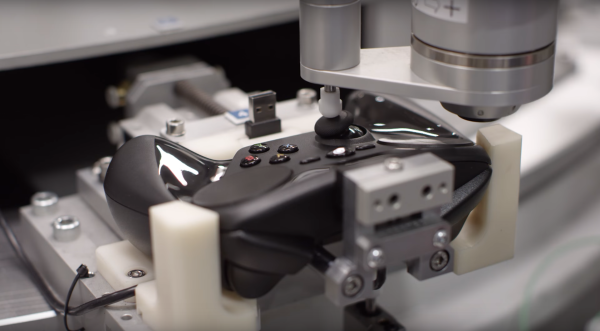
Right up front, we’ll cop to the inevitable “not a hack” comments on this one. This video of the Steam Controller assembly plant is just two minutes of pure robotics porn, plain and simple.

From injection molding of the case parts through assembly, testing and final palletizing of packaged controllers for the trip to distributors, Valve’s video is amazingly detailed and very well made. We’d wager that the crane shots and the shots following product down conveyors were done with a drone. A grin was had with the Aperture Labs logo on the SCARA arms in the assembly and testing work cell, and that inexplicable puff of “steam” from the ceiling behind the pallet in the final shot was a nice touch too. We also enjoyed the all-too-brief time-lapse segment at around 00:16 that shows the empty space in Buffalo Grove, Illinois being fitted out.

This may seem like a frivolous video, but think about it: if you’re a hardware hacker, isn’t this where you want to see your idea end up? Think of it as inspiration to get your widget into production. You’ll want to get there in stages, of course, so make sure you check out [Zach Fredin]’s 2015 Hackaday Superconference talk on pilot-scale production.

Continue reading “Industrial Automation In Action: Steam Controller Assembly”

First Plasma In The World’s Largest Stellerator

If you’re looking for the future of humanity, look no further than the first plasma generated in the Wendelstein 7-X Stellerator at the Max Planck Institute for Plasma Physics. It turned on for the first time yesterday, and while this isn’t the first fusion power plant, nor will it ever be, it is a preview of what may become the invention that will save humanity.

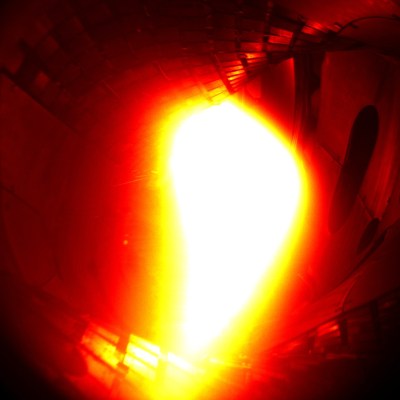
A glimpse of plasma in side the Stellerator

For a very long time, it was believed the only way to turn isotopes of hydrogen into helium for the efficient recovery of power was the Tokamak. This device, basically a hollow torus lined with coils of wire, compresses plasma into a thin circular string. With the right pressures and temperatures, this plasma will transmute the elements and produce power.

Tokamaks have not seen much success, though, and this is a consequence of two key problems with the Tokamak design. First, we’ve been building them too small, although the ITER reactor currently being built in southern France may be an exception. ITER should be able to produce more energy than is used to initiate fusion after it comes online in the 2020s. Tokamaks also have another problem: they cannot operate continuously without a lot of extraneous equipment. While the Wendelstein 7-X Stellerator is too small to produce a net excess of power, it will demonstrate continuous operation of a fusion device. [Elliot Williams] wrote a great explanation of this Stellerator last month which is well worth a look.

While this Stellerator is just a testbed and will never be used to generate power, it is by no means the only other possible means of creating a sun on Earth. The Polywell – a device that fuses hydrogen inside a containment vessel made of electromagnets arranged like the faces of a cube – is getting funding from the US Navy. Additionally, Lockheed Martin’s Skunk Works claims they can put a 100 Megawatt fusion reactor on the back of a truck within a few years.

The creation of a fusion power plant will be the most important invention of all time, and will earn the researchers behind it the Nobel prize in physics and peace. While the Wendelstein 7-X Stellarator is not the first fusion power plant, it might be a step in the right direction.