120v Switching

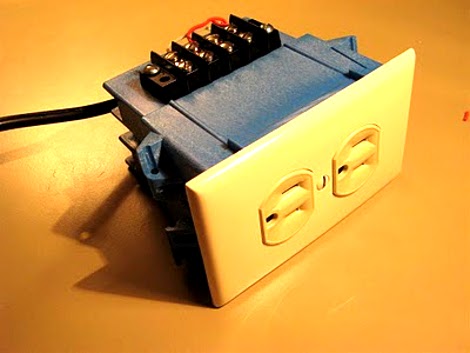
[Kenneth] built a 5v controlled power outlet inside of a junction box. We’ve seen plenty of projects that can switch 120v outlets using 5v logic for refrigerator controllers, lighting controllers, or grow systems, but they almost always use solid state relays to facilitate the switching. This iteration uses mechanical relays along with the necessary protection circuitry. The project is housed in an extra deep single-gang box and allows for individual switching of the two outlets. You can see this connected to an Arduino switching two lamps after the break.
Continue reading “120v Switching”

Adafruit Eagle Library

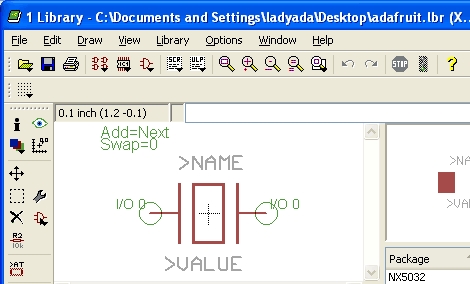
We love it when a PCB comes out right the first time. We’re careful enough with our designs that if something is wrong it’s usually a footprint problem, like we picked the wrong package for the components. Adafruit is helping to make the design process easier by sharing their Eagle library. Like the Eagle library version control we saw earlier in the month, this library is housed on github making it easy to stay up-to-date. The library includes many components (switches, crystals, IC’s, etc.), and fixes some prolbem-footprints, like 0805 surface mount pads.

Servo Hacked Linear Actuator

[AntonB] has modified a servo into a powerful linear actuator (think: changing rotational motion into linear motion). The process is simple enough, modify a servo for continuous rotation and then add the custom built actuating shaft. You do of course lose the precision of the servo, but a small price to pay to be able to lift ~20 pounds straight up. Inspiration for such a cheap solution came from his Planetary Surface Exploration Rover. Check out a video of both after the break.

[Thanks Eric]

Continue reading “Servo Hacked Linear Actuator”

Makita Battery Pack Repair

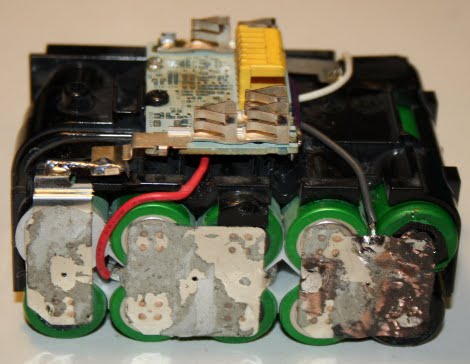
[Rob] grew tired of his Makita power tool battery packs dying so he figured out how to repair them himself. The video after the break walks us through the process which starts by cracking open the case. Inside there is a controller board and a battery of ten cells. [Rob] has pinpointed these battery failures to just the first cell, which is confirmed by measuring the cell voltages with a multimeter. The first cell in the demonstration battery reads zero volts and needs to be replaced. For some reason he’s got heck of a lot of these cells on hand, at the end of the video he shows off a massive block of them that provides one half of a kilowatt-hour of power.

To complete the resurrection he removed the control circuitry from the integrated PCB. It seems that the microcontroller on the battery’s PCB monitors it and bricks them when it thinks the life of the unit has ended. By hacking a charger he can now balance-charge the altered battery packs and get more use out of them before they hit the landfill.

Continue reading “Makita Battery Pack Repair”

Don’t Put That EPROM In Your Mouth!

[Jeremy] had some chips on hand that included EPROM.  We’re not talking about EEPROM, we mean EPROM that need a UV light source to erase. Most people don’t want to drop a few hundred dollars on a dedicated EPROM eraser, there must be another way.

Boy, EPROM really suck. But so do pacifiers and he already had a solution for exposing those to UV. He pulled out his $30 UV pacifier cleaner and tossed the chip inside. Two times through the cleaning cycle and the data was gone. We’ve looked into using UV LEDs to do the job but some experimentation shows that it doesn’t work. These pacifier cleaners are cheap and easy to get a hold of. The real question is are you still using chips that require UV for erasing?

Version Control For Eagle

[Jeff] set up version control for Eagle libraries and projects. He mentions that Eagle has become the standard for open source hardware projects and he’s absolutely right. We use it for our projects, and we’ve grown to expect that the posts we feature have Eagle files available in most cases.

But Eagle falls short in its library management. There is some amazing work from SparkFun to support a usable parts library, but who hasn’t added parts themselves? [Jeff] setup libraries using github so that changes and additions to the libraries can benefit all and cut the amount of time spent making custom footprints for new components and packages.

RepRap Acrylic Extrusion Using Hotbed

[Nophead] started the year off by successfully extruding acrylic using a RepRap machine. The problem when working with this material is that when the hot ooze hits the cold air the printed material tends to warp, badly. [Nophead] raised the ambient air temperature around the part being extruded by replacing the bed of the RepRap machine with a heated aluminum plate.

We took at look at his build details for the hotbed. The plate itself is aluminum that he had milled by a machinist friend of his. It looks like the heat is produced by a network of power resistors bolted and soldered to the bottom of the plate. The original idea was to produce a controllable SMT soldering platform. Unfortunately this heating method doesn’t have the power needed to raise the temp quickly but that failure turned out to be a RepRap success.