Sign And Speak Glove

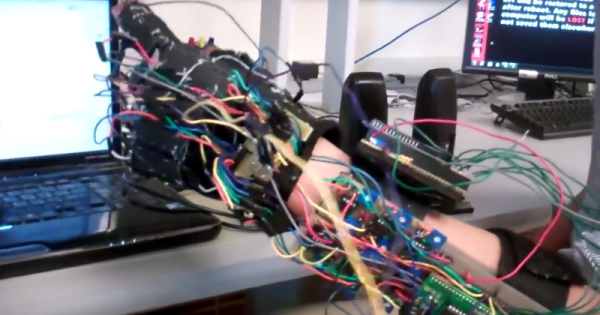
This wire covered glove is capable of turning your hand gestures to speech, and it does so wirelessly. The wide range of sensors include nine flex sensors, four contact sensors, and an accelerometer. The flex sensors do most of the work, monitoring the alignment of the wearer’s finger joints. The contact sensors augment the flex sensor data, helping to differentiate between letters that have similar finger positions. The accelerometer is responsible for decoding movements that go along with the hand positions. They combine to detect all of the letters in the American Sign Language alphabet.

An ATmega644 monitors all of the sensors, and pushes data out through a wireless transmitter. MATLAB is responsible for collecting the data which is coming in over the wireless link. It saves it for later analysis using a Java program. Once the motions have been decoded into letters, they are assembled into sentences and fed into a text-to-speech program.

You’ve probably already guess that there’s a demo video after the break.

Continue reading “Sign And Speak Glove”

A Blanket That Detects Its Own Orientation

If you want to capture a 3D model of a physical object, you could use a Kinect, a couple of lasers, constructive light, or even a simple touch sensor mounted on a robotic arm. Those are all expensive devices, and somewhat unnecessary now that you can just throw a blanket over an object and get a 3D model instantaneously.

The project is called IM BLANKY and it’s supposed to reproduce 3D shapes by simply throwing it over an object. The petals in the flower motif are pieces of conductive fabric that serve as contacts for the electrified tassel in the center of each flower. When the blanket is thrown over an object, the tassel is pulled by gravity, makes contact with one of the six conductive petals and sends a tilt switch to a microcontroller.

While we’re not too sure about the resolution IM BLANKY will provide with only 20 tilt sensors, but we imagine this could be used for a few medical applications.

via dvice

Badges? We Don’t Need No Stinking Badges!

In a an obvious marketing move akin to a drug dealer offering up free samples, Urban threads is offering free badge plans for hackerspaces that have robotic embroidery machines. We’ve seen this trend of badges coming up lately and we don’t know if it is the boy/girl scout in us, or the punk rocker that makes us pine for them. You may laugh, but look at that skull with the welding goggles on. If you don’t think that’s badass… then we disagree.

The idea of giving some away free isn’t new. You can download free photoshop brushes, free fonts, free circuits and all kinds of other free stuff from sites that sell better versions as well. We just couldn’t pass up the chance to point out that skull, and helping out hackerspaces is always good in our eyes. So, who has one of those embroidery machines?

Closing In On Nixie Cuff Links

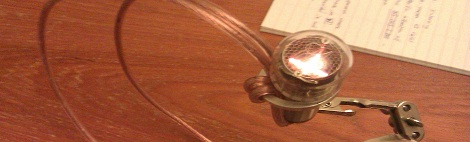
It’s not Nixie cuff links yet, but we’re seeing a lot of potential for a few very classy accoutrements with [thouton]’s Nixie tube necklace.

The build was inspired by this much clunkier necklace that found its way onto the MAKE blog. Unlike the previous necklace, [thouton] used a much smaller Mullard ZM1021 indicator bulb. Instead of the normal 0-9 digits in a Nixie, this tube displays only A V Ω + - % and ~, betraying its pedigree as part of the display from an ancient multimeter.

To power the bulb, [thouton] is using a single AA battery and a boost converter salvaged from a camera flash unit. All the circuitry is on a little piece of perfboard encased in a handsome aluminum tube. Power is delivered through two terminals with a bit of audio cable standing in as the chain of the necklace. We suppose this could be re-engineered to use a coin cell battery; although a coin cell doesn’t offer as many amp hours as a AA cell, [thouton] is confident the AA will last for a few days. A coin cell would be more than enough for a night on the town, though.

Electric Poncho Keeps You Warm On The Go

electric-poncho

With the mild winter and spring we have had, it might seem strange to think about ways to keep yourself warm, but there’s no better time than the present to prepare for chilly weather down the line.

In his blog [Berto] was thinking about how to keep warm when things cool off again, and decided that a heated poncho would be great to have on hand. He found a dead simple way to craft his heated poncho, requiring little more than a bit of wiring, some thread and cloth, as well as a pair of scissors.

[Berto] picked up a 12V-powered electric blanked, then proceeded to cut a head-sized slit in the middle of it, avoiding the heating coils. He sewed a bit of cloth around the hole to ensure it didn’t end up ripping over time, then he wired the blanket up to a 12V battery he tucked away in his backpack.

The result is a variable-temp poncho that you can use to keep warm in a variety of situations. [Alan Parekh] from Hacked Gadgets says that he thinks the poncho would be awesome on a full-day snowmobiling trip, and we think he’s right!

Continue reading to see a short video where [Berto] explains how to put one of these heated ponchos together.

Continue reading “Electric Poncho Keeps You Warm On The Go”

Heads-up Display Mounts On Brim Of Your Cap

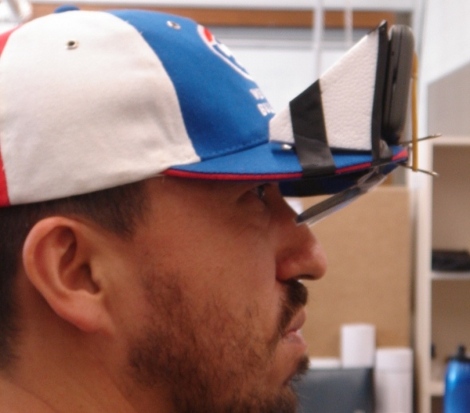
[Matt Kwan] says that coming up with a personal heads-up display wasn’t that hard. Well that’s because he made design choices that make all the difference.

The goal here was to add some augmented reality to his field of vision. He went with a baseball cap because it’s a pretty easy way to strap something to your head. You can’t see it from this angle, but the setup requires you to cut a rather large hole in brim. The image from a smartphone (HTC Desire Z in this case) which is situated with the screen pointing toward [Matt’s] forehead. The screen reflects off of a small mirror, guiding the image down through a Fresnel lens mounted in the hole of the brim. The image is reflected a second time by the plastic in front of his eyes which is coated with a slightly mirrored material. Since the image is reflected twice it appears right-side up, and the use of the Fresnel lens places the image out about 20 cm in front of his view. He tried to get some images of the effect, but we think you’ve got to see it in person before passing judgement.

This does away with the need to track head movement (there’s a few hacks for that out there though). Augmented reality software is used to turn the view from the smartphone camera into overlay data for the display.

[Thanks Tom]

Fashion Leads To Mind-controlled Skirt-lifting Contraption

This must be an example of when worlds collide. Who would have thought the geekery of Mindflex and Arduino could make its way into high fashion? But sure enough, this dress transforms based on the mental concentration of the model (must resist urge to crack joke here).

Details are a bit sparse, but you can get a look at the prototype in the video after the break. There’s no nudity; a larger skirt covers a more plain version. That over-skirt is connected to some type of motor system which is driven by an Arduino. When the EEG sensor in the hat detects a certain level of brain wave activity, the outer skirt is lifted and pulled to the back of the outfit, exposing the tighter version beneath.

[Lorenzo] wrote in to share the link to this garment hack. He mentions that a Lilypad and Mindflex are at work here. Looking more into the artist’s website we find this isn’t the only tech-wear produced. There’s a maternity outfit which can sense the baby’s beating heart, and harvest other data about both mother and baby, as well as a few others.

We can’t think this has much future as an everyday outfit, but more utilitarian versions are out there so we think the sky’s the limit on wearable tech.

Continue reading “Fashion Leads To Mind-controlled Skirt-lifting Contraption”