Fighting Household Air Pollution

When Kenyan engineer [Aloise] found out about the health risks of household air pollution, they knew there had to be a smart solution to combatting the problem while still providing a reasonable source of energy for families cooking without the luxury of cleaner fuels. Enter OpenHAP, a DIY household air pollution monitor that provides citizen scientists and researches the means to measure air particulates in developing countries.
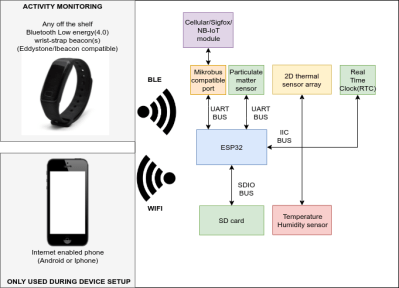
The device is based on an ESP32 communicating with a ZH03B Particulate matter sensor over UART; a DS3231SN real-time clock (RTC), temperature and humidity sensor, and MLX90640 2D thermal sensor array over I2C; and wirelessly sending the data received to a Bluetooth low energy wrist-strap beacon and an Internet enabled phone. The device also uses a TCA9534 GPIO expander to control the visual and auditory notifiers (buzzers and LEDs) and to interface to a SD card.

The project uses the libesphttpd project modified for the ESP32 for the webserver, which is used to stream data to a mobile handset or computer using the WiFi capabilities of the ESP32. The data includes real-time sensor information, system status, storage media status, visualizations of the thermal array sensor data (to ensure the camera is facing the source of heat), and tag information to test the limits of the Bluetooth tag with regards to distance.

Power input is provided through a Micro-USB connector, protected with a TVS diode and a Schottky diode in series to prevent reverse power flow.

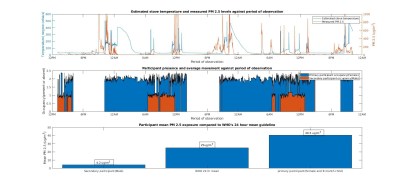
The project was tested in two real-life scenarios: one with a household in rural Kenya and another with an urban low-income family of four. In the first test, the family used a three stone open fire stove. A FLiR thermal camera captured the stove temperatures, while a standard camera was enough to capture the high levels of smoke inside the kitchen. The readings from OpenHAP were high enough to exceed the upper detection threshold for the particulate sensor, showing that the woman cooking in the house was receiving the equivalent of 8 cigarettes a day, about 8 x the WHO’s recommended particulate levels.

Within the second household, a typical energy mix of charcoal briquettes and kerosene was typically used for cooking, with kerosene used during the day and briquettes used at night. The results from measuring pollution levels using OpenHAP showed that the mother and child in the household regularly received around 1.5 x the recommended limit of pollutants, enough to lead to slow suffocation.

There’s already immense potential for this project to help researchers test out different energy sources for rural households, not to mention the advantage of having a portable low-energy pollution monitor for citizen scientists.
Continue reading “Fighting Household Air Pollution”

Laser Crown Shines At Night

Sometimes you need something really flashy to complete an outfit. Whether it’s a sparkly pair of earrings or a stylish necklace, accessories are key to competing on the fashion battlefield. For those who want to bring some serious firepower, [p3nguin’s] laser crown might be just what the doctor ordered.

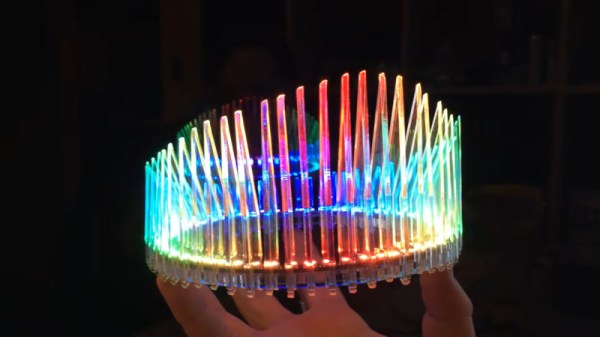
At the outset, we should state the crown only uses lasers in its construction, for cutting felt and acrylic. The light source is a Neopixel ring from Adafruit, capable of bringing the vibrant colors without risk of eye damage. The ring is then assembled with a series of snap-together acrylic parts and a felt cap, with slots for hair pins to keep the crown in place on the wearer’s head. A Trinket drives the show, with a LiPo battery used as a lightweight power supply.

It’s a nice build that’s sure to draw plenty of attention. We see some great wearables around these parts; this EL jacket is a particular favorite. Video after the break.

Continue reading “Laser Crown Shines At Night”

An RFID Ring For The Body Mod Squeamish

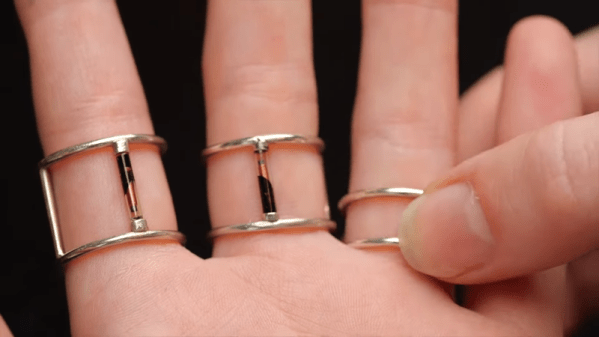
Some people get inked, while others get henna or those water transfer tattoos you might find in a box of Cracker Jack. [Becky] wanted the benefits of having an RFID tag in her finger — unlock doors or log into your computer with a swipe of your finger — but wasn’t ready to get an implant. Her solution: make an artistic ring that conceals a tiny glass capsule RFID tag.

Besides not having to shove some tech under your epidermis, there are a few other advantages: you can change out tags as easy as changing rings, for one. You can also easily loan your ring to someone just as you might give them keys to your door.

Continue reading “An RFID Ring For The Body Mod Squeamish”

This Heads Up Display Is All Wet

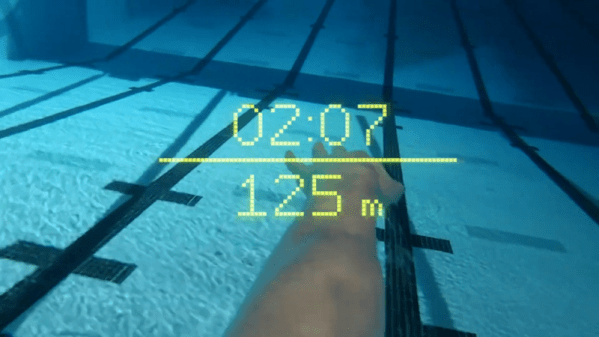
Athletes have a long history of using whatever they can find to enhance their performance or improve their training. While fitness tracker watches are nothing new, swimmers have used them to track their split times, distance, and other parameters. The problem with fitness trackers though is that you have to look at a watch. FORM has swim goggles that promise to address this, their smart goggles present the swimmer with a heads-up display of metrics. You can see a slick video about them below.

The screen is only on one eye, although you can switch it from left to right. The device has an inertial navigation system and is — of course — waterproof. It supposedly can withstand depths up to 32 feet and lasts 16 hours on a charge. It can use Bluetooth to send your data to your phone in addition to the display.

Continue reading “This Heads Up Display Is All Wet”

Hands-On: CCCamp2019 Badge Is A Sensor Playground Not To Be Mistaken For A Watch

Last weekend 5,000 people congregated in a field north of Berlin to camp in a meticulously-organized, hot and dusty wonderland. The optional, yet official, badge for the 2019 Chaos Communication Camp was a bit tardy to proliferate through the masses as the badge team continued assembly while the camp raged around them. But as each badge came to life, the blinkies that blossomed each dusk became even more joyful as thousands strapped on their card10s.

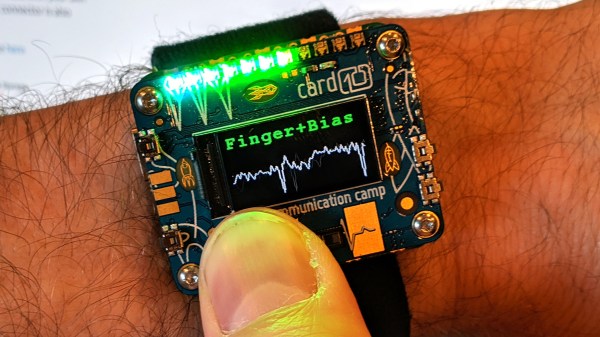
Yet you shouldn’t be fooled, that’s no watch… in fact the timekeeping is a tacked-on afterthought. Sure you wear it on your wrist, but two electrocardiogram (ECG) sensors for monitoring heart health are your first hint at the snoring dragon packed inside this mild-mannered form-factor. The chips in question are the MAX30001 and the MAX86150 (whose primary role is as a pulse sensor but also does ECG). We have high-res ADCs just waiting to be misused and the developers ran with that, reserving some of the extra pins on the USB-C connector for external devices.

There was a 10€ kit on offer that let you solder up some electrode pads (those white circles with gel and a snap for a solid interface with your body’s electrical signals) to a sacrificial USB-C cable. Remember, all an ECG is doing is measuring electrical impulses, and you can choose how to react to them. During the workshop, one of the badge devs placed the pads on his temples and used the card10 badge to sense left/right eye movement. Wicked! But there are a lot more sensors waiting for you on these two little PCBs.

Continue reading “Hands-On: CCCamp2019 Badge Is A Sensor Playground Not To Be Mistaken For A Watch”

Be Better Bracelet Breaks Bad Habits, Fosters Favorable Fixations

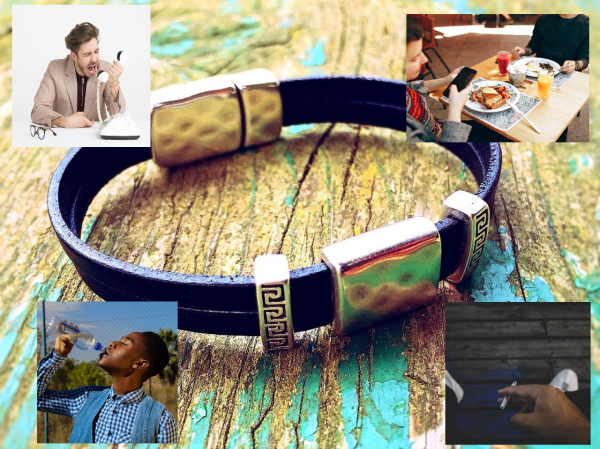
Do you want to be a better person? Maybe you want to curse less, drink more water, or post fewer inflammatory comments on the internet. You could go the old school route by wearing a rubber band around your wrist and snapping it every time you slip, or literally pat yourself on the back when you do the right thing. While these types of reinforcement methods may deter bad behavior and encourage good, they are quite lean on data. And who wants that?

After an unpleasant conference call, [Darian] cursed a blue streak that left his coworkers shocked and speechless. This inciting incident began the hero’s journey that will end with a kinder, gentler [Darian], as long as he has his trusty Be Better Bracelet. He tried involving Alexa when at home, and various apps elsewhere to track these venomous utterances, but he yearned for a single solution that’s always available.

The sole purpose of this bracelet is low-cost, unobtrusive habit tracking. Though tied to a phone, it won’t tell time, predict the weather, or alert the user to incoming what-have-yous. It will simply record button presses, which are assigned meaning in the app settings. It’s up to the user to set goals, analyze the data, and reward or punish themselves accordingly.

[Darian] is still working out the design kinks to make this as small and cheap as possible. If you have suggestions, let him know.

OTA Flash Tool Makes Fitness Tracker Hacking More Accessible

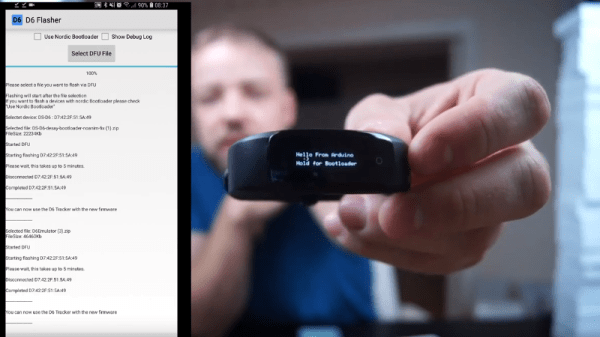
Over the last several months, [Aaron Christophel] has been working on creating a custom firmware for cheap fitness trackers. His current target is the “D6 Tracker” from a company called MPOW, which can be had for as little as $7 USD. The ultimate goal is to make it so anyone will be able to write their own custom firmware for this gadget using the Arduino IDE, and with the release of his new Android application that allows wirelessly flashing the device’s firmware, it seems like he’s very close to realizing that dream.

Previously, [Aaron] had to crack open the trackers and physically connect a programmer to update the firmware on the NRF52832-based devices. That might not be a big deal for the accomplished hardware hacker, but it’s a bit of a hard sell for somebody who just wants to see their own Arduino code running on it. But with this new tool, he’s made it so you can easily switch back and forth between custom and original firmware on the D6 without even having to take it off your wrist.

After the break, you can see the video that [Aaron] has put together which talks about the process of flashing a new firmware image. It’s all very straightforward: you simply pick the device from the list of detected BLE devices, the application puts the tracker into bootloader mode, and then you select the DFU file you want to flash.

There are a couple of ready-made firmwares you can put on the D6 right now, but where’s the fun in that? [Aaron] has put together a customized version of the Arduino IDE that provides everything you need to start writing and flashing your own firmware. If you’ve ever dreamed about creating a wearable device that works exactly the way you want, it’s hard to imagine a cheaper or easier way to get in on the action.

When we last heard from [Aaron] earlier this year, he was working on the IWOWN I6HRC tracker. But it looks like the availability of those devices has since dried up. So if you’re going to try your hand at hacking the MPOW D6, it might be wise to buy a few now while they’re still cheap and easy to find.

Continue reading “OTA Flash Tool Makes Fitness Tracker Hacking More Accessible”