Radio-controlled LED Light Show

HL1606_radio_controlled_light_show

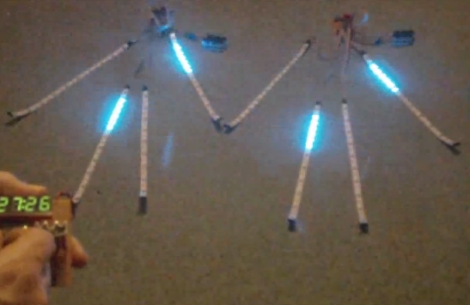
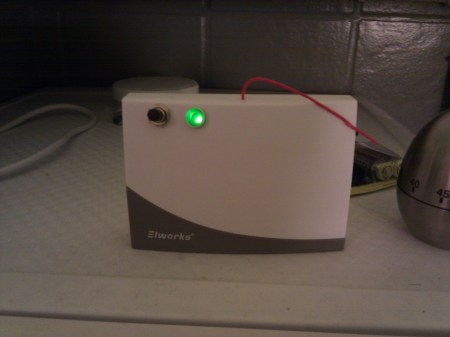
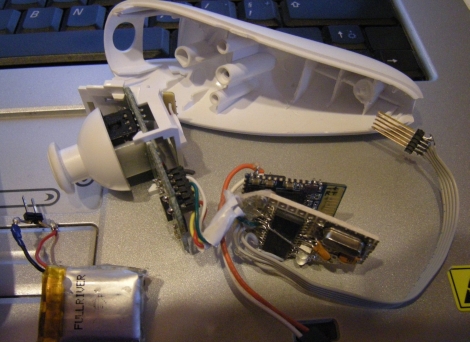
[Alan] was commissioned to make some wearable, radio-controlled LED strips for the Travelling Light Circus. It has taken some time, but he has recently finished some prototypes, and thought it was a good time to do a writeup on the project. The system is managed by a single controller unit, which communicates with any number of LED driver units, each controlling 4 HL1606 LED strips. The light displays are synchronized across all of the LED driver units via a 2.4 GHz radio, with each driver falling into synch almost immediately after being powered on. While some might be turned off to the fact that he uses Arduino Pro Minis to control the LEDs, this is far from a simple project.

[Alan’s] blog contains several posts about this project, with everything documented in detail. He spends quite a bit of time talking about the project’s software, as well as hardware issues he ran into along the way.

His blog is a must read, but even more so, it is a must see. The lighting effects are mesmerizing, as there are a ton of different light patterns these units can generate, so be sure to check out the following video of the lights in action.

Continue reading “Radio-controlled LED Light Show”

Target Hunting UAV Armed With Fireworks

Don’t just build a UAV, use it to blow things up. In this case a tri-copter seeks out colored balloons and pops them using low-grade fireworks. We’ve seen this type of flying armament before, but not in a ‘copter form factor. It looks like the targeting and firing is done by an operator, and is not an automated system despite what the text overlays on the video after the break says. The lack of autonomous firing capability makes this delightful, rather than scary. Don’t miss the build log for the tri-copter itself. How do you think this one stacks up to the last 3-bladed build?

Continue reading “Target Hunting UAV Armed With Fireworks”

Snail Mail Notification System

[Mime] lives on one of the upper levels of an apartment complex. The mailboxes, being located at the ground floor can be somewhat inconvenient to check regularly. [Mime] decided to rig up a device to let him know when his mailbox had been accessed. He started with a wireless doorbell, thinking he could use the door side button inside his mailbox as a trigger with only some slight modification. On the receiver side, he wanted an LED to flash, letting him know that it was time to check his mail. One simple circuit and a self blinking LED later and the whole setup was finished. Great job [Mime]

Wireless Electricity Enables Next Generation Of Annoying Packaging

Yep, these cereal boxes light up. They’re using a new branded-technology called eCoupling that provides electricity via induction, which means the shelves have a coil with AC power running through it. The “printed coils” on the boxes allow inventory control and data exchange presumably thanks to a low-power microcontroller. But in the video after the break you can see that the printed lighting on the boxes lets them flash parts of the box art as a way to attract customers’ attention. We’d bet that they’re using electroluminescent materials but we weren’t able to get find specifics on how this is done. We just hope advertisers don’t start rolling noise-makers into their packaging.

Continue reading “Wireless Electricity Enables Next Generation Of Annoying Packaging”

The Pirate Box

One of the most fun aspects of a LAN party was exploring the shared files of all the other users on the network. There were people that would show up, solely for the file swapping. That is exactly what this project is about. From the projects wiki, the Pirate box is a mobile p2p sharing and collaboration platform. Basically it is a wireless hotspot with a slick interface and a shared folder. It doesn’t connect to the internet, and it doesn’t log any connections. You can have a file swapping session simply by flipping it on and sharing its space with other people. They’ve included a step by step guide to setting up your own, but if you’re going to do some subversive file swapping we might suggest putting it in a less conspicuous enclosure. Imagine this as a portable verion of dead drops.

Wireless Sniffing And Jamming Of Chronos And Iclicker

The ubiquitous presence of wireless devices combined with easy access to powerful RF development platforms makes the everyday world around us a wireless hacker’s playground. Yesterday [Travis Goodspeed] posted an article showing how goodfet.cc can be used to sniff wireless traffic and also to jam a given frequency. We’ve previously covered the work of [Travis] in pulling raw data from the IM-ME spectrum analyzer, which also uses goodfet.cc.

The Texas Instruments Chronos watch dev platform contains a C1110 chip, which among other things can provide accelerometer data from the watch to an interested sniffer. The i>clicker classroom response device (which houses a XE1203F chip) is also wide open to this, yielding juicy info about your classmates’ voting behaviour. There is still some work to be done to improve goodfet.cc, and [Travis] pays in beer–not in advance, mind you.

With products like the Chronos representing a move towards personal-area wireless networks, this sort of security hole might eventually have implications to individual privacy of, for example, biometric data–although how that might be exploited is another topic. Related to this idea is that of sniffable RFID card data. How does the increasing adoption of short-range wireless technologies affects us, both for good and bad? We invite you to share your ideas in the comments.

Nokia Internet Key External Antenna

[Maurizio] was having some reception issues with his wireless internet and set out to add an external antenna to the USB dongle (translated). He had previously poked around inside of the Nokia internet key to find that the internal antenna was a flexible circuit substrate wrapped around a plastic box that made contact with main circuit board via a spring connector. This plastic frame is just right for mounting an SMA connector in just the right place for it to stick out the end of the case as seen in the picture above. It gives him better range, but since speed depends on how much traffic the wireless node is under, it’s not a guarantee that you’ll get a snappier connection after this hack.