Xbox 360 Briefcase Is Ready To Go Wherever You Do

portable_xbox

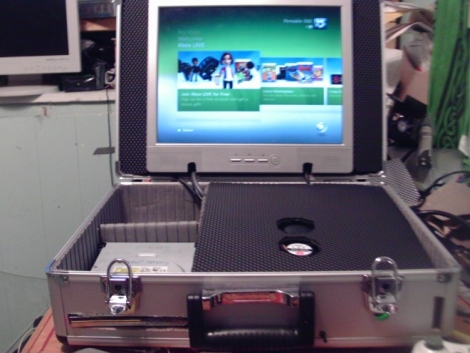
Hackaday forum member [azazelcrey] recently wrote in to share his portable Xbox 360 build. This is not his first attempt at constructing one of these, as he completed his first portable console a few years back. This time, he has taken what he learned from the first go round, making his newest creation a bit cleaner and more compact.

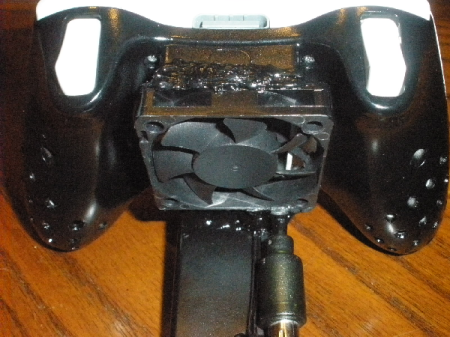
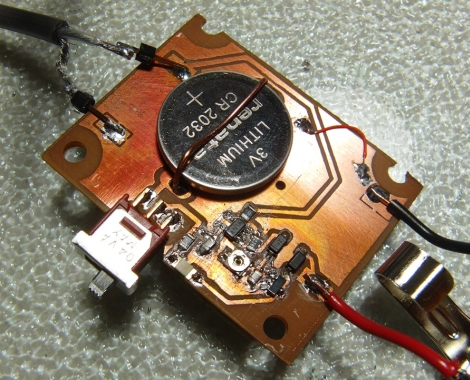
He sourced an LCD monitor with built-in speakers to use as the display, mounting it into a $20 metal-sided suitcase from Home Depot. He disassembled his Xbox and added it to the case, installing a couple extra fans to keep things cool. Some standard Xbox functions were externalized, allowing him to power on the console, load games, and synchronize controllers, all while keeping the briefcase shut.

This obviously isn’t something that you would carry on a train or bus for on-the-go gaming, but it’s a great way to travel with your Xbox as well as a handful of gear.  We imagine this rugged, fully-contained gaming center is quite useful for one-off Xbox LAN parties, and it seems like it would be a good way to get your game on if stuck overnight in a hotel.

Check out his web site if you are interested in seeing his first build or more pictures of this one.

Real-time Wireframe Video Effect Overlay With Kinect

linedance

[Francois] over at 1024 Architecture has been working on a project we think you’ll be likely to see in a professional music video before too long. Using his Kinect sensor, ha has been tracking skeletal movements, adding special effects to the resulting wire frame with Quartz Composer. While this idea isn’t new, the next part is. He takes the QC tweaked video stream and then projects it back over the performer using MadMapper to match the video to the body movements, recording the resultant display.

The project started out with a few hiccups, including a noticeable delay between the body tracking and the display. It caused the performer to have to move more slowly than he would like, so things had to be tweaked. [Francois] first tested the latency between his computer and the projector by displaying a timecode representation on the screen as well as via the projector. He found the projector to have a latency of 1 frame at 60 fps, which wasn’t too bad. This led him to believe the culprit was his Kinect, and he was right.  There was a 6 frame delay, so he locked the video output to 30 fps in hopes of cutting that delay in half.

The effect is slightly reminiscent of Tron, but with more distortion. We can’t wait to see more projects similar to this one in the future.

The resulting video embedded below is pretty cool in our opinion, but you can judge for yourself.

Continue reading “Real-time Wireframe Video Effect Overlay With Kinect”

Giving “sight” To The Visually Impaired With Kinect

NAVI

We have seen Kinect used in a variety of clever ways over the last few months, but some students at the [University of Konstanz] have taken Kinect hacking to a whole new level of usefulness. Rather than use it to control lightning or to kick around some boxes using Garry’s Mod, they are using it to develop Navigational Aids for the Visually Impaired, or NAVI for short.

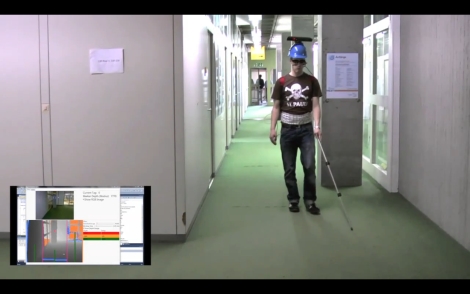
A helmet-mounted Kinect sensor is placed on the subject’s head and connected to a laptop, which is stored in the user’s backpack. The Kinect is interfaced using custom software that utilizes depth information to generate a virtual map of the environment. The computer sends information to an Arduino board, which then relays those signals to one of three waist-belt mounted LilyPad Arduinos. The LilyPads control three motors, which vibrate in order to alert the user to obstacles. The group even added voice notifications via specialized markers, allowing them to prompt the user to the presence of doors and other specific items of note.

It really is a great use of the Kinect sensor, we can’t wait to see more projects like this in the future.

Stick around to see a quick video of NAVI in use.

[via Kinect-Hacks – thanks, Jared]

Continue reading “Giving “sight” To The Visually Impaired With Kinect”

Microsoft Points Algorithm Cracked… They’re Out $1M

Looks like someone figured out the algorithm that Microsoft uses to generate unique codes for their alternative currency: Microsoft Points. We were always a bit baffled by the need to do this sort of thing (Disney dollars, tokens at arcades, etc.) but figured it’s just a grift to get you to spend more dough. Looks like this time it may have come back to bite them in the ass with early loss projections somewhere in the $1-$1.2 million range.

But as most of you know, it’s not just an algorithm that can cause this kind of havoc. Whomever figured out how to crunch the numbers apparently packaged the method into a nice GUI and distributed it over the Internet. Check out the video after the break to see that not only will it give you a code, but you can verify that it works at the click of a button. Microsoft is taking steps to invalidate all of the ill-gotten redemption codes, but we wonder how effective they can be at it. Surely they already had contingency plans for this and we wonder if the company didn’t also carry insurance against this kind of loss.

Try as we might, we couldn’t turn up a press release on the subject. If you know of any, please be kind and leave a link in the comments.

Continue reading “Microsoft Points Algorithm Cracked… They’re Out $1M”

Kinect Hacked To Work With Garry’s Mod Means Endless Hours Of Virtual Fun

garrys_mod_kinect

[John B] is a software engineer and had some spare time on his hands, so he started messing around with his Kinect which had been sitting unused for awhile. He wanted to see what he could create if he was able to get Kinect data into a virtual environment that supported real-world physics. The first idea that popped into his head was to interface the Kinect with Garry’s Mod.

If you are not familiar with Garry’s Mod, it is a sandbox environment built on top of Valve’s Source engine. The environment supports real-world physics, but beyond that, it pretty much lets you do or build anything you want. [John] found that there was no good way to get Kinect data into the software, so he built his own.

He used OpenNI to gather skeletal coordinate data from Kinect, which was then passed to some custom code that packages those coordinates inside UDP packets. Those packets are then sent to a custom Lua script that is interpreted by Garry’s Mod.

The result is just plain awesome as you can see in the video below. Instead of simply playing some random game with the Kinect, you get to design the entire experience from the ground up. The project is still in its infancy, but it’s pretty certain that we’ll see some cool stuff in short order. All of the code is available on github, so give it a shot and share your videos with us.

Continue reading “Kinect Hacked To Work With Garry’s Mod Means Endless Hours Of Virtual Fun”

Xbox 360 Controller Mod For A Friend In Need

xbox_controller_external_button_mod

[Adrian] has a friend that, due to an accident, can no longer play Xbox games in the standard fashion. His friend is unfortunately unable to hold the game pad properly, and no longer has the manual dexterity to reach the shoulder buttons and triggers on the top side of his Xbox 360 controller. Being the good guy that he is, he set out to see what he could do in order to bring the joy of playing Xbox back into his friend’s life.

Inspired by the many different gaming mods he has seen [Ben Heck] construct, he pulled apart an Xbox 360 wireless controller and began to investigate how the four top buttons were activated. In no time, he had four large buttons wired to the PCB where the triggers and shoulder buttons once connected.

[Adrian] mentions that his modification isn’t quite complete, as he is going to mount the buttons into a board which can easily be laid on his friend’s lap or a table. The only thing we are left wondering is whether or not he was able to replicate the analog functionality of the triggers, or if they are treated as simple on/off switches. Either way, we are sure his friend will be thrilled!

Kinect To Get Windows Drivers Months After Open Source Drivers Were Developed

Microsoft is planning to release Windows drivers for the Kinect this spring, months after open source drivers were developed by a motivated hacking community. [Johnny Chung Lee], who worked with the Microsoft team when the hardware was developed, mentions that he had pushed for the giant to develop and release at least basic Windows drivers. That refusal led him to a position as top cheerleader and bounty contributor in Adafruit’s Open Kinect Contest which resulted (quickly we might add) in the availability of open source drivers. If you’ve been following Hackaday or any other tech blogs the last three months you’ll know that an explosion of projects using the Kinect followed, and [Johnny] figures Microsoft’s decision to release Windows drivers is an attempt to ride this wave on their own flagship OS rather than continue to watch from the sidelines.