Hackaday Links Column Banner

Hackaday Links: March 29, 2026

Whether it’s a new couch or a rare piece of hardware picked up on eBay, we all know what it feels like to eagerly await a delivery truck. But the CERN researchers involved in a delivery earlier this week weren’t transporting anyone’s Amazon Prime packages, they were hauling antimatter.

Moving antimatter, specifically antiprotons, via trucks might seem a bit ridiculous. But ultimately CERN wants to transfer samples between various European laboratories, and that means they need a practical and reliable way of getting the temperamental stuff from point A to B. To demonstrate this capability, the researchers loaded a truck with 92 antiprotons and drove it around for 30 minutes. Of course, you can’t just put antiprotons in a cardboard box, the experiment utilized a cryogenically cooled magnetic containment unit that they hope will eventually be able to keep antimatter from rudely annihilating itself on trips lasting as long as 8 hours.

Speaking of deliveries, anyone building a new computer should be careful when ordering components. Shady companies are looking to capitalize on the currently sky high prices of solid-state drives by counterfeiting popular models, and according to the Japanese site AKIBA PC Hotline, there are some examples in the wild that would fool  all but the most advanced users. They examine a bootleg drive that’s a nearly identical replica of the Samsung 990 PRO —  the unit and its packaging are basically a mirror image of the real deal, the stated capacity appears valid, and it even exhibits similar performance when put through a basic benchmark test.

Continue reading “Hackaday Links: March 29, 2026”

A photo of the old mechanical and new digital altimeters

Ben Eater Explains How Aircraft Systems Communicate With The ARINC 429 Protocol

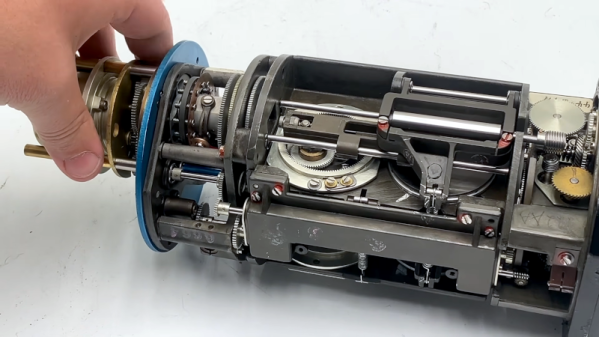
Over on his YouTube channel the inimitable [Ben Eater] takes a look at an electronic altimeter which replaces an old mechanical altimeter in an airplane.

The old altimeter was entirely mechanical, except for a pair of wires which can power a backlight. Both the old and new altimeters have a dial on the front for calibrating the meter. The electronic altimeter has a connector on the back for integrating with the rest of the airplane. [Ben] notes that this particular electronic altimeter is only a backup in the airplane it is installed in, it’s there for a “second opinion” or in case of emergency.

Continue reading “Ben Eater Explains How Aircraft Systems Communicate With The ARINC 429 Protocol”

Hackaday Podcast Episode 329: AI Surgery, A Prison Camp Lathe, And A One Hertz Four-Fer

Join Hackaday Editors Elliot Williams and Tom Nardi as they talk about their favorite hacks and stories from the previous week. They’ll start things off with a small Supercon update, and go right into fusion reactors, AI surgeons, planned obsolescence, and robotic cats and dogs. They’ll also go over several entries from the ongoing 2025 One Hertz Challenge, an ambitious flight simulator restoration project, old school lightning detectors, and how Blu-ray won the battle against HD DVD but lost the war against streaming. Stick around to the end to hear an incredible story about a clandestine machine shop in a WWII prisoner of war camp, and the valiant fight to restore communications with the Lunar Trailblazer spacecraft.

Check out the links below if you want to follow along, and as always, tell us what you think about this episode in the comments!

Download in DRM-free MP3 and add it to your collection.

Continue reading “Hackaday Podcast Episode 329: AI Surgery, A Prison Camp Lathe, And A One Hertz Four-Fer”

Hackaday Links Column Banner

Hackaday Links: June 29, 2025

In today’s episode of “AI Is Why We Can’t Have Nice Things,” we feature the Hertz Corporation and its new AI-powered rental car damage scanners. Gone are the days when an overworked human in a snappy windbreaker would give your rental return a once-over with the old Mark Ones to make sure you hadn’t messed the car up too badly. Instead, Hertz is fielding up to 100 of these “MRI scanners for cars.” The “damage discovery tool” uses cameras to capture images of the car and compares them to a model that’s apparently been trained on nothing but showroom cars. Redditors who’ve had the displeasure of being subjected to this thing report being charged egregiously high damage fees for non-existent damage. To add insult to injury, if renters want to appeal those charges, they have to argue with a chatbot first, one that offers no path to speaking with a human. While this is likely to be quite a tidy profit center for Hertz, their customers still have a vote here, and backlash will likely lead the company to adjust the model to be a bit more lenient, if not outright scrapping the system.

Continue reading “Hackaday Links: June 29, 2025”

FLOSS Weekly Episode 829: This Machine Kills Vogons

This week, Jonathan Bennett chats with Herbert Wolverson and Frantisek Borsik about LibreQOS, Bufferbloat, and Dave Taht’s legacy. How did Dave figure out that Bufferbloat was the problem? And how did LibreQOS change the world? Watch to find out!

Continue reading “FLOSS Weekly Episode 829: This Machine Kills Vogons”

Hackaday Podcast Episode 299: Beaming Consciousness, Understanding Holograms, And Dogfooding IPv6

On this episode of the Hackaday Podcast, Editors Elliot Williams and Tom Nardi talk about the optical witchcraft behind holograms, the finer points of designing 3D printable threads, and the challenges of switching your local network over to IPv6. They’ll also cover how a clever software patch improves the graphics in a flight simulator from the 1990s, and why spacecraft flying into orbit powered by the SABRE engine is going to remain a dream for now.

From there you’ll hear about a reproduction VW gas gauge that works better than the real thing, custom ball screws, and the latest and greatest in homebrew battery charging. Finally, they’ll cap the episode off by exploring the conundrum that’s heating up London’s Underground, and diving into the (mostly) fictional history of teleportation.

Check out the links below if you want to follow along, and as always, tell us what you think about this episode in the comments!

Direct Download Link

Continue reading “Hackaday Podcast Episode 299: Beaming Consciousness, Understanding Holograms, And Dogfooding IPv6”

Hackaday Podcast Episode 298: Forbidden USB-C, A Laser Glow-o-Scope, And The Epoch Super Cassette Vision

This week’s Hackaday podcast has a European feel, as Elliot Williams is joined by Jenny List for a look at the week’s happenings in the world of cool hardware hacks. Starting with the week’s news, those Redbox vending machines continue to capture the attention of hackers everywhere, and in the race to snag one before they’re carted off for recycling someone has provided the missing hardware manual in the form of a wiki. Europeans can only look on wistfully. Then there’s the curious case of life on the asteroid sample, despite the best efforts of modern science those pesky earth bacteria managed to breach all their anti-contamination measures. Anyone who’s had a batch of homebrew go bad feels their pain.

The week provided plenty of hacks, with the team being wowed by [Bitluni]’s CRT-like laser projector, then the many ingenious ways to 3D-print a hinge, and perhaps one of the most unforgiving environments in the home for a piece of robotics. Meanwhile our appetite for cool stuff was sated by an entire family of Japanese games consoles we’d never heard of, and the little voltage reference whose data sheet also had an audio amplifier circuit. Finishing up, our colleague Arya has many unorthodox uses for a USB-C cable, and we have a frank exchange of views about Linux audio.

Give it a listen below and check out all the links, and by all means, give us a roasting in the comments!

Continue reading “Hackaday Podcast Episode 298: Forbidden USB-C, A Laser Glow-o-Scope, And The Epoch Super Cassette Vision”