Making A Treadmill Into A 3D Printer

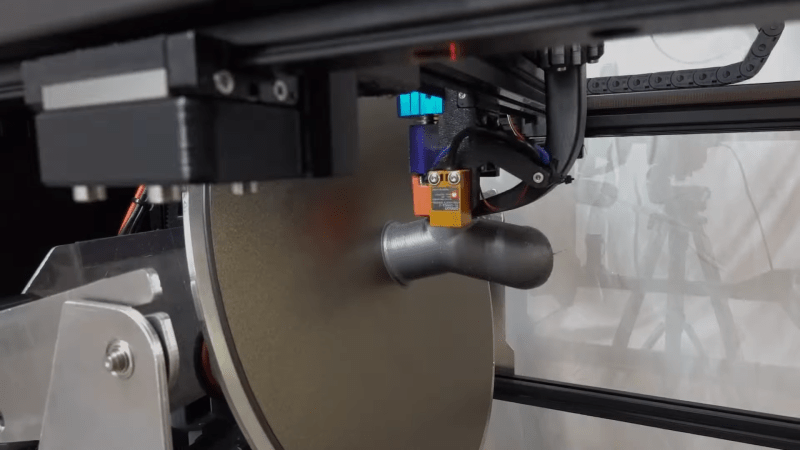
A treadmill-style bed can be a great addition to a 3D printer. It allows prints to be shifted out of the build volume as printing continues, greatly increasing the size and flexibility of what you can print. But [Ivan Miranda] and [Jón Schone] had a question. Instead of making a treadmill to suit a 3D printer, what if you just built a 3D printer on top of a full-size treadmill?

The duo sourced a piece of real gym equipment for this build. They then set about building a large-scale 3D printer on top of this platform. The linear rails were first mounted on to the treadmill’s frame, followed by a gantry for the print head itself and mounts for the necessary stepper motors. The printer also gained a custom extra-large extruder to ensure a satisfactory print speed that was suitable for the scale of the machine. From there, it was largely a case of fitting modules and running cables to complete the printer.

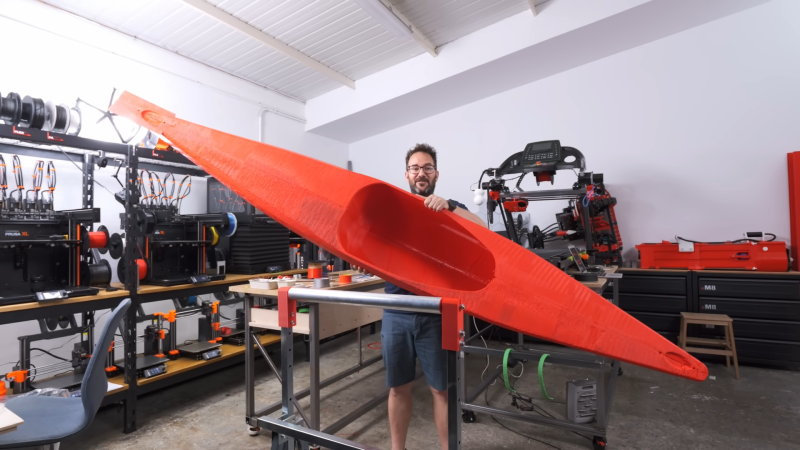
Soon enough, the machine was printing hot plastic on the treadmill surface, thereby greatly expanding the usable print volume. It’s a little tricky to wrap your head around at first, but when you see it in action, it’s easy to see the utility of a build like this, particularly at large scale. [Ivan] demonstrated this by printing a massive girder over two meters long.

We started seeing attempts at building a belt-equipped “infinite build volume” printer back in 2017, and it took awhile before the concept matured enough to be practical. Even today, they remain fairly uncommon.

Continue reading “Making A Treadmill Into A 3D Printer”

Hacking Different Sized Nozzles For AnyCubic Printers

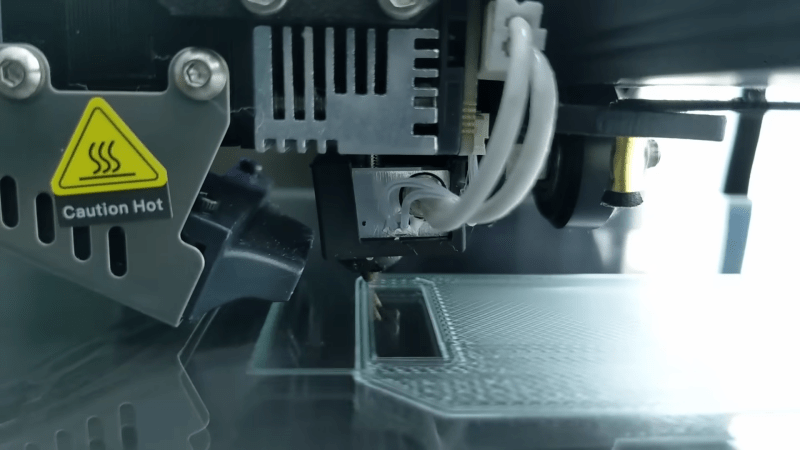
If you’ve got a popular 3D printer that has been on the market a good long while, you can probably get any old nozzles you want right off the shelf. If you happen to have an AnyCubic printer, though, you might find it a bit tougher. [Startup Chuck] wanted some specific sized nozzles for his rig, so set about whipping up a solution himself.

[Chuck]’s first experiments were simple enough. He wanted larger nozzles than those on sale, so he did the obvious. He took existing 0.4 mm nozzles and drilled them out with carbide PCB drills to make 0.6 mm and 0.8 mm nozzles. It’s pretty straightforward stuff, and it was a useful hack to really make the best use of the large print area on the AnyCubic Kobra 3.

But what about going the other way? [Chuck] figured out a solution for that, too. He started by punching out the 0.4 mm insert in an existing nozzle. He then figured out how to drive 0.2 mm nozzles from another printer into the nozzle body so he had a viable 0.2 mm nozzle that suited his AnyCubic machine.

The result? [Chuck] can now print tiny little things on his big AnyCubic printer without having to wait for the OEM to come out with the right nozzles. If you want to learn more about nozzles, we can help you there, too.

Continue reading “Hacking Different Sized Nozzles For AnyCubic Printers”

A New And Weird Kind Of Typewriter

Typewriters aren’t really made anymore in any major quantity, since the computer kind of rained all over its inky parade. That’s not to say you can’t build one yourself though, as [Toast] did in a very creative fashion.

After being inspired by so many typewriters on YouTube, [Toast] decided they simply had to 3D print one of their own design. They decided to go in a unique direction, eschewing ink ribbons for carbon paper as the source of ink. To create a functional typewriter, they had to develop a typebar mechanism to imprint the paper, as well as a mechanism to move the paper along during typing. The weird thing is the letter selection—the typewriter doesn’t have a traditional keyboard at all. Instead, you select the letter of your choice from a rotary wheel, and then press the key vertically down into the paper. The reasoning isn’t obvious from the outset, but [Toast] explains why this came about after originally hitting a brick wall with a more traditional design.

If you’ve ever wanted to build a typewriter of your own, [Toast]’s example shows that you can have a lot of fun just by having a go and seeing where you end up. We’ve seen some other neat typewriter hacks over the years, too. Video after the break.

Continue reading “A New And Weird Kind Of Typewriter”

Supercon 2024: Sketching With Machines

When it comes to our machines, we generally have very prescribed and ordered ways of working with them. We know how to tune our CNC mill for the minimum chatter when its chewing through aluminium. We know how to get our FDM printer to lay perfect, neat layers to minimize the defects in our 3D prints.

That’s not what Blair Subbaraman came down to talk about at the 2024 Hackaday Supercon, though. Instead, Blair’s talk covered the magic that happens when you work outside the built-in assumptions and get creative. It’s all about sketching with machines.

Continue reading “Supercon 2024: Sketching With Machines”

3D Printing A Useful Fixturing Tool

When you start building lots of something, you’ll know the value of accurate fixturing. [Chris Borge] learned this the hard way on a recent mass-production project, and decided to solve the problem. How? With a custom fixturing tool! A 3D printed one, of course.

Chris’s build is simple enough. He created 3D-printed workplates covered in a grid of specially-shaped apertures, each of which can hold a single bolt. Plastic fixtures can then be slotted into the grid, and fastened in place with nuts that thread onto the bolts inserted in the base. [Chris] can 3D print all kinds of different plastic fixtures to mount on to the grid, so it’s an incredibly flexible system.

3D printing fixtures might not sound the stoutest way to go, but it’s perfectly cromulent for some tasks. Indeed, for [Chris]’s use case of laser cutting, the 3D printed fixtures are more than strong enough, since the forces involved are minimal. Furthermore, [Chris] aided the stability of the 3D-printed workplate by mounting it on a laser-cut wooden frame filled with concrete. How’s that for completeness?

We’ve seen some other great fixturing tools before, too. Video after the break.

Continue reading “3D Printing A Useful Fixturing Tool”

Jolly Wrencher Down To The Micron

RepRap was the origin of pushing hobby 3D printing boundaries, and here we see a RepRap scaled down to the smallest detail. [Vik Olliver] over at the RepRap blog has been working on getting a printer working printing down to the level of micron accuracy.

The printer is constructed using 3D printed flexures similar to the OpenFlexure microscope. Two flexures create the XYZ movement required for the tiny movements needed for micron level printing. While still in the stages of printing simple objects, the microscopic scale of printing is incredible.

Continue reading “Jolly Wrencher Down To The Micron”

A 3D printer frame made of red plastic is shown on the left-hand side of the image. On the right-hand side, there is a large motor with a plastic frame attached to the frame. Next to the 3D printer, a blue plastic mesh is being fed through a red plastic frame.

The Most Printable 3D Printer Yet

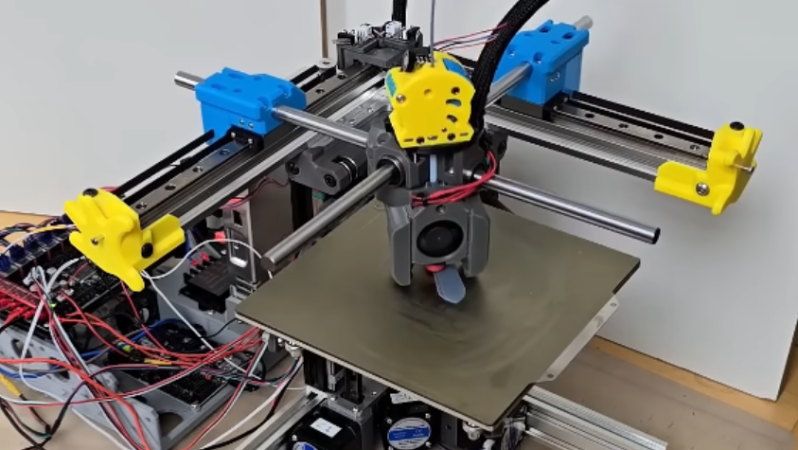
Despite the best efforts of the RepRap community over the last twenty years, self-replicating 3D printers have remained a stubbornly elusive goal, largely due to the difficulty of printing electronics. [Brian Minnick]’s fully-printed 3D printer could eventually change that, and he’s already solved an impressive number of technical challenges in the process.

[Brian]’s first step was to make a 3D-printable motor. Instead of the more conventional stepper motors, he designed a fully 3D-printed 3-pole brushed motor. The motor coils are made from solder paste, which the printer applies using a custom syringe-based extruder. The paste is then sintered at a moderate temperature, resulting in traces with a resistivity as low as 0.001 Ω mm, low enough to make effective magnetic coils.

Continue reading “The Most Printable 3D Printer Yet”