Netflix And Chill – And Socks?

Waking up to spoilers in the last episode after falling asleep during the first episode of a Netflix binge-watching session ranks right up there on the list of first-world problems. Luckily there’s a solution in the form of a pair of Netflix enabled socks, which looks like a pretty neat wearable IoT project.

To be sure, calling these socks Netflix enabled is a bit of a stretch. Aside from the sock designs, which are based on popular Netflix original series, there’s nothing about the electronics that’s specific to the popular streaming service. These socks, with their Arduino Pro Trinket and accelerometer, detect when you stop moving and send an IR signal to do your bidding – pause the movie, kill the TV, or whatever. The electronic side of the build is pretty approachable – it’s just a couple of modules soldered together. The fiber arts side of the project might be a little outside the wheelhouse of the typical hardware hacker, but you can either team up with someone who knits – an experienced knitter, as socks are not a beginner’s pattern – or just slip the felt-clad hardware into your favorite comfy socks. We’d be a bit concerned about ESD protection for the hardware in the wooly environment, though.

“Netflix and chill” is the current version of last century’s “Watching the submarine races,” and as such the need for special socks or a custom Netflix switch for the occasion is a bit puzzling. Still, the underlying wearables idea is pretty good, with plenty of possibilities for expansion and repurposing.

Continue reading “Netflix And Chill – And Socks?”

Reading Smart Cards From A PLC (with A Little Arduino Help)

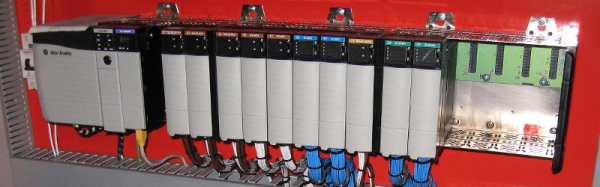
If you’ve spent any time on a factory or plant floor, it is a good bet you’ve run into PLCs (Programmable Logic Controllers). These are rugged computers that do simple control and monitoring functions, usually using ladder logic to set their programs. [plc4u] wanted to connect a smart card reader to an Allen Bradley PLC, so he turned to an Arduino to act as a go-between.

The Arduino talks to a USB card reader using a USB host shield. Then it communicates with the PLC using an RS232 link and the DF1 protocol that most Allen Bradley PLCs understand. You may not need a smart card, but once you know how to communicate between an Arduino and the PLC, you could do many different projects that leverage other I/O devices and code available on the Arduino and connects to existing PLC installations. Just remember that you’ll probably need to ruggedize the Arduino a bit to survive and be safe to the same level as a PLC (which might include a NEMA enclosure or even an explosion-proof box).

Continue reading “Reading Smart Cards From A PLC (with A Little Arduino Help)”

Code Craft – Embedding C++: Templates

The language C++ is big. There is no doubting that. One reason C++ is big is to allow flexibility in the technique used to solve a problem. If you have a really small system you can stick to procedural code encapsulated by classes. A project with a number of similar but slightly different entities might be best addressed through inheritance and polymorphism.

A third technique is using generics, which are implemented in C++ using templates. Templates have some similarities with #define macros but they are a great deal safer. The compiler does not see the code inserted by a macro until after it has been inserted into the source. If the code is bad the error messages can be very confusing since all the developer sees is the macro name. A template is checked for basic syntax errors by the compiler when it is first seen, and again later when the code is instantiated. That first step eliminates a lot of confusion since error messages appear at the location of the problem.

Continue reading “Code Craft – Embedding C++: Templates”

ATtiny Does 170×240 VGA With 8 Colors

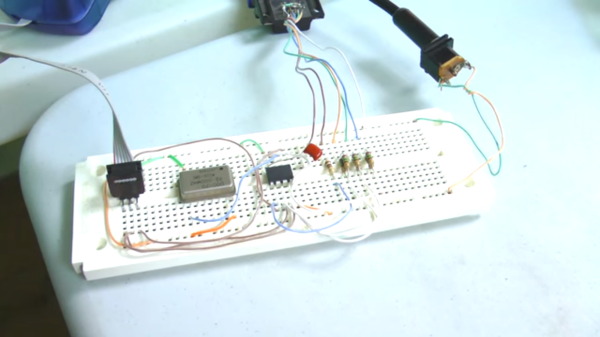
The Arduino is a popular microcontroller platform for getting stuff done quickly: it’s widely available, there’s a wealth of online resources, and it’s a ready-to-use prototyping platform. On the opposite end of the spectrum, if you want to enjoy programming every bit of the microcontroller’s flash ROM, you can start with an arbitrarily tight resource constraint and see how far you can push it. [lucas][Radical Brad]’s demo that can output VGA and stereo audio on an eight-pin DIP microcontroller is a little bit more amazing than just blinking an LED.

[lucas][RB] is using an ATtiny85, the larger of the ATtiny series of microcontrollers. After connecting the required clock signal to the microcontroller to get the 25.175 Mhz signal required by VGA, he was left with only four pins to handle the four-colors and stereo audio. This is accomplished essentially by sending audio out at a time when the VGA monitor wouldn’t be expecting a signal (and [lucas][Rad Brad] does a great job explaining this process on his project page). He programmed the video core in assembly which helps to optimize the program, and only used passive components aside from the clock and the microcontroller.

Be sure to check out the video after the break to see how a processor with only 512 bytes of RAM can output an image that would require over 40 KB. It’s a true testament to how far you can push these processors if you’re determined. We’ve also seen these chips do over-the-air NTSC, bluetooth, and even Ethernet.

Continue reading “ATtiny Does 170×240 VGA With 8 Colors”

Ball Balancing Arduino-Style

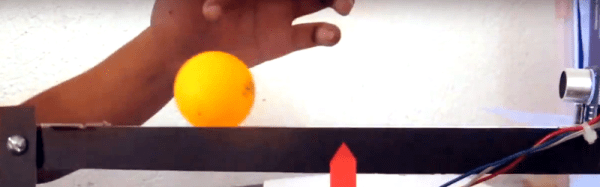
If you have a good sense of balance, you can ride a unicycle or get on TV doing tricks with ladders. We don’t know if [Hanna Yatco] has a good sense of balance or not, but we do know her Arduino does. Her build uses the ubiquitous HC-SR04 SONAR sensor and a servo.

This is a great use for a servo since a standard servo motor without modifications only moves through part of a circle, and that’s all that’s needed for this project. A PID algorithm measures the distance to the ball and raises or lowers a beam to try to get the ball to the center.

Continue reading “Ball Balancing Arduino-Style”

Encryption For Arduino With Spritz

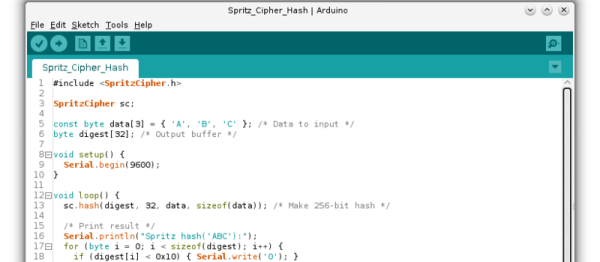
Hackaday.io user [Abderraouf] has written an implementation of the new(ish) Spritz cipher and hash for Arduino. While we’re not big enough crypto-nerds to assess the security of the code, it looks like it’s going to be pretty handy.

Spritz itself is a neat cipher. Instead of taking in fixed blocks of data and operating on them, it allows you to process it in (almost) whatever chunks it comes in naturally, and then extract out the encrypted results piecewise. It works both as a two-way cipher and as a one-way hash function. It looks like Spritz is a one-stop-shop for all of your encryption needs, and now you can run it on your Arduino.

In case you are afraid of new implementations of new ciphers (and you should be), Spritz’s pedigree should help to put you at ease: it was developed by [Ron Rivest] to be a successor to his RC4 algorithm, and it incorporates a lot of the lessons learned about that algorithm over the past. This doesn’t exclude subtle flaws in the implementation of the library (no offence, [Abderraouf]!) or your work downstream, but at least the underlying algorithm seems to be the real deal.

[Abderraouf] links it in his writeup, but just for completeness, here’s the Spritz paper (PDF). What crypto libraries do you currently use for Arduino or microcontroller projects? We’ve been fans of XXTEA for ages, but more because it’s simple and small than because it’s secure. Spritz may be simple enough to implement easily, and still more secure. Sweet.

Robot Listens To Commands–Literally

Where you might see a can, [Adam Kumpf] sees a robot. [Adam’s] robot (named [Canny]) doesn’t move around, but it does have expressive eyebrows, multicolored eyes, and a speaker for a mouth. What makes it interesting, though, is the fact that it receives audio commands via the headphones it wears. You can see [Canny] in action in the video below.

The headphones couple audio tones to [Canny’s] microphone using AFSK (audio frequency shift keying). [Canny] uses an opamp to bring the microphone level up and then uses a 567 PLL IC to decode the audio tones. [Adam] selected two clever frequencies for the mark and space (12345 Hz and 9876 Hz). In addition to being numerically entertaining, the frequencies are far enough apart to be easy to detect, pass through the headphones with no problem, and are not harmonically related.

Continue reading “Robot Listens To Commands–Literally”