Color Changing Bag Matches Clothing Color, Tells You What’s Inside

color-changing-shoulder-bag

Adding some lights to your everyday items will certainly give you a style leaning toward the world of Blade Runner. But if you can add functionality to control the blinky components you’ve actually got something. A great example of this is [Kathryn McElroy’s] Chameleon Bag. It’s a shoulder bag with a light-up flap. It can color match your clothing, but she also built some features that will let you know what is inside of the bag.

The project started by using a cardboard template in the size and shape of the bag’s flap. After adding an Arduino to control the LEDs and an RFID reader for an interactive element she sewed a replacement flap that also acts as a diffuser. In the video after the break she demonstrates matching the color of her scarf by reading a tag sewn in the end of it. She then starts loading up all the stuff needed for a day away from home. As the keys, phone, and computer are placed in the bag their tags are read, resulting in different combinations of color. Once everything she needs is inside, the flap turns green and she heads out the door.

This will go great with your illuminated umbrella.

Continue reading “Color Changing Bag Matches Clothing Color, Tells You What’s Inside”

Building A Hardware Security Module

secure

[Stefan] was nervous about putting the secret key for his Amazon Web Services account in his config file. In the security world, storing passwords in plain text is considered a very bad thing. but luckily there are ways around it. [Stefan]’s solution was to make a hardware security module out of the newest ARM-powered Arduino Due.

The build puts the secret key for [Stefan]’s AWS account right in the firmware of the Arduino Due (with the security bit on the Arduino flipped, of course). A Python web service then receives sign requests and talks to the Due over a serial port. The Due then signs the request and sends it off to another bit of Python code that handles the AWS API.

Hardware security modules are frequently used by three-letter government agencies to manage cryptography keys and ensure their data are encrypted properly. Instead of a hardware module costing tens of thousands of dollars, [Stefan]’s only cost the price of an Arduino Due; not too shabby for a hardware security module that can sign more than 2000 requests per second.

nerf-sentry

Nerf Sentry Gun For The Apocalypse

nerf-sentry

If you’ve ever wanted to shoot someone with a Nerf gun, but just didn’t have the energy to get off the couch, this hack may be for you. It’s also a good way to ward off zombies if another apocalypse, Mayan or otherwise, is on the horizon.

Although the effects are very cool, as seen in the video after the break, the method for making this setup was quite simple. The requirements for this project were that the gun could not be permanently modified, and everything had to fire automatically. These restrictions may have contributed to the simplicity of the design as many of us would start breaking things before we had to.

Instead of some elaborate hack, the trigger was tied back in the firing position at all times. A relay was then used to interrupt the power supply to the mechanism allowing an Arduino equipped with an infrared sensor to automatically control the firing. The setup is explained after the break, but skip to around 1:55 if you’d rather just see the guns in action. Continue reading “Nerf Sentry Gun For The Apocalypse”

Robot Can Barely Move With So Much Hardware Strapped To It

web-server-robot

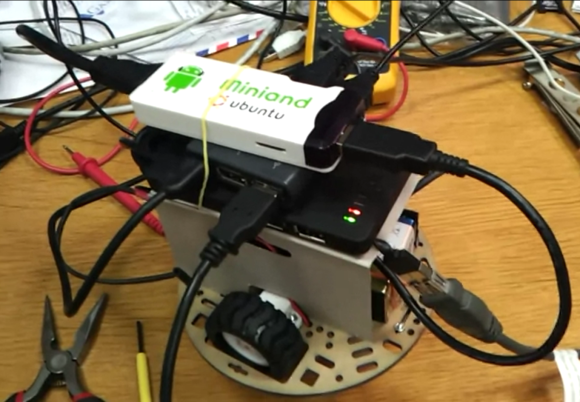
We think that [Andrej Škraba] needs to start looking for a beefier motor platform. This little robot has so much hardware strapped to it the motors can barely keep up. But with a little help it can make its way around the house, and it takes a whole lot of connectivity and computing power along for the ride.

The white stick on the top is a single-board computer. The MK802 Mini sports an A10 processor and up to a gig of ram. Just below that is a USB hub which is sitting on top of a USB battery pack. This powers the computer and gives him the ability to plug in more than one USB device. The robot chassis is from Pololu. It uses an Arduino and a motor shield for locomotion, with commands pushed to it via USB.

This setup makes programming very easy. Here [Andrej] has a keyboard and HDMI monitor plugged in to do a little work. When not coding it can be disconnected and driven over the network. He makes this happen using an Apache server on the MK802 and node.js. See a demo of the system in the clip after the break.

Continue reading “Robot Can Barely Move With So Much Hardware Strapped To It”

Animated Holiday Wreath From A String Of LED Lights

animated-holiday-wreath

[Dennis Adams’] wreath lights project looks pretty good. But he did some amazing coding to produce a whole set of interesting animated patterns that really seal the deal for the project. Don’t miss the video after the break where he shows off all of his hard work.

He started with a string individually addressable LEDs. These are the 12mm variety like what Adafruit sells (we’ve seen them popping up in a number of projects). To mount each pixel he tried a several different prototypes before settling on a ring that was 14″ in diameter. The design was laser cut from acrylic, with sets of staggered holes to host each ring of LEDs. The final touch was to add ping-pong balls to diffuse the light.

As we mentioned earlier, the light patterns really add the finishing touch to the project, but there is more functionality there too. [Dennis] rolled in the ability to monitor a Twitter feed with the wreath. When he gets a new tweet, a different animation will let him know about it.

Continue reading “Animated Holiday Wreath From A String Of LED Lights”

FireHero: Raspberry Pi Controlled Pyrotechnics

Fire Hero 3

To put on a live pyrotechnic show at a music festival, [Chris] built the FireHero 3. The result is remotely controlled flames shooting up to 100 feet in the air.

The system is controlled by a Raspberry Pi and an Arduino. A server runs on the Pi and allows a remote computer to control the system. The Pi sends commands over serial to the Arduino, which switches solid state relays that actuate the valves.

There’s also some built in safety features: the system won’t boot unless you have the right key and RFID tag, and there are pressure transducers and temperature sensors to ensure the system is operating safely. A CO2 actuated valve can quickly stop fuel flow in an emergency.

Vaporized propane creates the fireballs. The vapor is created by heating the supply tank in a hot water bath. An accumulation tank stores the vapor and custom built manifolds distribute it to the various flame cannons. At each cannon, a silicon nitride hot surface igniter (HSI) is used to ignite the flames once the valve is opened.

After the break, watch a video the the FireHero making some flames.

Continue reading “FireHero: Raspberry Pi Controlled Pyrotechnics”

Stellarino Brings Wiring-style Coding To The Stellaris Launchpad

wiring-for-stellaris-launchpad

[Sultan Qasim] wrote in to tell us about the work he’s been doing on the Stellarino library. It’s goal is to break down the coding barriers present for those looking to move from Arduino to ARM. This is accomplished by facilitating Wiring-stlye code for the Stellaris Launchpad ARM development board.

Right off the bat [Sultan] mentions that the interface is Wiring-like, but is not compatible with it. This means you can’t just plop your existing sketches into a C file and get them to work with the addition of a simple include file. But what it does do is provide access to the functions to which seasoned Arduino users have grown accustomed. You can see some examples above, including analogWrite(), digitalRead(), and a simple delay function.

We had a quick look at the library. It uses StellarisWare components which are stored in the ROM of the chip (these are all preceded by ‘ROM_’). The one thing missing is the UARTstudio library which apparently carries a license incompatible with GPL.