Control An Arduino From Android Over Bluetooth

Whether you’d like to do some real-time logging of data, or just want to control a project with your Android phone, [Thomas]’s Arduino-Android Bluetooth connection instructable is sure to be useful

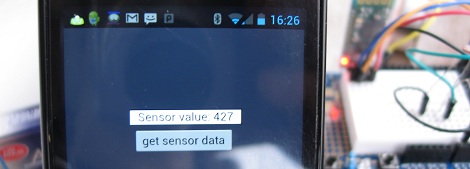
[Thomas]’ build uses the very inexpensive JY-MCU Bluetooth module that’s available on eBay or dealextreme. This Bluetooth module ties directly into the Tx and Rx lines of the Arduino so a wireless serial connection between an Android device can be established. On the Android side of the build, Python for Android and the Scripting Layer for Android allow for reading wireless sensor data over Bluetooth.

While connecting an Android device to an Arduino is also possible with an IOIO  or an Android Open Accessory dev kit, we haven’t seen much (barring this) about controlling or reading simple electronics with Android over Bluetooth. Sometimes you just don’t need an awesome dev board to bodge up a simple project, so we hope [Thomas]’s very nice instructable will help get a few more builds off the ground.

Becoming The YouTube Loading Animation

Whether you’re used to dropped wifi connections, or your housemates are using up all the bandwidth for streaming, we’ve all see the spinning octet of disks that is the YouTube loading animation. [technocrat] thought it would be a great idea to actually become YouTube and set out on designing a physical manifestation of the loading animation.

[technocrat] used eight ping-pong balls as the main structure of the build. After drilling each ping-pong ball and gluing white LEDs in, the only thing left was to connect everything up to an Arduino. The code loops through each LED and provides the ‘light trail’ animation YouTube has burned into our memory.

To complete the build, [technocrat] attached his physical loading animation to a black t-shirt emblazoned with the YouTube logo to make everything more understandable. While it may not be as colorful as the beachball of death or as conceptual as the Windows ‘spinning hourglass’, we’re really liking this build. Check out the video after the break.

Continue reading “Becoming The YouTube Loading Animation”

PushingBox Alerts You Of Your Cat’s Roaming Habits

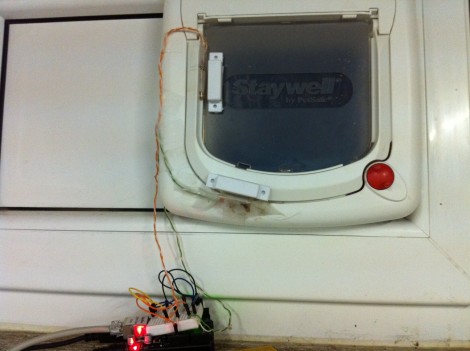
Dogs may be man’s best friend, but cats are certainly a hacker’s best muse. They provide so many ‘reasons’ for projects, like this cat door which [Clement] augmented to monitor the comings and goings of his feline friend (translated). He’s using a web service we hadn’t heard of before called PushingBox to send notifications like Tweets and Emails from the Arduino monitoring that door.

The two white rectangles attached to the cat door in the image above are magnets commonly used for entry door monitoring. Using a pair of them along with reed switches lets the system differentiate between an incoming or outgoing cat. The Arduino is web-connected and running the PushingBox API to manage the notification messages. See a demo of the system in the clip after the break.

This would be a nice addition to the cat door we saw [Dino] build. Of course, if you really want to go all out with the cat hacks the next project should be a GPS tracking collar. Continue reading “PushingBox Alerts You Of Your Cat’s Roaming Habits”

Workout Timer Has Its Own Fight Bell

This workout timer turned out great. We think [Douglas] managed to end up with a professional look and a full range of features even though he was doing a lot of learning along the way.

He wanted a clock that was capable of counting up or down to time different segments of his workout. In order to be really useful it needed to have a remote control and a way to signal when time had run out. He grabbed an Arduino and started prototyping with an LED marquee at first, but after adding a second Arduino to deal with the display scanning issues he finally switched over to these LED segment displays.

The timer includes an IR receiver so that it can be controlled with a handheld remote. The large red bell to the side has a heck of a ding and is used to signal the start and end of timing. Perhaps the driver for that bell could be incorporated into the home automation project from Wednesday. Once the hardware decisions were finalized [Douglas] set out to build an enclosure that he could be proud of (mission accomplished!). Don’t miss the video after the break where he walks through all various aspects of the user interface. Continue reading “Workout Timer Has Its Own Fight Bell”

Short And Squat Balancing Bot Is Extremely Stable

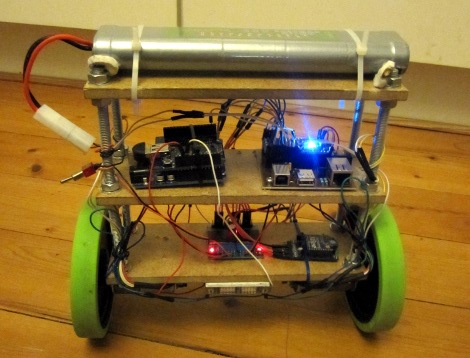
[Lauszus] really put together an impressive self balancing robot platform. It is virtually motionless when balancing in place, and that stability is never lost even when motoring across the room.

Part of the success behind this build is the use of quality components. He’s got a really nice set of motors with built-in encoders which give feedback to the balancing system. They work in conjunction with a gyroscopic sensor and PID code to keep the two-wheeled platform upright. An mbed board running 96 MHz provides plenty of computing power for the balancing system. But an Arduino can also be found on board. This was included to facilitate Bluetooth connectivity with the remote control as [Lauszus] didn’t want to port the code he had already written.

The fourteen minute video after the break shares the details behind how the PID controller is tuned and how [Lauszus] implements target angle and a few other factors. Of course he talks about the hardware choices, and demonstrates functionality by driving the bot around using a wireless PS3 controller.

The construction method which uses masonite strips and threaded rod does a good job of protecting the hardware mounted on it. We’re always a bit worried about these bots falling over and some of the projects we see offer little or no protection. Once thing that helps protect against a spill is a piezo buzzer which sounds when the battery is getting low.

Continue reading “Short And Squat Balancing Bot Is Extremely Stable”

Your Theme Song Greets You At The Front Door

One thing you can look forward to when arriving at home after a long, arduous day at the office is some peppy theme music when you walk in the door. [Sebastian Sommer] built the system, and shows it off in the video after the break by dancing to James Brown’s I feel good.

The setup uses an Arduino as a microcontroller. It monitors a hall effect sensor on the jamb which detects a passing magnet on the door. We guess this means the system doesn’t know if you’re coming or going but perhaps a future upgrade would add an infrared beam to detect your legs as head out the door. The music itself is played by an SparkFun MP3 shield which has a decoder chip, microSD slot, and audio jack for the powered speakers. [Sebastian] grabbed a copy of [Bill Porter’s] mp3 shield library to get the project up and running quickly.

This is a pretty cool addition if you’re already using an Arduino for a door lock or vice versa. Or maybe you’re not home enough to make this hack worth it, in which case you simply must take this music playing Tesla coil hat along on your commute.

Continue reading “Your Theme Song Greets You At The Front Door”

Antique Phone Provides A Soundtrack Perfect For Restoring Old Cars

crank-phone-music

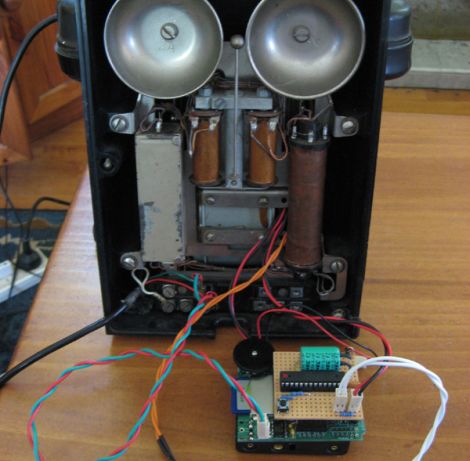
[Simon] is in the middle of restoring/building himself an Austin 7 Special out in his garage, and like most tinkerers, found that music helps to move the process along. He happened to have an old Bakelite generator phone out in the garage as well, and figured that he might as well have it do something other than simply hang on the wall.

Playing music from the 1930 seemed like a fitting enough task, so he picked up an Adafruit Waveshield and spent some time wiring it up to the old telephone. His new radio works simply enough, piping .wav files through the handset, provided someone has cranked the phone’s generator recently.

While cranking the generator is required to play music, the Arduino is actually powered off a pair of AA batteries. The cranking is all cosmetic, but he did program the Arduino to slow the music down every once in awhile, requiring that the generator be turned to get things back up to speed.

It really is a neat way to repurpose the old phone, and we like the fact that [Simon] did not gut it to put this project together.

Continue reading to see a short video of his new music player in action.

Continue reading “Antique Phone Provides A Soundtrack Perfect For Restoring Old Cars”