Controlling An Infuriating Game With An Accelerometer

[Daniel] just made a motion controlled game controller to go with his infuriating game. Thankfully, [Daniel] posted the source for this game so first time players already know the level select codes.

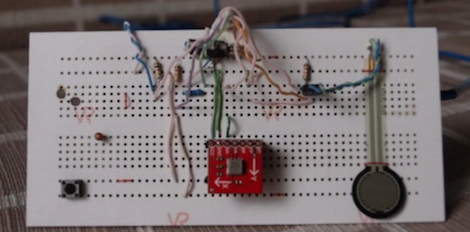
The controller is based on an Arduino Uno with what looks to be a Sparkfun 2-axis accelerometer providing the tilt sensing. A similarly sourced half-inch force sensitive resistor and temperature sensor control the ‘jump pads’ in the game. A small vibrating pager motor strapped onto the controller as a rumble pack.

Continue reading “Controlling An Infuriating Game With An Accelerometer”

Roomba Used To Map Indoor Air Quality

roomba_based_air_quality_tester

The next time you set off for a long day in the coal mines, forget the canary – bring your Roomba along instead!

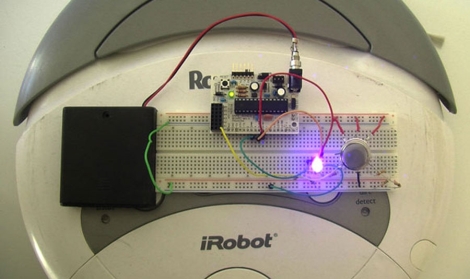
While we are pretty sure that canaries are no longer used in the mining industry, this Roomba hack could make a suitable replacement if they were. A team from the Public Laboratory for Open Technology and Science (PLOTS) recently showed off a Roomba which they modified to test an area’s air quality. Using an Arduino and a volatile organic chemical (VOC) detecting air quality sensor, the Roomba goes about its normal business, lighting an LED any time it encounters overly contaminated air. When captured via a long exposure image, the process creates a “bad air” map of sorts, with the polluted areas highlighted by the glow of the LED.

While the Roomba currently only detects VOCs, the team plans on adding additional sensors in the near future to expand its functionality. The Roomba is merely a proof of concept at the moment, but we imagine that similar technology will be adapted for use in unmanned explorations of chemically hostile environments, if that hasn’t happened already.

[via DVice] [Image via TechnologyReview]

Beat707 LE: A Button Pad-based Standalone MIDI Sequencer

sparkfun_button_pad_midi_controller

[Guilherme] picked up a SparkFun Button Pad and was taking a closer look at the device when he noticed that it was based off the ATMega328 microcontroller. Since he loves working with MIDI, he thought that the Button Pad would make a slick yet compact standalone MIDI controller.

Since his ultimate goal was to create a completely standalone controller aside from the power plug and MIDI interface, it forced him to work quite closely with the ATMega chip. He and his partners spent a good deal of time working through some serial communications issues so as not to block the LEDs or MIDI block timer during operation. Ensuring that the Arduino doesn’t block any other functions is obviously important when you are building a MIDI timer, and it seems [Guilherme] was successful in his quest.

The MIDI controller works quite nicely as you can see in the videos below, great job!

Continue reading “Beat707 LE: A Button Pad-based Standalone MIDI Sequencer”

Chilean Teen Builds Automatic Earthquake Alarm

chilean_teen_earthquake_alarm

When an earthquake is about to strike in Chile, who do you think is first to sound the alarm? You might be surprised that it’s not the government, but rather a 14 year old boy.

After living through an earthquake in 2010 and seeing the devastation this spring in Japan, Chilean teenager [Sebastian Alegria] decided that he wanted to construct something similar to Japan’s earthquake warning system. He purchased an off the shelf earthquake detector for less than $100, and connected it to his computer via an Arduino.

Now, whenever seismic activity is detected, his sensor tweets an alert letting his 29,000+ followers know that a perceptible earthquake is 5 to 30 seconds away. Apparently the Chilean government is working on a similar system that is still at least a year away, so in the meantime his fellow citizens rely on [Sebastian] instead.

While it might seem like a relatively easy hack to pull off compared to other earthquake detectors, we’re impressed by [Sebastian’s] creativity, and his will to help others. He’s been pounding away at computers since he was about 4 years old and has several other popular Twitter-based projects under his belt already, so we won’t be surprised if we hear from him again in the future.

Obstacle Avoiding Hexapod From Reused Parts


[Rob] built this hexapod one day when he had some free time after work. Just like the last hexapod we saw, he based the build on the Pololu design which uses three servo motors for surprisingly reliable movement.

The hardware is very straight forward. A Dorkboard serves as the brain. It’s a PCB that is wider on each side by the width of one female pin-header than a standard AVR 28-pin microcontroller. This gives easy access to all of the pins on the Arduino chip while making it small and light. You can see that a four-pack of batteries hangs below the servo motors to provide power.

Protruding above the 6-legger is a PING ultrasonic rangefinder. This adds autonomy to the little robot, which you can see running some obstacle avoidance routines in the video after the break. We’ve asked [Rob] if is able to share his code and will update this post if we hear back from him.

Update: Here’s a link to the sketch, and we’ve updated the picture with one that [Rob] sent to us.

Continue reading “Obstacle Avoiding Hexapod From Reused Parts”

One Really Big Quadcopter That Is Following In The Steps Of The Spruce Goose

Behold the Land-Bear-Shark, a quadcopter on a rather grand scale. At a full eight kilograms it’s an easy target to compare the [Howard Hughes] behemoth, but in addition to the weight, this still has yet to make its first flight.

To give you some scale to the image above, the board at the center is an Arduino. It controls the beast, along with the help of a SparkFun IMU board which rides atop. Really, if any quadcopter of this size has a chance of working, this should be the one. The construction is beautiful, making use of carbon fiber rod along with 3D-printed connectors to assemble the frame. A lot of thought has gone into small things like conserving weight used on the landing gear, which are incorporated into the bottom corner brackets. The batteries are connected in a manner that makes them easy to adjust, acting as ballast for balancing the craft.

We’re keeping our fingers crossed that this will be more than the tongue-in-cheek title of the post which calls it a Quadrotor-shaped sculpture.

[via Adafruit]

word_clouds_from_broacast_television

Analyzing TV’s Talking Heads With Processing

[Michael] from Nootropic Design wrote in to share an interesting and fun project he put together using one of the products his company sells. The gadget in question is their “Video Experimenter” shield which was designed for the Arduino. It is typically used to allow the manipulation of composite video streams via overlays and the like, but it can also serve as a video analyzer as well.

When used for video analysis, the board lets you decode closed captioning data, which is exactly what [Michael] did here. He decided it would be fun to scrape the closed captioning information from various shows and commercials to do a little bit of content analysis.

Using a Processing sketch on his Arduino, he reads the closed captioning feed from his cable box, keeping a count of every word mentioned in the broadcast. As the show progresses, his sketch dynamically constructs a cloud that shows the most commonly used words in the video feed.

The results he gets are quite interesting, especially when he watches the nightly news, or some other broadcast with a specific target audience. We think it would be cool to run this application during a political debate or perhaps during a Hollywood awards ceremony to discover which set of speakers is the most vapid.

if you’re interested in learning more about the decoding process, [Michael] has put together a detailed explanation of how the closed captioning data can be pulled from a video stream. For those of you who just want to see the decoder in action, keep reading to see a quick video demonstration.

Continue reading “Analyzing TV’s Talking Heads With Processing”