AVR Programming 02: The Hardware

You may be able to write the most eloquent code in the history of embedded systems but without a way to run it on the hardware it will be worthless. In this installment of the tutorial series we will:

  • Look at some of the available AVR programmer options
  • Place the microcontroller on a breadboard and connect it to a power supply and a programmer.
  • Use programming software to send some example code to the microcontroller

If you missed Part 1 take a few minutes to review that portion of the tutorial and then join us after the break.

Series roadmap:

Continue reading “AVR Programming 02: The Hardware”

New Dynamic Duo, Arduino And Eclipse

There are a lot of solutions to programing an Arduino: the default avr-g++, Studio, etc. But [Sandeep] let us know about using one of the more powerful IDEs out there, Eclipse, to do the same. We’ve already outlined why Eclipse is a great IDE but now the fact that you can use it in your MCU based projects adds to its usefulness and already large feature list. However, don’t be turned off by [Sandeep’s] tutorial. While it is aimed at people who are completely new to setting up an IDE and working with an AVR, the tips certainly can benefit even the most experienced hacker.

Cheap And Easy SMS Via GSM For Your MCU

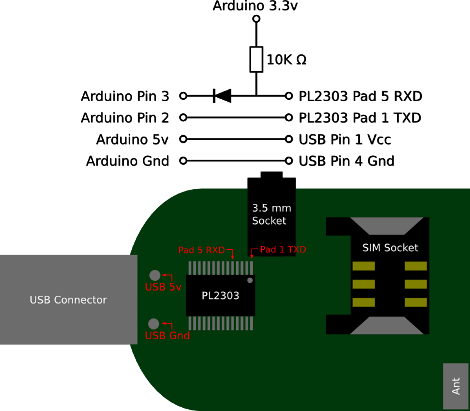
Non acronym version of the title: send and receive text messages via cell phone communication towers using an Arduino or other microcontroller. “We’ve been doing that for years!” you cry, well yes, technically. But [Fincham] lays it outs simply; commercial offerings are expensive and finding a cell phone that uses RS232 now a days is getting difficult, so a new way of doing the same old is necessary. The good news is USB GSM modems are readily available, cheap, and only require a few interface pins to get them talking with an Arduino. In fact, the image above is all you need.

Data Confirmation With RF Communications

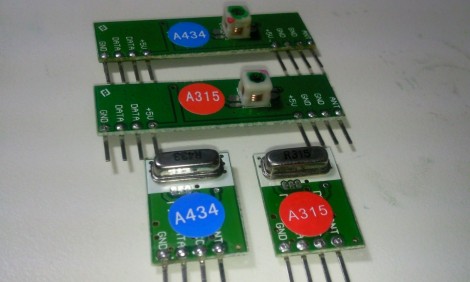
[Rafael] built a system that uses radio frequency for communications. The code he was using with the inexpensive receiver/transmitter pairs already had some error correction but from time to time an entire message would be missed by the receiver. He set out to make these RF communications more robust.

A little more than a year ago we looked at using these same transmitters with an Arduino. [Rafael] has a similar setup but since they are unidirectional he chose to use two pairs for bidirectional communication (each operating at a different frequency to avoid interference). On one end, a computer transmits data to the Arduino which is in a remote location. His confirmation protocol relies on a randomly generated message identifier. The computer will continually transmit the same message. The Arduino continually receives these messages, comparing them with the last successfully received message. If they match, it is considered a successful data transfer and the Arduino transmits a confirmation back to the computer which then starts transmitting the next message.

This isn’t an application-specific protocol. For demonstration purposes [Rafael] built a quick home automation setup that uses it to operate a house lamp.

Data Plotting For The Visually Impaired

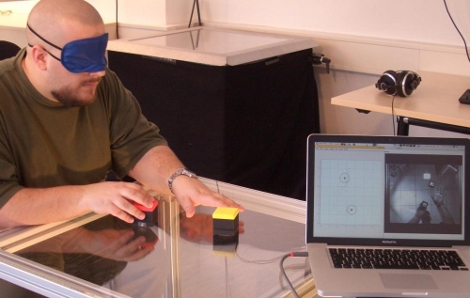
This setup helps to represent data in a meaningful way to for visually impaired people. It uses a combination of physical objects to represent data clusters, and audio feedback when manipulating those objects. In the video after the break you’ll see that the cubes can orient themselves to represent data clusters. The table top acts as a graphing field, with a textured border as a reference for the user. A camera mounted below the clear surface allows image processing software to calculate the locations for the cubes. Each cube is motorized and contains an Arduino and ZigBee module, listening for positioning information from the computer that is doing the video processing. Once in position, the user can move the cubes, with modulated noise as a measure of how near they are to the heart of each data cluster.

The team plans to conduct further study on the usefulness of this interactive data object. We certainly see potential for hacking as this uses off-the-shelf components that are both inexpensive, and easy to find. It certainly reminds us of a multitouch display with added physical tokens.

Continue reading “Data Plotting For The Visually Impaired”

Brightest Day, Darkest Night, Charge It With Arduino’s Light

To userp the Green Lantern oath is a sacrilege. But calm your rage as you take in this Green Lantern battery and ring project. [Jon] built the power battery portion out of LEGO, but inside you’ll find an added bonus. An Arduino uses a set of LEDs and an RFID reader to bring the object alive. A matching ring contains the RFID tag that activates the lights when held up to the lantern’s lens. You can see this used to charge the power ring (and join in by saying the oath) in the video after the break.

Want to build something like this but don’t have an RFID reader? This would be easy to pull off by adding a magnet to the ring and a hall effect sensor in the lantern. Maybe this will make you rethink your Halloween costume this year.

Continue reading “Brightest Day, Darkest Night, Charge It With Arduino’s Light”

Add-on Panel Brings Automated Vents Flaps To A PC

[SXRguyinMA] built a replacement top bezel for his computer case. He wanted to add vents that would automatically open or close based on the cooling needs of the computer. With some careful measurements he modeled the parts in Sketchup and sent out for them to be cut from styrene with a water jet cutter. The parts came back looking great and the assembly of the shutters went swimmingly. The bezel also includes a lighted screen for temperature information, as well as the front USB ports, headphone and mic jacks, etc. Hidden underneath is an Arduino board and servo motor. The Arduino polls the temperature and drives the servo to adjust the fins accordingly. There’s even a supercap in the circuit that will close the vents when the PC powers down or when power is unexpectedly lost. See it in action after the break.

Continue reading “Add-on Panel Brings Automated Vents Flaps To A PC”