Electronic Wind Chime

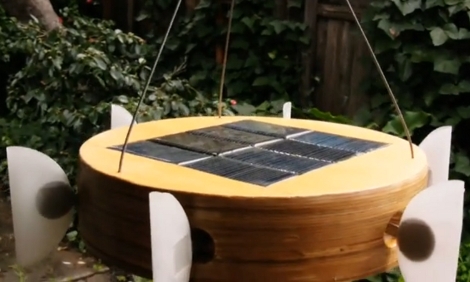
The Winduino II uses fins to pick up the movement of the wind and translate it into music. Each fin is attached to the main body using a piezo vibration sensor. The signals are processed by an Arduino housed inside and the resulting data makes its way to a computer via a Bluetooth connection to facilitate the use of Max/MSP for the audio processing. Included in the design is an array of solar panels used to keep the battery for the device charged up. Hear and see this creative piece after the break.

Continue reading “Electronic Wind Chime”

Game Controllers Using USB Host Shield

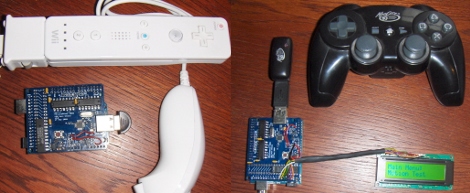
[I-Bot] has put together some libraries that make it easy to use gaming controllers with an Arduino. They interface through the USB host shield. This means that PS3 controllers connect via USB through a cable or a dongle. With the Wii remote things get a little more interesting. A Bluetooth dongle is used to make the connection wirelessly. What we have here is a cheap and easy way to add Bluetooth connectivity to your projects either through the USB Host shield, or by building your own hardware with the schematics and code that are available from Circuits@Home. There are several pages that walk you through the protocols using as well as a demonstration video you can see after the break. Continue reading “Game Controllers Using USB Host Shield”

Add A Bluetooth Terminal To Your Kindle

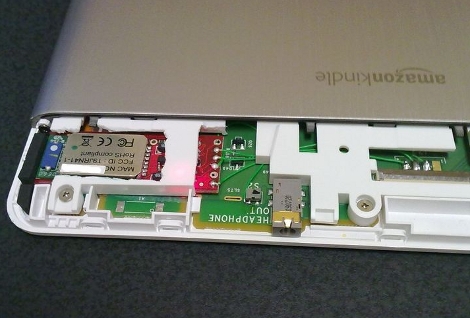
This is an Amazon Kindle DX with a Sparkfun Bluetooth Mate stuck in it. [Darron] hacked the two together in order to have a wireless serial terminal on the device. There are three big pads in the middle of the Kindle PCB labelled GND, RX and TX, making it easy to figure out those connections. Getting voltage was a bit more difficult. He managed to find 4V coming off of one side of the Kindle’s wakeup switch which works well because the Bluetooth Mate has a voltage regulator on board. To protect the Bluetooth module he modified it to pull-up the TX from the on-board regulated 3.3V rather than the 4V coming in from the Kindle.

He’s also been doing some software work on the device now that he has easy access to it. Along the lines of the Ubuntu-on-Kindle hack from September, he’s compiled QT for the Kindle and written a couple of programs such as Sudoku to show that it works.

BT Phone Is Much More Than Retrofit

[Santiago] turned his Ericfon into a Bluetooth phone. This is completely different from the handset retrofits we looked at last month. This is because he didn’t simply crack open a BT headset and cram it into his phone. He developed his own hardware for full functionality.

This is an open source project with available hardware details that he intends to turn into a kit. [Santiago] has purposed a PIC microcontroller to connect with a WT32 bluetooth module. The PIC allows for a dial tone, dialing with the original rotary dial, and produces the original sound when the phone rings. What he now has is a way to have a home phone without a landline. As seen the video after the break, the Ericfon works the same as it did when it was new, except the connection is made through Bluetooth and not via a copper phone line. Continue reading “BT Phone Is Much More Than Retrofit”

Bluetooth Handset Hacks

Cramming Bluetooth headset circuitry into an analog telephone body has become an extremely popular hack. With declines in the prices of these headsets, and older telephones being seen as storage-room-clutter this hack is just waiting for you to get started. Join us after the break for a look at what others have already accomplished.

Continue reading “Bluetooth Handset Hacks”

Bluetooth Based Pseudorandom Number Generation

[MS3FGX] has done an interesting study about using Bluetooth adapters as a source for Pseudorandom Number Generation (PRNG). As it turns out, the Bluez package has a function that calls a remote Bluetooth adapter to return a random number. He picked up 10 compatible adapters for about $30 from DealExtreme and set about assembling some numbers to see how this compares to an OS-based PRNG.

Because millions of samples are needed for an accurate comparison, time became a problem. The adapters are a little bit slow responding to a request, sending just 4800 numbers in the first 30-second test. This can be overcome with multiple adapters being accessed by multiple computers for hours at a time. What can this be used for? Your guess is as good as ours, but [MS3FGX] has done a great job of writing up his tests. He’s also made a set of 20.7 million randomly generated values available if you want to generate your own statistical analysis.

Bluetooth Bracelet Hacked

[Jeffery] hacked the Bluetooth standard in order to use this bracelet as a custom display. He took up our challenge to hack the device when we first saw it back in February.

In order to display his own messaged he looked into how the HFP is implemented in the Bluetooth stack. The details are shared in his readme file but it goes something like this: The Bluez package needs to be compiled with a dummy backend that is not phone-specific and that will then allow external manipulation of the data being sent. This provides something of an API that a Python script can manipulate. His proof-of-concept allows for the script to be called with the message you want displayed as the command line argument. This should be simple enough to incorporate for just about any purpose that suits your fancy. Unfortunately, messing with the Bluetooth package in this way makes it impossible to use other devices with your phone, but that’s a hack for another day.