Bonfire – Interactivity Using Pico Projectors And Cameras

[youtube=http://www.youtube.com/watch?v=O3MZYRAZJNk]

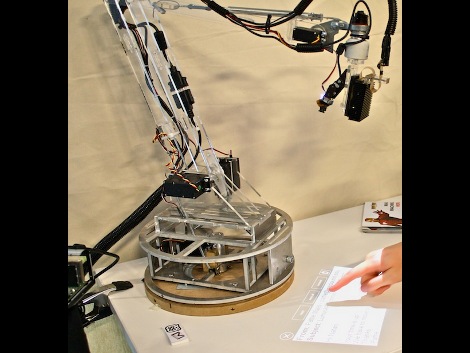
This video shows a demonstration of Bonfire, an additional interface for computers. It consists of a pico projector and camera hang on the back of either side of a laptop. The projector displays information on the table top and the camera monitors the area for interaction. It can recognize your hand or objects such as a smartphone or headphones and react accordingly. An accelerometer in the laptop picks up tapping (we’d guess you have to tap pretty hard) and there is also support for gestures. This was presented at 2009 UIST and unfortunately the published article is not available for free [Thanks for the link Ciflet].

We hope to see this kind of thing, as well as skin based input, come to the market some day. Until then, you’ll have to build your own.

[via Procrastineering]

Beer Can Pinhole Camera

When [Justin Quinnell] sent in his beer can pinhole camera, we were just floored. The parts are easy to obtain, and the process for building and ‘shooting’ with the camera are near effortless.

The really impressive part of this hack is letting your camera sit for 6 months facing the sun. Yes, you read that correct, a 6 month exposure. Check out after the break for one of his astonishing shots, and trust us, its well worth the click. Continue reading “Beer Can Pinhole Camera”

Convert An Early 60s Polaroid To Modern Film

[Adam] sent in this cool project. He has modified a Polaroid J66 camera to use modern film. Most of the initial modifications look fairly simple, but things get a little more complicated when they also convert it to a fully manual camera. There is a section that explains a neat little trick of using a cheap solar panel attached to your computer sound card to figure out what ISO the camera is shooting at.

Ask HackADay: Network Security Camera

Today we received the question,

“How to control a web cam via internet,
i want to use it for security reasons, always out of the house and my PC connected want to open the cam from time to time to checkout if something wrong!!”

– [Mohamed Saleh]

What a fun project we thought! And so many different ways of tackling it. Find out what we suggested to [Mohamed] after the break. Continue reading “Ask HackADay: Network Security Camera”

Packshotnik: 360 Degree Image Creation

[youtube=http://www.youtube.com/watch?v=sk7_XRgxCas]

Packshotnik is a circuit designed to help with creating 360 degree images. It consists of a main board and motorized rotating platform. The board can send IR signals to a camera to snap pictures at intervals in the rotation. The source code, schematic, and pcb files are all available from the project page. While he is using this primarily for rotating 360 degree images, you could also just plop your camera onto the platform and end up with panoramic sets.

Third-person Vehicle

Here is something we didn’t expect (NSFW). The machinima crew behind RedVsBlue, Rooster Teeth, actually did a hack!

The idea is simple enough, how could you experience driving a vehicle like in a video game – aka, third-person. With some steel bar, Canon 5D camera, and a 15inch monitor inside of a blacked out cab, they accomplished just that.

What surprised us the most, is the great difficulty and difference there is between the video game vehicle and the real life one. But all of us here at HAD know why; they need to replace the steering wheel with a joystick. While they’re at it they can make it wireless and remote-controlled. Finally a HUD would be easy enough to program (might we suggest processing). Oh dear lord, is the world ready for this!?

Flood Triggered Camera

When the Department of Natural Resources of Australia decided that they needed to capture data about the natural flooding of a cave, they turned to a hacker to get results. The goal was to photograph the area during these floods with an automated system. In the end, they used a gutted Lumix digital camera mounted in a trash can, covered in aluminium foil. Though it sounds a bit silly, the final product turned out quite nice. You can see the build log, schematics, and results on the project page.

[via hackedgadgets]