Cellphone Charger Has A USB Port Forced Upon It

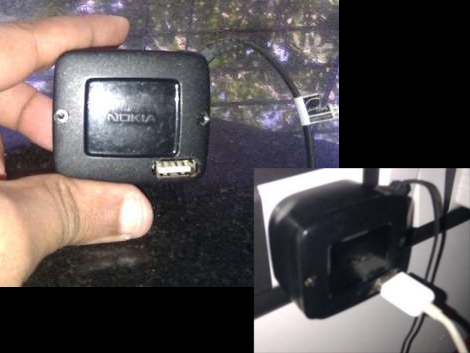
We still can’t figure out why a standard charging scheme hasn’t been developed for handheld devices (other than greed). Certainly we understand that many devices have different electrical needs as far as voltage and current are concerned, but we still long for the ability to use one charger for many different doodads. [Rupin] is trying to narrow down the number of dedicated chargers he uses by adding a USB charging port to his Nokia cellphone charger. Since the USB standard calls for regulated 5V a hack like this can often be done just by patching into the power output coming off of the voltage regulator in the plug housing of the device. [Rupin’s] charger had 5V printed on the case, but when he probed the output he found well over 8 volts. He added a 7805 linear regulator to get the stable output he needed, then cut a hole in the case to house the connector.

Since [Rupin] wants to use this as an iPod charger he couldn’t just let the two data lines float. Apple uses a specific charger verification scheme which requires some voltage dividers to get the device to start charging.
Toy Helicopter Charging Fix

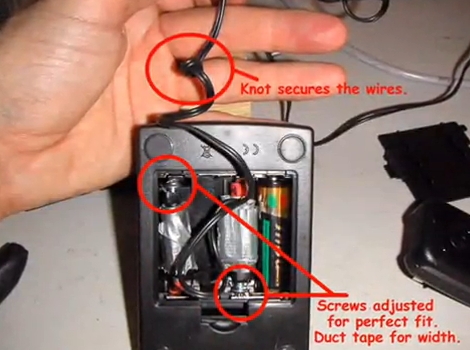
[Onefivefour] was surprised that his E-flite Blade MCX radio controlled helicopter came with a charger that used AA batteries to recharge the lithium batteries in the flying unit. Yeah, that’s a bit crazy. He set out to modify the base unit to work with AC power. There are four batteries inside this base unit, one of them powers the charge detector circuit and the others are used to juice-up the chopper’s rechargeable cells. He took a 5V regulated charger from a Motorola cellphone and modified it to interface with the contacts for the three AA cells. Like the Magic Trackpad hack, he did this without altering the holder by cutting a couple of pencils to length and attaching the positive and negative contacts from the AC charger to them. Check out the video after the break for a walk though, noting how he still has the option to go back to battery power if he so chooses.

Continue reading “Toy Helicopter Charging Fix”

Breathing Motion Powered USB Charger

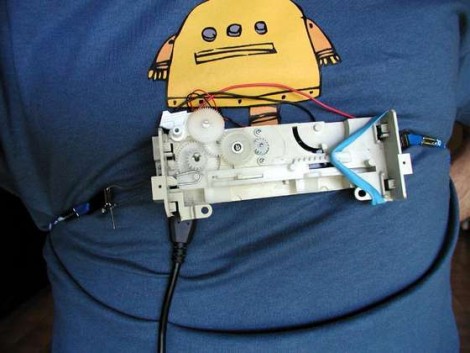
When your batteries run low you can use your body to recharge them. This contraption generates power from chest expansion while breathing. [Jmengel] used some gears from old optical drives to boost the RPM generated by a belt around your torso that he calls a thorax expansion coupler. When you breath in, that belt pulls on a plate that spins the gears, ultimately rotating a small motor. The AC current generated by that motor is run through a rectifier and a boost converter, then fed to a charging circuit.

Does it work? Not really, as this only outputs around 50 mW. But we like the twinge of Dune nostalgia we get looking at it. Wouldn’t this be a perfect addition to a stillsuit?

Ridiculous Exerciser Becomes Useful As A Charger

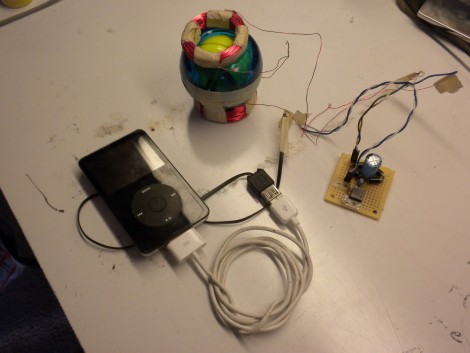
[Scott Nietfeld] built a charger from a Dyna-flex wrist exerciser. We hadn’t heard of a these gyroscopic devices before but once we saw the promo video (embedded after the break) we realized that this is the kind of thing that infomercials were made to sell. [Scott] knew the internals spun to fairly high RPM and figured that adding a few magnets on the inside and coils on the outside would turn this thing into a generator. Four rare-earth magnets fit the bill, with two external coils feeding a rectifier and linear regulator. Below you can see his demonstration video where he takes the orb apart, then spins it up, generating 250 mA at about 7.5 volts to drive the regulator and charge a cellphone. Not bad!

Continue reading “Ridiculous Exerciser Becomes Useful As A Charger”

The Quest For A Bicycle Power System

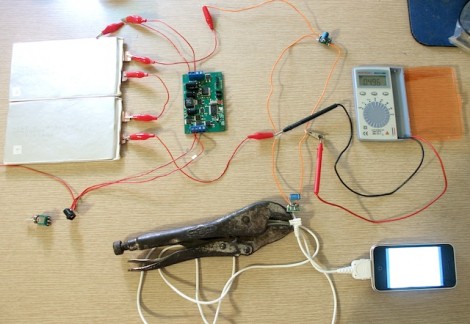
[Garote] has been extremely busy. Busy building an electrical system into his bicycle, and even busier writing a monumental post about it. He covers an impressive range of topics, starting with the goal of adding a generator, battery, charging system, lights, and accessories to the bike. From there he clicks off one thing at a time, researching and ordering a wheel with a Dynamo hub for the generator, assembling and testing the cells of his battery, choosing the controller board for the charging system, and designing the accessory circuits like the iPhone charger above. If he adds too much more to the two-wheeled rig he’s going to have to plan a big road trip with it.

[Thanks Xuxo]

Reverse Engineering Apple’s Recharging Scheme

[vimeo=http://vimeo.com/13835359]

[Ladyada] has been hard at work reverse engineering the charging method used by Apple products. This saga takes us through the years as new devices were released and subsequently broke Minty Boost’s charging capabilities. It seems the data lines were gradually adopted as a means for iPhones and iPods to identify the charger that had been connected. By adding voltage dividers to the D+ and D- lines you can instruct the handheld to pull 1 Amp (with data voltages of 2.8v and 2.0v) for wall chargers or 0.5 Amps (2.0v on both data lines) for portable chargers. In the video above [Ladyada] removes the surface mount resistors from a commercial charger in order to measure the voltage divider and discover the secret.

Update: Custom Cellphone Induction Charging

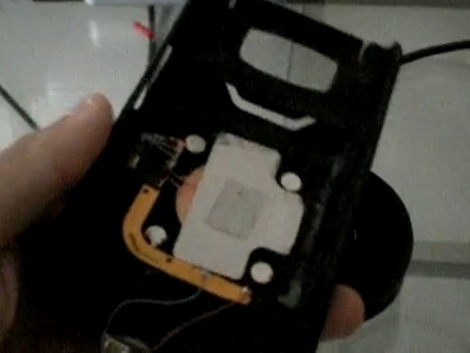
This is a custom back plate with induction charging circuitry that [Derek Hughes] build for his HTC HD2 cellphone. When we checked in with him last week he showed us how to add an inductive charger without voiding the warranty but it wasn’t very pretty because the stock back plate blocked the inductive field and couldn’t be used. The solution he came up with will work with any device if you want to put some time into the build.

He took two different aftermarket cases; one fits his cellphone and the other is a BlackBerry case meant for housing a credit card. After cutting a hole in the back of the cellphone case he epoxied the credit card holder in place, smoothed the seam with Bondo, and repainted. Not only does the charger fit in the credit card case, but there’s still room for a credit card. [Derek] also measured the magnetic fields around the circuitry and found they will not damage the magnetic strip on that American Express Black you’ve been keeping on you. In the video after the break he mentions the last step in finishing this case will be to locate a 90-degree USB plug as the current connector is a bit of an eyesore.

[youtube=http://www.youtube.com/watch?v=DgNOqJBSKmQ]