Hackaday Links: Tuesday, July 19th

Here’s another “useless machine” variant.  The trick to this one is that it has dual “fingers” and can work either way. Which way it turns off is selectable via a switch on the side, and the fingers can both be turned on to “fight” each other. Check out the video here.

This video depicts the assembly of a Gameboy MAME-style cabinet. For those wanting to try something like this, this video may fill you in on some of the required assembly techniques, such as how to put decals on the side of your cabinet.

This video featuring the “Autonomous Ultimate Wall-E” shows this robot’s navigational skills around the house.  Additionally, it has some nicely actuated arms.

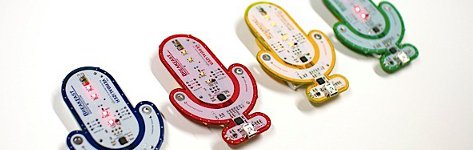
The Verbalizer is a microphone designed to be used with Google’s voice search. It’s also designed with Arduino compatibility in mind and is open-source. Could be a good tool for your next hack.

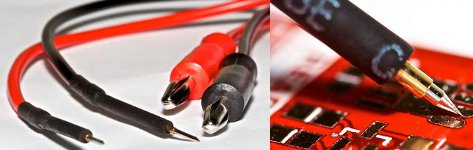
These clever multimeter probes were built using pogo pins used in electrical test equipment. The springs inside of these pins help keep them planted firmly on the test point in question and reportedly gives a very good connection.

Minecraft Is Now A 3d Design Tool

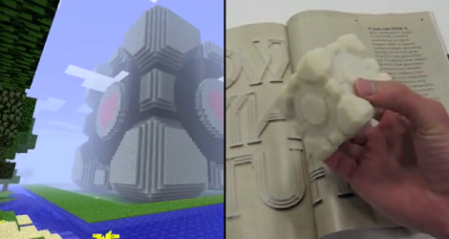
[Cody Sumter] and [Jason Boggess] are students at the MIT Media Lab, and they just came up with Minecraft.Print(), an attempt to create a bridge between Minecraft and the real world via 3D Printers.

The print is first prepared by placing obsidian, diamond, gold, and iron blocks on opposite corners of the model in Minecraft. From there, a Python script takes over and parses the world map to generate an .STL file for a RepRap or MakerBot.

So far, [Cody] and [Jason] have printed a few Companion Cubes and the model of the Enterprise D. We’re pretty impressed with the resolution of the prints, especially considering the original model is voxelated. The prints look very nice, and right now we really want to print out all the cool stuff we’ve seen, like Isengardgigantic CPU, or maybe a Minecraft 3D printer.

Minecraft.Print() sure is a nice program [Cody] and [Jason] have there. It would be a shame if anything happened to it. Check out a video demo after the break.

Continue reading “Minecraft Is Now A 3d Design Tool”

A Plotter Made From Lego Parts

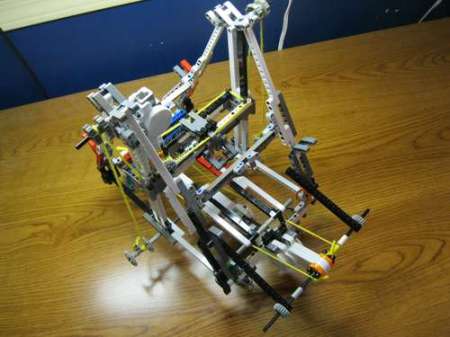
We’re always amazed at what people can come up with using Lego parts, but this hack certainly pushes the limits. Originally conceived as a 3D printer, this plotter is still an impressive proof-of-concept. Ironically, this “3D printer” was build with the hope of winning a Makerbot 3D printer, so be sure to vote for it if you’re impressed.

it’s pretty impressive seeing what [graphmastur] has done using only Lego parts. It’s especially entertaining to see a sheet of Lego “grass” used as the Y-axis table. The build was designed in Lego Digital designer, and the parts are available in “LDD” format or HTML.

This project is explained further in the video after the break. If you’d like to simply see it do a plotting operation, fast forward to around 4:30. The device is not perfect, but as the video says “it worked, pretty well” when drawing a square with an ordinary marker. Continue reading “A Plotter Made From Lego Parts”

CNC-PBDU (pancake Batter Dispenser Unit)

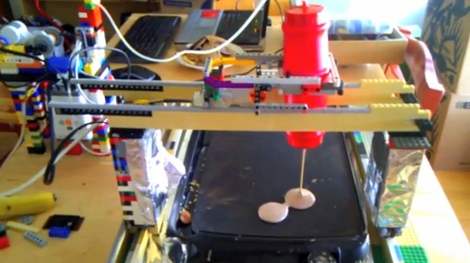
Flapjacks taste infinitely better when they’re machine-made. Well, that’s true for [Mexican Viking] who built an automatic pancake maker to the delight of his family.

Obviously, the building material of choice is Lego. The machine consists of a base with two linear gears on either side. A gantry is held high above this base, travelling upon geared towers to either side. The writing nozzle, fashioned out of ketchup bottles, can move back and forth along this gantry for a full range of motion along the X and Y axes. Lego pneumatic pumps supply pressurized air which forces the batter out of the bottle reservoir. This dispensing system is extremely clever and worth reading a bit more about. But if you just want us to make with the good stuff, you can see it grilling up pancakes in the video after the break.

The only thing missing is automatic flipping.

Continue reading “CNC-PBDU (pancake Batter Dispenser Unit)”

3 Axis Plotter Made From Spare Parts

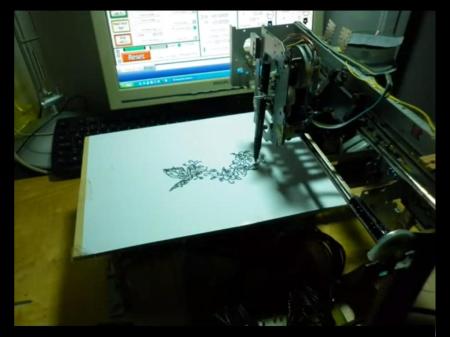
The plotter featured above was, according to the author, made almost entirely of salvaged parts. In addition to what he had accumulated, only $20 in parts was needed to complete this build. Pretty good considering the thousands of dollars that a new plotter goes for.

Control of all axes is accomplished using unipolar stepper motors.  In this case only one unipolar motor was available along with two bipolar motors. [Lovro] actually hacked these into a unipolar setup to save costs on the build.

Mach3 control software along with a parallel port is used to control the steppers. A similar “junk” setup could be used to power a CNC mill or laser engraver, so think twice before tossing that old printer in the trash!  Check out the video of this plotter in action after the break! Also, see this hack for a similar laser engraving machine using Mach3 control software. Continue reading “3 Axis Plotter Made From Spare Parts”

Tripod CNC Plotter

tripod printer machine

Although some may have heard of a machine like this, the CNC tripod remains an unknown machine to many in the engineering word.  This particular machine is set up as a plotter, drawing incredibly straight lines, shapes, and letters.

The machine appears to have 6 servo motors, 3 working as pairs.  This would simplify control and allows the pen to be held at a perpendicular angle to the paper.  Once could envision this being used with, instead of a pen, a spindle and mill.  Instead of the traditional movement of a CNC mill or router, this could be used to cut out complex shapes.

Additionally, if the servos were not driven in 3 tandem pairs, but were all controlled independently, it should be possible to twist the tool in a controlled angular direction.  This would add an extra axis of control to an already robust CNC setup.  It will be exciting to see how this technology develops in the future.  Until then, check out the video after the break: Continue reading “Tripod CNC Plotter”

Crosshair Aiming System For Your Laser Cutter

diy_laser_crosshairs

[Rich] was having quite a bit of fun with his newly-acquired laser cutter, but was not impressed by the stock aiming laser that came with it. The problem with the built-in laser is that it did not actually follow the cutting laser’s path – instead, it has to be calibrated for a fixed focal length. This becomes problematic when engraving and cutting since they require different focal lengths, so it becomes a guessing game as to where the cutting laser will actually end up in respect to the aiming laser.

An additional optic module that solves this problem can be had for about $300, but after sinking $2500 into the laser setup, [Rich] was not inclined to purchase one. Instead, he bought a pair of cheap laser levels online and scavenged the line lens from one module, which was mounted on the laser cutter’s existing aiming laser. The second module was epoxied to the top of the cutting head, to create a set of cross hairs on the work surface.

As you can see in the video below, the hack works quite well, and the lasers are accurate at a variety of different focal lengths.

Continue reading “Crosshair Aiming System For Your Laser Cutter”