Food poisoning is never a fun experience. Sometimes, if you’re lucky, you’ll bite into something bad and realize soon enough to spit it out. Other times, you’ll only realize your mistake much later. Once the tainted food gets far enough into the digestive system, it’s too late. Your only option is to strap in for the ride as the body voids the toxins or pathogens by every means available, perhaps for several consecutive days.
Polymers are one of the most important elements of modern-day society, particularly in the form of plastics. Unfortunately most common polymers are derived from fossil resources, which not only makes them a finite resource, but is also problematic from a pollution perspective. A potential alternative being researched is that of biopolymers, in particular those produced by microorganisms such as everyone’s favorite bacterium Escherichia coli (E. coli).
These bacteria were the subject of a recent biopolymer study by [Tong Un Chae] et al., as published in Nature Chemical Biology (paywalled, break-down on Arstechnica).
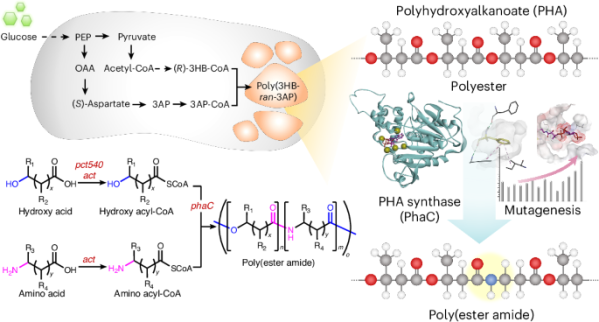
By genetically engineering E. coli bacteria to use one of their survival energy storage pathways instead for synthesizing long chains of polyester amides (PEAs), the researchers were able to make the bacteria create long chains of mostly pure PEA. A complication here is that this modified pathway is not exactly picky about what amino acid monomers to stick onto the chain next, including metabolism products.
Although using genetically engineered bacteria for the synthesis of products on an industrial scale isn’t uncommon (see e.g. the synthesis of insulin), it would seem that biosynthesis of plastics using our prokaryotic friends isn’t quite ready yet to graduate from laboratory experiments.
While we’re still waiting for ET to give us a ring, many worlds might not have life that’s discovered the joys of radio yet. Scientists ran a two-pronged study to see how bacteria might fare on other worlds.
We currently define the Habitable Zone (HZ) of a planet by the likelihood that particular planet can host liquid water due to its peculiar blend of atmosphere and distance from its star. While this doesn’t guarantee the presence of life, its a good first place to start. Trying to expand on this, the scientists used a climate model to refine the boundaries of the HZ for atmosphere’s dominated by H2 and CO2 gases.
When we think of bacteria, we think of simple single-celled organisms that basically exist to consume resources and reproduce. They don’t think, feel, or remember… or do they? Bacteria don’t have brains, and as far as we know, they’re incapable of thought. But could they react to an experience and recall it later?
New research suggests that some bacteria could have a rudimentary form of memory of their experiences in the environment. They could even pass this memory down across generations via a unique mechanism. Let’s dive into the latest research that is investigating just what bacteria know, and how they happen to know it.
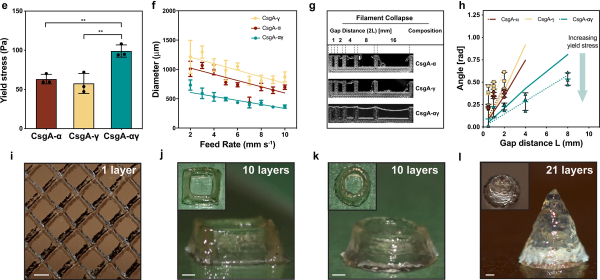
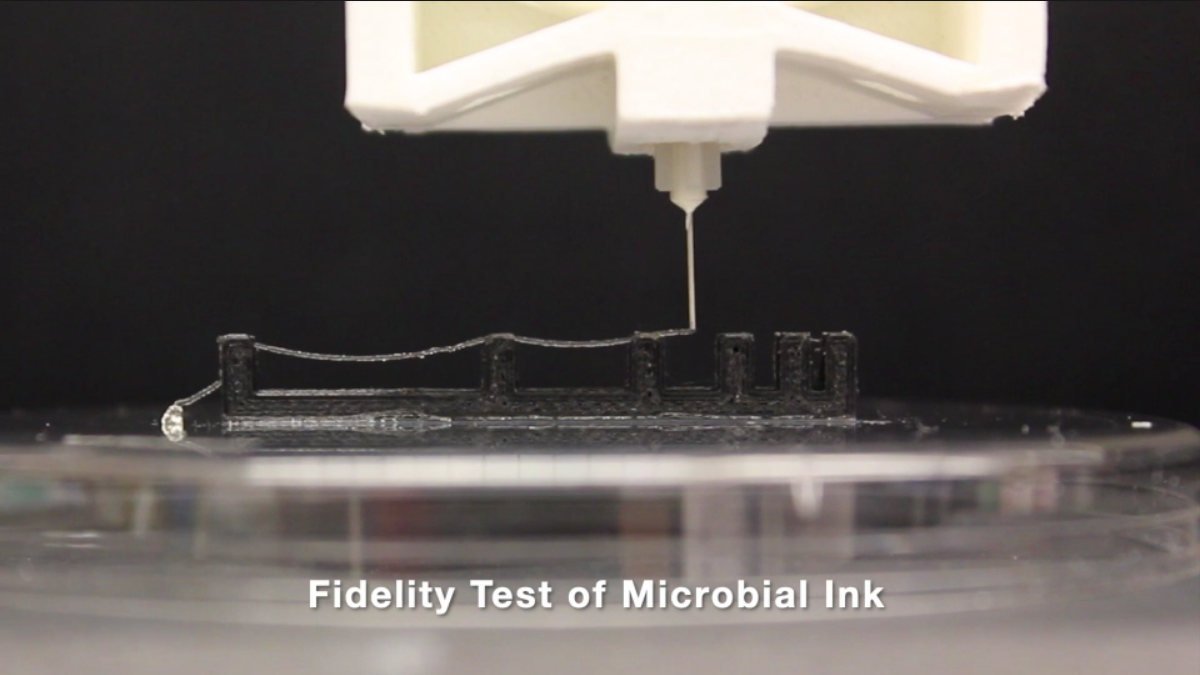
Passing the pillar test up to 16mm. Image via Nature
Because the ink is alive, it is technically programmable in the sense that it can self-assemble proteins into nanofibers, and further assemble those into nanofiber networks that comprise hydrogels.
One of the researchers compared the ink to a seed, which has everything it needs to eventually grow into a glorious tree. In this way, the ink could be used as a renewable building material both on Earth and in space. Though the ink does not continue to grow after being printed, the resulting structure would be a living system that could theoretically heal itself.
The ink creation process begins when the researchers induce genetically-engineered bacteria cultures to grow the ink, which is also made of living cells. The ink is then harvested and becomes gelatin-like, holding its shape well enough to go through a 3D printer. It even passes the bridging test, supporting its own weight between pillars placed up to 16 mm apart. (We’d like to see a Benchie.)
When you’ve got a diabetic in your life, there are few moments in any day that are free from thoughts about insulin. Insulin is literally the first coherent thought I have every morning, when I check my daughter’s blood glucose level while she’s still asleep, and the last thought as I turn out the lights, making sure she has enough in her insulin pump to get through the night. And in between, with the constant need to calculate dosing, adjust levels, add corrections for an unexpected snack, or just looking in the fridge and counting up the number of backup vials we have on hand, insulin is a frequent if often unwanted intruder on my thoughts.
And now, as my daughter gets older and seeks like any teenager to become more independent, new thoughts about insulin have started to crop up. Insulin is expensive, and while we have excellent insurance, that can always change in a heartbeat. But even if it does, the insulin must flow — she has no choice in the matter. And so I thought it would be instructional to take a look at how insulin is made on a commercial scale, in the context of a growing movement of biohackers who are looking to build a more distributed system of insulin production. Their goal is to make insulin affordable, and with a vested interest, I want to know if they’ve got any chance of making that goal a reality.
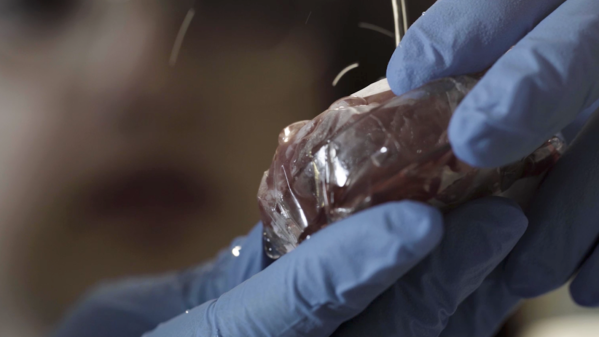
The wrap can be applied to things temporarily, much like that stuff you wrestle from the box and stretch over your leftovers. It can also be shrink-wrapped to any compatible surface without losing effectiveness. The ability to cover surfaces with bacteria-shielding armor could have an incredible impact on superbug populations inside hospitals. It could be shrink-wrapped to all kinds of things, from door handles to railings to waiting room chair armrests to the pens that everyone uses to sign off on receiving care.