A black race car with white text of sponsors moves across an asphalt surface. There is a blue wall and a green, grassy field in the background. The car has white and red stripes as well.

Students Set EV Acceleration World Record

Humans have a need for speed, and students from the Academic Motorsports Club Zurich (AMZ) have set a new acceleration record for an electric vehicle with a 0 to 100 km/h (0 to 62 mph) time of 0.956 seconds.

The mythen features four custom electric hub motors with a total output of 240 kW and a vehicle weight of 140 kg (309 lb) thanks to the use of carbon fiber and aluminum honeycomb. The car was able to get up to speed over only 12.3 m (40 ft)! As with many student design team projects, every component was hand built and designed to optimize the power to weight ratio of the vehicle.

The students from ETH Zurich and Lucerne University of Applied Sciences and Arts were excited to regain the record from the team at the University of Stuttgart, having previously held the title in 2014 and 2016. We suspect that they will find any European EV maker’s engineering department excited for the chance to hire them come graduation.

If you want to go fast at a smaller scale, checkout 3D printing RC car wheels for speed, and if you’d rather ride the rails at an accelerated rate, here’s an article on high speed rail.

Continue reading “Students Set EV Acceleration World Record”

A DeLorean sitting on patchy snow next to a driveway. It's angled away from the viewer to the left showing off the open engine compartment with bright orange high voltage lines coming out of a square metallic charger box.

A DeLorean With An Electrifying Secret

There are few production cars with as much geek cred as the DMC DeLorean. If you want to kick the nerdiness up a notch without doing a full Back to the Future prop-mod, then the next best thing is to make it an EV.

[Bill Carlson] took a 1981 DeLorean and transplanted the drivetrain from a Chevy Bolt to electrify this ride. With the DeLorean being a rear wheel drive vehicle and the Bolt front wheel, there was some amount of component reshuffling to do. The motor is now in the rear of the car along with the main contactor, charger, and motor controller while the batteries are split between a pack in the original engine compartment and another up front under the hood.

The electric power steering and brake booster from the Bolt now also live under the hood, and the accelerator and steering column from the EV were transplanted into the cockpit. [Carlson] still needs to tidy up the interior of the car which is currently a nest of low voltage cables as well as add the cooling system which will bring this stainless monster up to a hefty 3200 lbs (~1450 kg) versus the original 2850 lbs (~1300 kg). We suspect the total bill came in a bit lower than getting an electric DeLorean Alpha5.

This isn’t the first electric DeLorean we’ve covered here, and if that isn’t cool enough, how about this DeLorean-inspired hovercraft?

Continue reading “A DeLorean With An Electrifying Secret”

Ask Hackaday: Why Don’t Automakers Make Their Own EV Batteries?

Sales of electric vehicles continue to climb, topping three million cars worldwide last year. All these electric cars need batteries, of course, which means demand for rechargeable cells is through the roof.

All those cells have to come from somewhere, of course, and many are surprised to learn that automakers don’t manufacture EV batteries themselves. Instead, they’re typically sourced from outside suppliers. Today, you get to Ask Hackaday: why aren’t EV batteries manufactured by the automakers themselves? Continue reading “Ask Hackaday: Why Don’t Automakers Make Their Own EV Batteries?”

Hong Kong Hacker Builds Electric Vehicle From Waste

Recycled Parts Round Out Soap Shaped Electric Car

[Handy Geng] has a knack for fitting his creations with a large percentage of recycled material. And as is exemplified by the video below the break, he also loves to mix the practical with the whimsical.

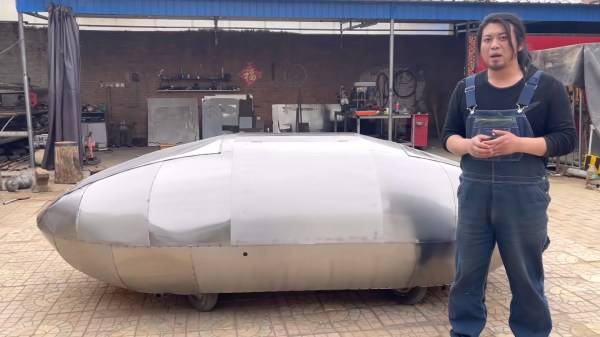
Using parts salvaged from motor scooters, trash heaps, and likely many other sources, [Handy] has put together a small vehicle that he himself describes as looking like a bar of soap as it slips across the floor. You’ll agree when you see the independent front and rear steering at work, allowing the car’s front and rear to be driven and steered on their own. Crabbing sideways, driving diagonally, and we’re guessing spinning in place are possible.

What’s also clear in the video below is that [Handy] is a talented fabricator. While not taking himself too seriously (keep an eye out for the 360° selfie cam!) he clearly takes pride in the work. [Handy]’s workshop and skill set show that at the core, he’s quite serious about his craft. We appreciate the creative use of scrap materials used in such an inspiring build. The turn signals and “communicator” hand is absolutely marvelous.

If building with recycled materials is your thing, then you’ll love the Trash Printer, too. Thanks to [Fosselius] for the tip!

Continue reading “Recycled Parts Round Out Soap Shaped Electric Car”

Being Green, It’s A Rich Man’s Game

It’s an old saying with an apocryphal origin: “May you live in interesting times“. We Brits are certainly living in interesting times at the moment, as a perfect storm of the pandemic, rising energy prices, global supply chain issues, and arguably the post-Brexit departure of EU-national truck drivers has given us shortages of everything from fresh vegetables in the supermarket to carbon dioxide for the food industry. Of particular concern is a shortage of automotive fuels at the filling station, and amid sometimes-aggressive queues for the pumps it’s reported that there’s a record uptick in Brits searching online for information about electric cars.

Nothing Like A Crisis To Make You Green

My VW Polo loaded for EMF 2018
How I miss my little car, here loaded for EMF 2018.

This sudden interest in lower-carbon motoring may be driven by the queues rather than a concern for the planet, but it’s certainly true that as a culture we should be making this move if we are to have a hope of reducing our CO2 production and meeting our climate goals. A whole slew of lifestyle changes will have to be made over the coming years of which our car choices are only a part. Back to those beleaguered Brits again, a series of environmental protests have caused major disruption on the motorway network round London, not protesting against the traffic but campaigning for better home insulation.

For reasons of personal circumstance rather than principle, earlier this year I gave my trusty VW Polo to an old-Volks-nut friend and now rely on a bicycle. Living where I do within reach of everything I need it hasn’t been as challenging as I expected it to be, and aside from saving a bit of cash I know my general fitness level has gone up. Though I have less need for a car now than I used to, I intend to find myself another vehicle in due course so that I can do silly things such as throwing a Hackaday village in the back and driving halfway across Europe to a hacker camp. With an awareness that whatever I choose should be as good for the planet as I can make it then, I’ve been cruising the used-car websites to see what I can find.

Continue reading “Being Green, It’s A Rich Man’s Game”

A Robot To Top Up Your Tesla

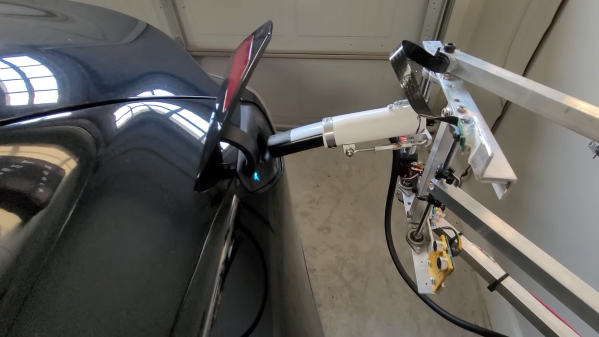
The convenience of just plugging in your car in the evening and not going into a gas station is great as long as you remember to do the plugging. You really don’t want to get caught with an empty battery while you’re in a rush. [Pat Larson]’s Tesla plugging robot might be a handy insurance policy if you count forgetfulness among your weaknesses.

The robot consists of a standard Tesla charging plug attached to a 2-axis robotic arm mounted on [Pat]’s garage wall. Everything is controlled by a Python script running on Raspberry Pi 4. After taking a picture with a camera module, it uses a Tensor Flow Lite machine learning model to determine the position of a reflector on the charging port cover. The platform moves back and forth to align with the charging port, after which it opens the charging port using the Tesla API. It then extends the arm towards the charging port, using ultrasonic proximity sensors for distance control, and again uses the camera module and Tensor Flow to look for the illuminated Tesla logo adjacent to the charging port. The charge plug is flipped out using a large servo, and after some final position adjustment, it takes the plunge. While robot won’t be winning any interior design contests, it does the job well, and adds a bit of convenience and peace of mind.

Other Tesla hacks we’ve seen include building a working Model S for $6500, turning an old Honda into a speed demon using Tesla parts, and a Casio F-91W that can unlock your Tesla.

Electric Vehicles Could Be The Grid Storage Solution We’ve Been Dreaming Of

As nation states grapple with the spectre of environmental and economic losses due to climate change, we’ve seen an ever greater push towards renewable energy sources to replace heavier polluters like coal and natural gas. One key drawback of these sources has always been their intermittent availability, spurring interest in energy storage technologies that can operate at the grid level.

With the rise in distributed energy generation with options like home solar power, there’s been similar interest in the idea of distributed home battery storage. However, homeowners can be reluctant to make investments in expensive batteries that take years to pay themselves off in energy savings. But what if they had a giant battery already, just sitting outside in the driveway? Could electric vehicles become a useful source of grid power storage? As it turns out, Ford wants to make their electric trucks double as grid storage batteries for your home.

Continue reading “Electric Vehicles Could Be The Grid Storage Solution We’ve Been Dreaming Of”