[Matt Meerian]’s workbench seems to be in perpetual shadow, so he has become adept at mounting LED strips under all his shelves and cabinets. These solve any problems involving finding things in the gloom, but present a new problem in that he risks a lot of LED strips being left on, and going round turning them all off is tedious.
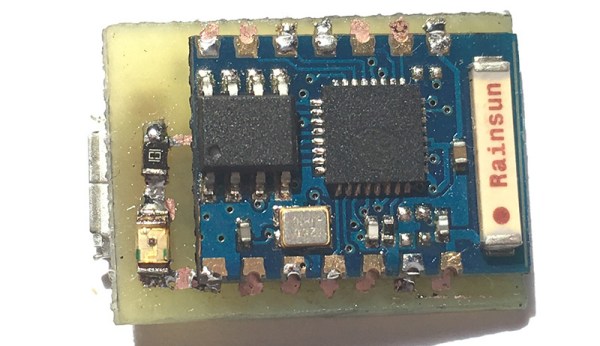
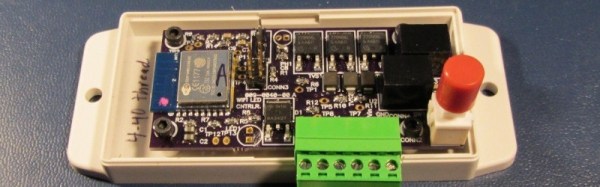
His solution is to make a wireless controller for all his home LED strips, under the command of a web app from his Android tablet. An ESP8266 and a set of MOSFETs provide the inner workings, and the whole is presented on a very compact and well-designed purple OSH Park PCB reflow soldered on a $20 Wal-Mart hotplate and set in a plastic enclosure. The web interface is still in development, but has a fairly simple CSS front end for the ESP8266 code. All software, the schematic, and BoM can be downloaded from the Hackaday.io page linked above.
This project isn’t going to end world hunger or stop wars, but it’s beautifully done and well documented, and it makes [Matt]’s life a lot easier. And that makes it a good entry for the Hackaday Prize.





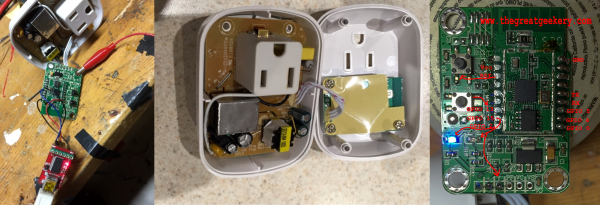
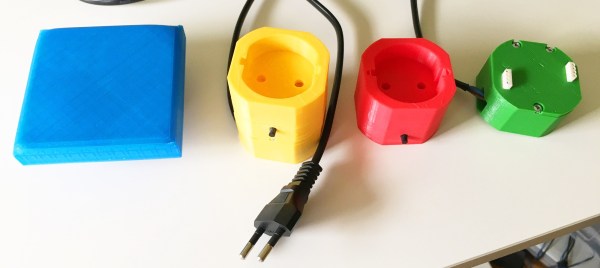
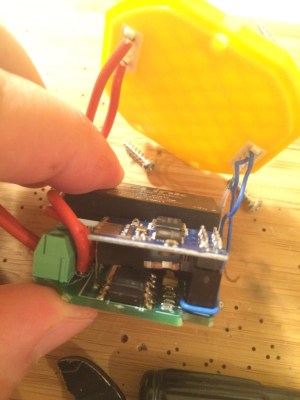 It’s all based around a simple board. An encapsulated power supply converts the 220V offered by the Bulgarian power authorities into two rails of 3.3V and 5V respectively. The 3.3V is used for an ESP8266 whose primary concern is the control of a triac and an RGB LED. The 5V is optional if the user decides to add a shield that needs it. That’s right, your light switches will now have their own shields that decide the complexity of the device.