Tiny House Forecasts Weather

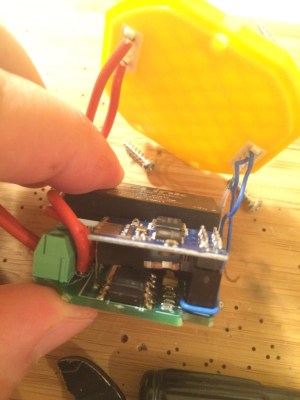
Before the information age, it wasn’t quite as easy to glean information about the weather. Sure, there were thermometers and barometers and rhymes about the sky, but if you lived in or near Germany back then you might have also had access to something called a “weather house” which could help predict rain. [Moritz] aka [Thinksilicon] found one of these antequated devices laying around, and went about modernizing it. (Google Translate from German)

A traditional weather house is essentially a hygrometer housed in an intricate piece of artwork. Two figures, typically a man and woman, are balanced on a platform that is suspended in the middle by a small section of horsehair. When the humidity is low, the hair tightens up and turns the platform one way, and when humidity is high — suggesting rain is coming — it turns the other way. When the man comes out of the house, it predicts rainfall.

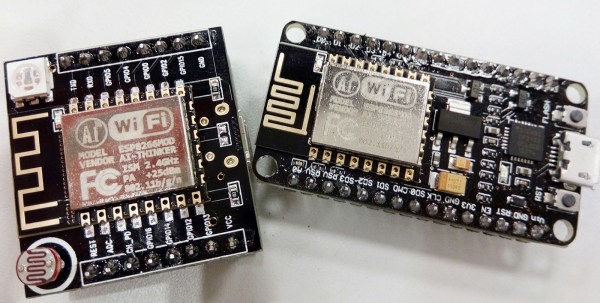
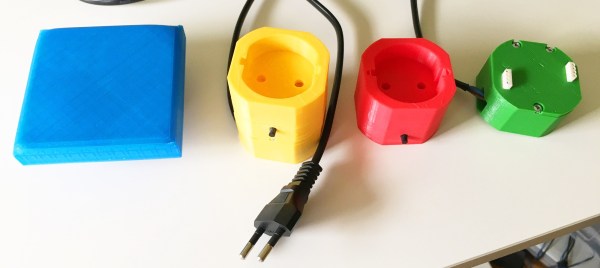
To get the weather house upgraded, [Moritz] outfitted the front with an OLED display which replaced the traditional thermometer. Instead of using horsehair to spin the figures he installed a small servo on the platform. The entire house is controlled by an ESP8266 which pulls data from the Open Weather API and spins the figures based on the information it receives.

Much like unique clocks, we enjoy interesting weather indicating/forecasting builds. This one’s right up there with using squirrels to predict the weather, or having a small weather-recreation right on your bookshelf.

Bewegungsfelder Is A Wireless IMU Motion Capturing System

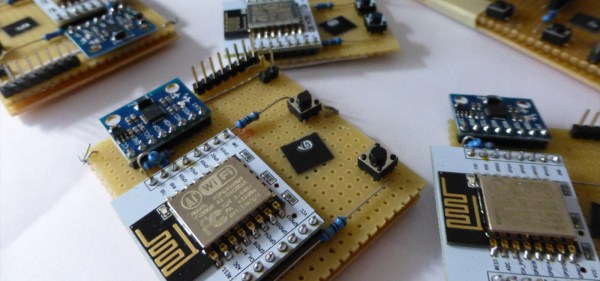
For several years, hackers have been exploring inertial measurement units (IMUs) as cheap sensors for motion capturing. [Ivo Herzig’s] final Diploma project “Bewegungsfelder” takes the concept of IMU-based MoCap one step further with a freely configurable motion capturing system based on strap-on, WiFi-enabled IMU modules.

Continue reading “Bewegungsfelder Is A Wireless IMU Motion Capturing System”

Simple Clock From Tiny Chip

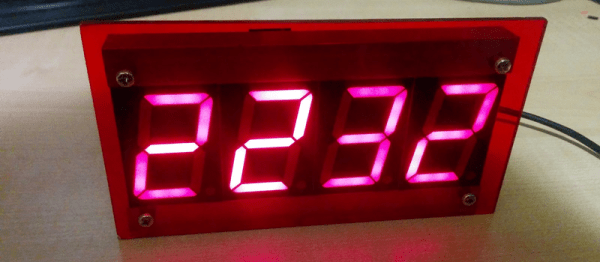
If you haven’t jumped on the ESP8266 bandwagon yet, it might be a good time to get started. If you can program an Arduino you have pretty much all of the skills you’ll need to get an ESP8266 up and running. And, if you need a good idea for a project to build with one of these WiFi miracle chips, look no further than [Ben Buxton]’s dated, but awesome, NTP clock.

Continue reading “Simple Clock From Tiny Chip”

Overhauling The ESP8266’s Flash Memory Handling

If you’ve ever corrupted a flash memory on a power failure, you’ll be glad to hear that the ESP8266 SDK implements a very secure and almost infallible read/write management for its flash memory. The catch: It’s also very wasteful. For a single memory block of stored data, three memory blocks of physical flash memory are occupied. [Peter Scargill] enlightens us with a better solution.

Continue reading “Overhauling The ESP8266’s Flash Memory Handling”

Reverse Engineering And Networking The A/C Remote Control

IoT has become such an polarizing, overused term. But here it is in its essence: [zeroflow] had a thing (his airconditioner) and he needed to put it on the Internet.

For his contribution to this modern vernacular atrocity, he first had to build an IR debugging tool and reverse engineer the signals coming from the air conditioner’s remote. He wrote up a really good summary of the process, and worth reading. He loads up an IR library onto an Arduino and dumps the resulting 32 bits of information to his computer. In a process much like filling in the blanks on a word puzzle, he eventually determines which blocks of the data correspond to the remote’s different buttons.

Next he throws an array of IR LEDS and an ESP8266 onto a bit of protoboard. After writing some code, available on GitHub, he could set the temperature of his room from anywhere on the planet. We take it on faith that [zeroflow] has a compelling reason for doing so.

Bolstered by this success, he didn’t stop there. [Zeroflow] admits to having more than one thing on the Internet. Boom! Internet of things.

Run A RepRap On An ESP8266

What can’t the little $5 WiFi module do? Now that [lhartmann] has got an ESP8266 controlling the motors of a 3D printer, that’s one more item to check off the list.

What’s coolest about this project is the way that [lhartmann] does it. The tiny ESP8266 has nowhere near the required number of GPIO pins, the primary SPI is connected to the onboard flash memory, and the secondary SPI is poorly documented and almost nobody uses it. So, [lhartmann] chose to use the I2S outputs.

I2S is most often an audio protocol, so this might at first seem like a strange choice. Although I2S sounds like I2C, it’s really essentially an SPI protocol with a fourth wire that alternates to designate the right or left channel. It’s actually just perfect for sending 16×2 bits of data at high data rates.

[lhartmann] takes these 32 bits and feeds them into four shift registers, producing 32 outputs from just the four I2S data lines. That’s more than enough signals to run the stepper motors. And since it updates at 192 kHz sample rate, it’s plenty fast enough to drive them.

The other side benefit of this technique is that it can work on single-board computers with just a little bit of software. Programming very complicated stepper movements then becomes just a matter of generating the right “audio” file and playing it out. [lhartmann] demonstrated this earlier with an Orange Pi. That’s pretty cool, too.

The code for turning the ESP8266 and a short handful of 74HC595s into a 3D printer controller are up on GitHub, so go check it out.

Thanks [CNLohr] for the tip!

Software USB On The ESP8266

A while back, [cnlohr] needed a USB keyboard and mouse. His box ‘o junk didn’t hold this particular treasure, and instead of hopping on Amazon like a normal geek or venturing into the outside realm on a mid-level ‘store’ quest like a normal person, [cnlohr] decided to turn an ESP8266 into a USB keyboard and mouse. How hard could it be? The ESP doesn’t support USB, but bitbanging hasn’t stopped him before. The end result is a USB stack running on the ESP8266 WiFI module.

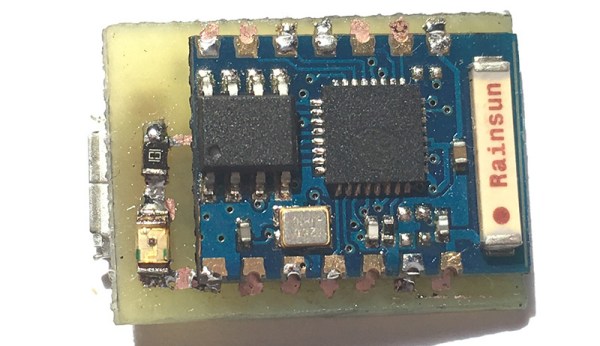
[cnlohr] has been working for about a month on this USB implementation for the ESP, beginning with a logic analyzer, Wireshark, Xtensa assembly, and a lot of iteration. The end result of this hardware hacking is a board based on the ESP8285 – an 8286 with integrated Flash – that fits snugly inside a USB socket.

This tiny board emulates low-speed USB (1.5 Mbps), and isn’t really fast enough for storage, serial, or any of the fancier things USB does, but it is good enough for a keyboard and mouse. Right now, [cnlohr]’s ESP USB device is hosting a webpage, and by loading this webpage on his phone, he has a virtual keyboard and mouse on a handheld touchscreen.

If you’re keeping track, [cnlohr] has now brought Ethernet and USB to a tiny microcontroller that can be bought for a few bucks through the usual online outlets. If you’d like to build your own ESP USB stick, all the files are over on the Gits.

Thanks [lageos] for the tip.

Continue reading “Software USB On The ESP8266”