Breaking The Flash Encryption Feature Of Espressif’s Microcontrollers

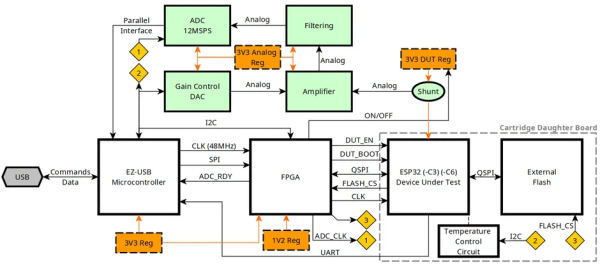
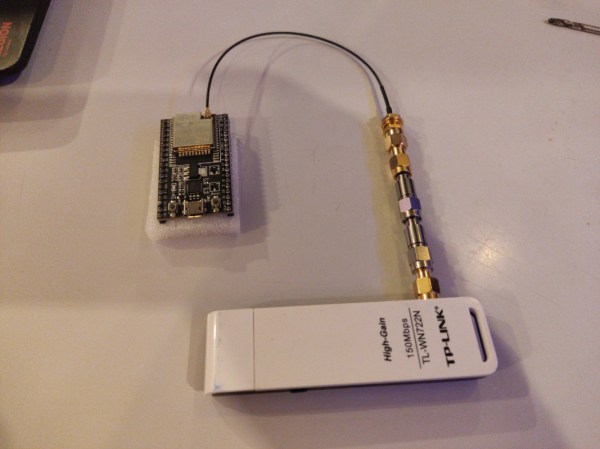
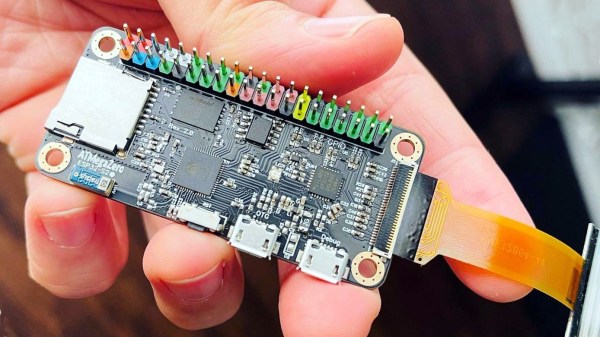
Espressif’s ESP32 microcontrollers come with a Flash encryption feature that when enabled ensures that the data and code stored on the (usually external) Flash chip is encrypted with AES-256 (ESP32) or better (ESP32-C3, -C6). For the ESP32 this encryption feature has been shown to be vulnerable to side channel attacks (SCA), leading [courk] to not only replicate this result with a custom ESP Correlation Power Analysis (CPA) board (pictured) that captures power usage of the MCU, but also to try his luck with the ESP32-C3 and ESP32-C6 parts that should be tougher nuts to crack.

Whereas the ESP32 uses a fairly straightforward AES-256 encryption routine that together with the exposed Flash communication lines on the QSPI bus make for a textbook SCA example, the ESP32-C3 ups the encryption to XTS-AES, which uses two 128-bit keys on the -C3 part (XTS-256). This particular MCU is still susceptible to the same SCA attack with CPA, making it somewhat harder to attack than the ESP32, but by no means impossible.

Continue reading “Breaking The Flash Encryption Feature Of Espressif’s Microcontrollers”

One Less Binary Blob

Open-source software has gone a long way into making modern technology the way it is today. The Linux kernel alone is almost single-handedly holding up the entire Internet, and various other open-source projects allow for more access to computing resources not just because the software is often free, but because it’s possible to look under the hood and modify it for specific needs. Without open-source software available we often run into problems both expected, such as software licensing costs, and unexpected, which often come up because a developer can’t or won’t fix issues or add features. To that end, a group at Ghent University in Belgium are attempting to rectify a problem with the ESP32 by eliminating one of its binary blobs and replacing it with an open source driver.

The ESP32 is famously a low-cost microcontroller with on-board wireless capabilities, but its Wi-Fi functionality currently relies on closed-source software from Espressif. The team is currently working on building a fully working open-source networking stack with the hopes of enabling greater flexibility of these devices but also making things like security auditing possible. The other major goal is to improve low-cost mesh networking which is currently not available with the proprietary driver. Reverse engineering is the name of the game here, both from a hardware and a software level, but current versions of the software already able to send and receive packets.

The source code for the project is available on the team’s GitHub page for any open-source aficionados to take a look at. We certainly hope the project gains some steam, as any new open source project helps all of us using the platform. Open source projects frequently get stymied by a single or small handful of binary blobs too, often with little hope for recourse. Examples include Android being an open-source operating system but generally using the closed-source Google Play suite in practice, or Firefox including support for Adobe Flash. Another great example is that even computers running 100% open-source code once they boot their operating systems, there’s still some black boxes running in the background few of us think about.

Thanks to [Crote] for the tip!

New Part Day: ESP32-P4 Espressif RISC-V Powerhouse

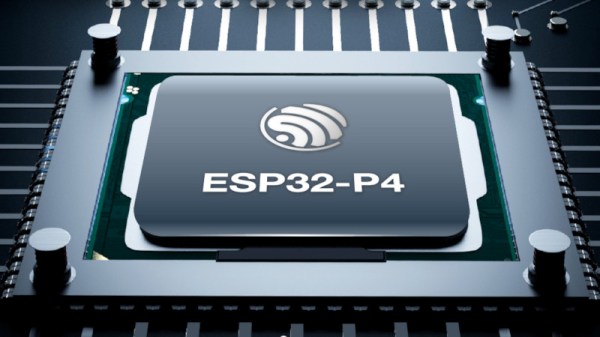
It seems every day there’s a new microcontroller announcement for which the manufacturer is keen to secure your eyeballs. Today it’s the turn of Espressif, whose new part is the ESP32-P4, which despite being another confusingly named ESP32, is a high-performance addition to their RISC-V line-up.

On board are dual-core 400 MHz and a single-core low power 40 MHz RISC-V processors, and an impressive array of hardware peripherals including display and camera interfaces and a hardware JPEG codec alongside the ones you’d expect from an ESP32 part. It’s got a whopping 768 KB of on-chip SRAM as well as 8 K of very fast cache RAM for intensive operations.

So after the blurb, what’s in it for us? It’s inevitable that the RISC-V parts will over time displace the Tensilica parts over time, so we’ll be seeing more on this processor in upcoming Hackaday projects. We expect in particular for this one to be seized upon by badge developers, who are intent on pushing extra functionality out of their parts.So we look forward to seeing the inevitable modules with this chip on board, and putting them through their paces.

Thanks [Renze] for the tip.

A grid of 5 3D Printed projects with ESP-32 microcontroller boards

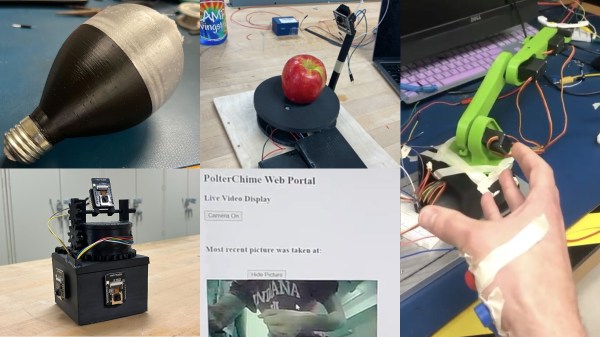
ESP32 Projects From Northwestern University’s Embedded Electronics Class

Northwestern University’s Embedded Electronics Class delivered a bumper crop of ESP-32 projects this year. The student teams recorded their progress on hackaday.io with project descriptions, logs, BOMs, diagrams, photos, and videos to share with other makers. While all utilized the web connection that the ESP32 offers some teams chose to use ESP32 Cams to incorporate photos, video, and computer vision. We love the variety of projects the teams created, some customized versions of consumer products and others new types of smart-devices. Continue reading “ESP32 Projects From Northwestern University’s Embedded Electronics Class”

New Part Day: An ESP With ZigBee

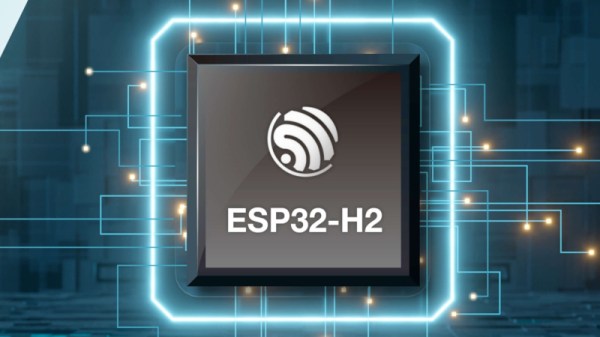
It seems that the folks at Espressif are doing their best to produce chips to fit every possible niche in the microcontroller-with-radio market, because here comes news of their latest chip bearing the ESP32 name: a single-core 96MHz RISC-V part with built-in IEEE 802.15.4 to support ZigBee 3.x and Thread 1.x. The ESP32-H2 is not the most powerful of the Espressif line-up, but it will find its place in home automation products and projects.

The ESP32-H2 joins a multitude of other IEEE 802.15.4 devices from manufacturers such as Microchip, ST, NXP, and Nordic in an increasingly crowded marketplace, so what can if offer that the others can’t? If previous ESP chips are anything to go by we’d expect it to compete on price as well as the obvious attraction for developers used to working with other Espressif products. We look forward as always to seeing what you do with it.

New Part Day: ESP32-WROOM-DA

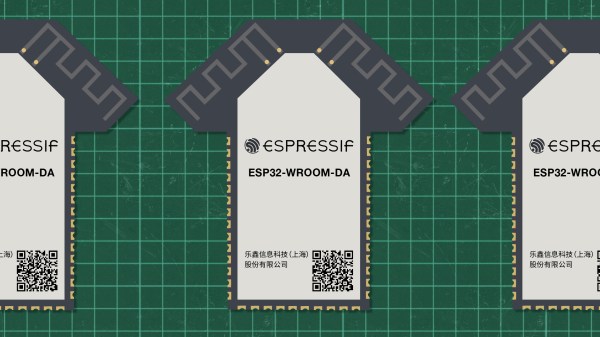
We’re always interested in the latest from the world’s semiconductor industry here at Hackaday, but you might be forgiven for noticing something a little familiar about today’s offering from Espressif. The ESP32-WROOM-DA has more than a passing resemblance to the ESP32-WROOM dual-core-microcontroller-with-WiFi  module that we’ve seen on so many projects over the last few years because it’s a WROOM, but this one comes with a nifty trick to deliver better WiFi connectivity.

The clever WiFi trick comes in the form of a pair of antennas at 90 degrees to each other. It’s a miniaturised version of the arrangement with which you might be familiar from home routers, allowing the device to select whichever antenna gives the best signal at any one time.

We can see that the larger antenna footprint will require some thought in PCB design, but otherwise the module has the same pinout as the existing WROVER. It’s not much of a stretch to imagine it nestled in the corner of a board at 45 degrees, and we’re sure that we’ll see it appearing in projects directly. Anything that enhances the connectivity of what has become the go-to wireless microcontroller on these pages can only be a good thing.

Looks Like A Pi Zero, Is Actually An ESP32 Development Board

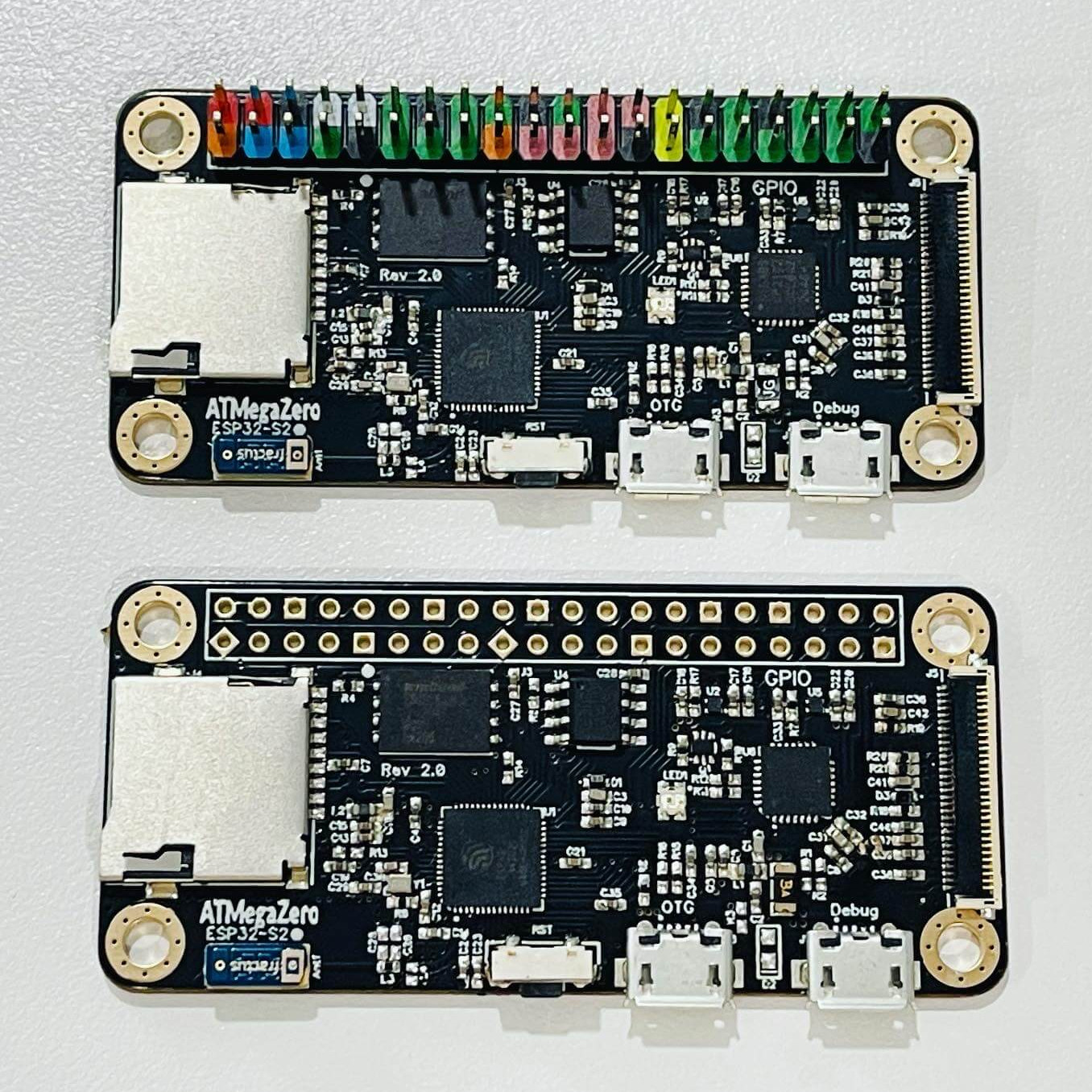
ATMegaZero ESP32- S2, showing optional color-coded 40-pin header (top)

The ATMegaZero ESP32-S2 is currently being funded with a campaign on GroupGets, and it’s a microcontroller board modeled after the Raspberry Pi Zero’s form factor. That means instead of the embedded Linux system most of us know and love, it’s an ESP32-based development board with the same shape and 40-pin GPIO header as the Pi Zero. As a bonus, it has some neat features like a connector for inexpensive SSD1306 and SH1106-based OLED displays.

Being able to use existing accessories can go a long way towards easing a project’s creation, and leveraging that is one of the reasons for sharing the Pi Zero form factor. Ease of use is also one of the goals, so the boards will ship with CircuitPython (derived from MicroPython), and can also be used with the Arduino IDE.

If a microcontroller board using the Pi Zero form factor looks a bit familiar, you might be remembering the original ATMegaZero which was based on the Atmel ATMega32U4, but to get wireless communications one needed to attach a separate ESP8266 module. This newer board keeps the ATMegaZero name and footprint, but now uses the Espressif ESP32-S2 to provide all the necessary functions.

CircuitPython has been a feature in a wide variety of projects and hacks we’ve seen here at Hackaday, and it’s a fine way to make a microcontroller board easy to use right out of the box.