How-to: Programmable Logic Devices (CPLD)

Complex programmable logic devices (CPLDs) contain the building blocks for hundreds of 7400-serries logic ICs. Complete circuits can be designed on a PC and then uploaded to a CPLD for instant implementation. A microcontroller connected to a CPLD is like a microcontroller paired with a reprogrammable circuit board and a fully stocked electronics store.

At first we weren’t sure of the wide appeal and application of CPLDs in hobbyist projects, but we’ve been convinced. A custom logic device can eliminate days of reading datasheets, finding the ideal logic IC combination, and then waiting for chips to arrive. Circuit boards are simpler with CPLDs because a single chip with programmable pin placement can replace 100s of individual logic ICs. Circuit mistakes can be corrected by uploading a new design, rather than etching and stuffing a new circuit board. CPLDs are fast, with reaction times starting at 100MHz. Despite their extreme versatility, CPLDs are a mature technology with chips starting at $1.

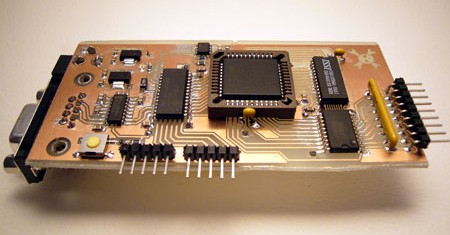
We’ve got a home-etchable, self programming development board to get you started. Don’t worry, this board has a serial port interface for working with the CPLD, and doesn’t require a separate (usually parallel port) JTAG programmer.

Continue reading “How-to: Programmable Logic Devices (CPLD)”

Notacon Call For Papers

notaconbadge

Notacon has just announced their first round of talk selections. The Cleveland, OH area hacker conference will be celebrating its sixth year April 16th-19th. When we attended this year we saw talks that ranged from circuit bending to the infamous TSA bagcam. Self-taught silicon designer [Jeri Ellsworth] presented on FPGA demoing. [Trixter] covered his demo archiving process. You can find a video archive of this year’s talks here.

We’re really looking forward to the conference. [SigFLUP] is already on the schedule to cover Sega Genesis development. Get your talk in soon though; they’re already handing out space to the knitters.

The Underhanded Hardware Challenge

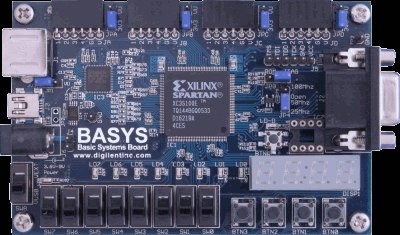
The Polytechnic Institute of NYU is hosting an interesting embedded systems contest. They’ve constructed a solid state cryptographic device that uses a 128-bit private key. Contestants will be tasked with designing and implementing several trojans into the system that will undermine the security. The system is built on a Digilent BASYS Spartan-3 FPGA board. The trojans could do a wide variety of things: transmitting unencrypted, storing and transmitting previously entered plain text, or just shutting down the system entirely. The modified devices still need to pass the factory testing procedure though, which will measure power consumption, code size, and function. After a qualification round, participants will be given the necessary hardware to compete.

[via NYC Resistor (Happy Birthday!)]

Metalab’s LED Matrix Display


Our friends at Vienna’s Metalab have been working on this project quite a while. Soldering their hearts out to create an FPGA controlled monochrome LED dot matrix display. It’s 48×72 array totaling 3,456 LEDs, soldered by hand. It creates some serious geek bling thanks to an mplayer plugin developed just for the project and it runs up to 72fps. Build details and source code are on the project page. Be sure to check out the awesome video demo below.

Continue reading “Metalab’s LED Matrix Display”

FPGA Projects Roundup


FPGA’s have become especially useful to the hacker community of late. Once upon a time, these lovely pieces of dedicated hardware were fabled to only be within reach of deep pocketed graphics card producers working to up their shader and vertex counts. Today they’re often found in the bowels of high end network gear. As reprogrammable arrays of logic gates, FPGAs represent a happy middle ground between general purpose CPUs and dedicated silicon. After the break, we’ll recount some of the more interesting FPGA projects we’ve seen, like the open source graphics card we featured yesterday.

Continue reading “FPGA Projects Roundup”

Open Graphics Card Available For Preorder


The Open Graphics Project has started accepting preorders for their OGD1, a graphics card with a completely open source design. This initial release is billed as a high-end FPGA prototyping kit specifically designed to test computer graphics architectures. The card has two DVI connectors, S-Video, 256MB RAM, and a 64bit PCI-X connector. The core of the system is a Xilinx Spartan-3 XC3S4000 FPGA. A nonvolatile Lattice XP10 FPGA is used to bootstrap the Xilinx at power up. Here’s the layout of the specific components.

An open design like this could prove very beneficial to the free software community. The open hardware makes driver development much easier; binary drivers from traditional graphics manufacturers have been very hard to work with in the past. The OGD1 could also be used with CPU architectures that wouldn’t be unsupported by normal graphics cards. An FPGA based design means that CPU intensive processes like video decoding could be offloaded to the video card without needing a dedicated chip. There is still a lot of work to be done and at $1500 we’re pretty sure most of you won’t be buying the first generation. It’s still exciting to see traditional PC hardware getting reinvented and opened up. Check out the OGD1’s FAQ for more info.